What Is an Agent Harness? An Explanation Without the Jargon
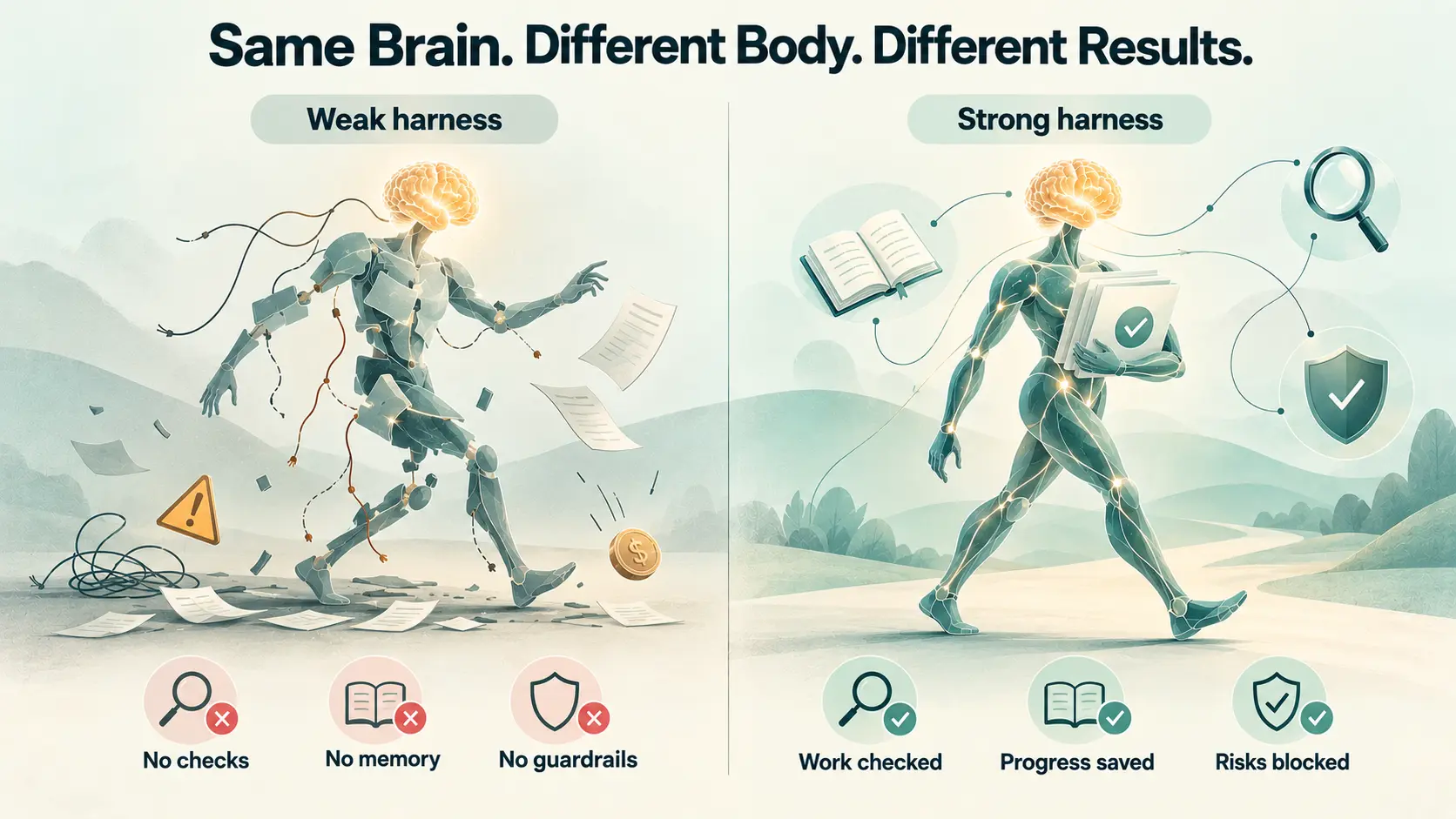
Same brain, very different results.
 Vivek Satasiya14 min read
Key takeaways
- An agent harness is the body around the AI brain. It is all the software that lets the brain see, act, remember, stay safe and finish real work.
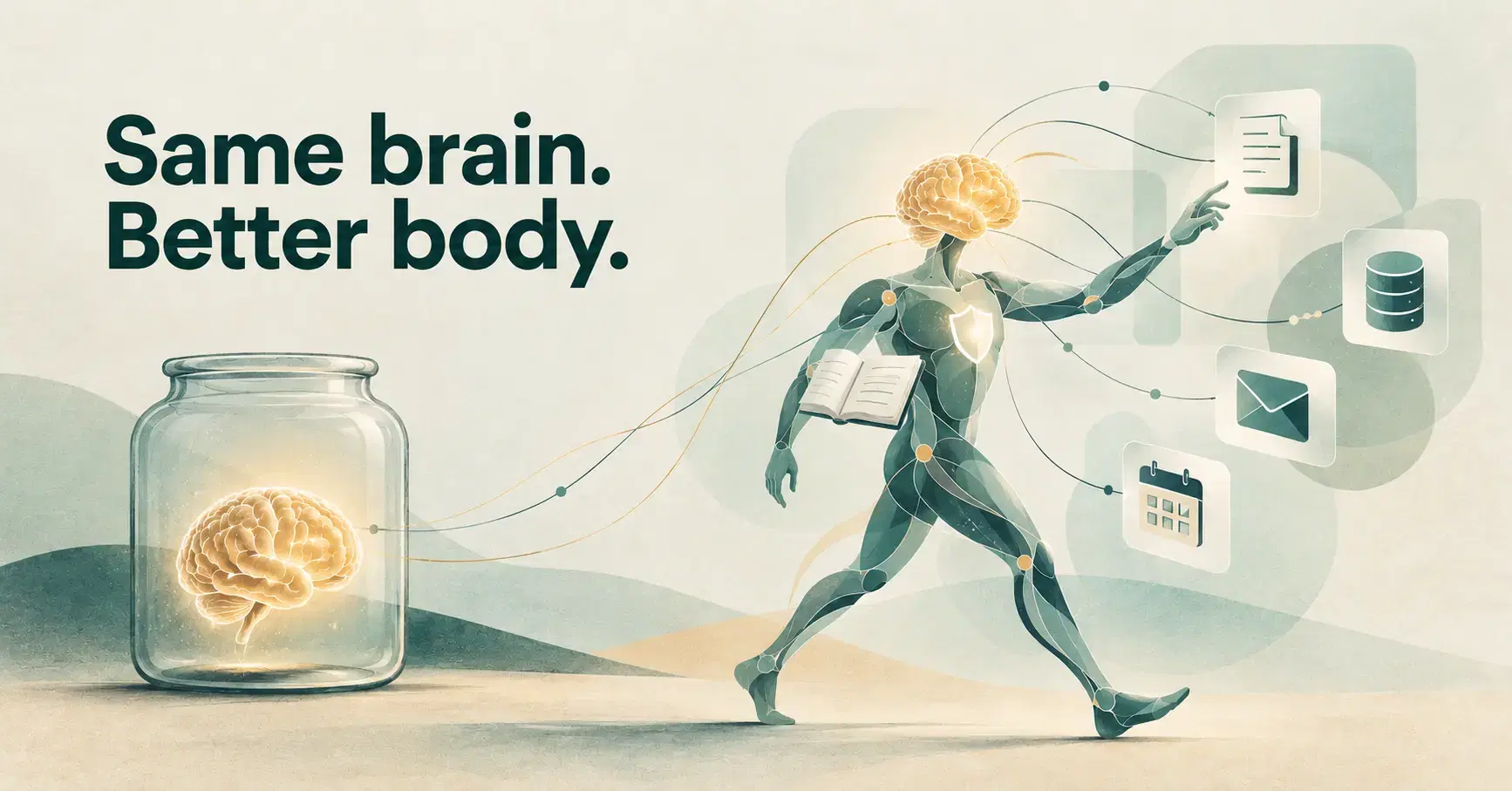
- AI Agent = Brain (the LLM) + Body (the harness)
- Two companies can use the exact same LLM. The one with the better harness gets the better results.
- The brain is becoming a commodity. The body is where your results come from.
Same brain, very different results
Most companies using AI today are renting the same few brains. GPT, Claude, Gemini and a handful of open models sit behind almost every AI product you have seen.
So why does the same AI work brilliantly in one company and fall apart in another?
The answer is rarely the brain. It is everything built around it. In the AI world, that "everything around it" has a name: the agent harness.
You do not need to know how to build one. But as a business leader, you do need to know what it is. It decides whether AI in your company stays a clever demo or becomes a dependable co-worker.
In this article, I will explain it the simplest way I know: through the human body.
First, the brain: what an LLM really is
The AI models you hear about, like GPT or Claude, are called Large Language Models (LLMs). Think of an LLM as a brain. A very well-read one.
It can read, reason, write, summarise and plan. You give it words, it gives you words back. Text in, text out.
Now imagine that brain sitting alone in a glass jar. It is brilliant, but:
- It has no hands. It can tell you how to update a customer record. It cannot actually open your CRM and do it.
- It has no eyes on the world. It only knows what it learned during training, plus whatever you type in front of it.
- It cannot remember you. Every conversation starts fresh. Yesterday never happened.
- It has no reflexes. Nothing stops it from confidently doing the wrong thing.
- It does not check its own work. It writes an answer and moves on, right or wrong.
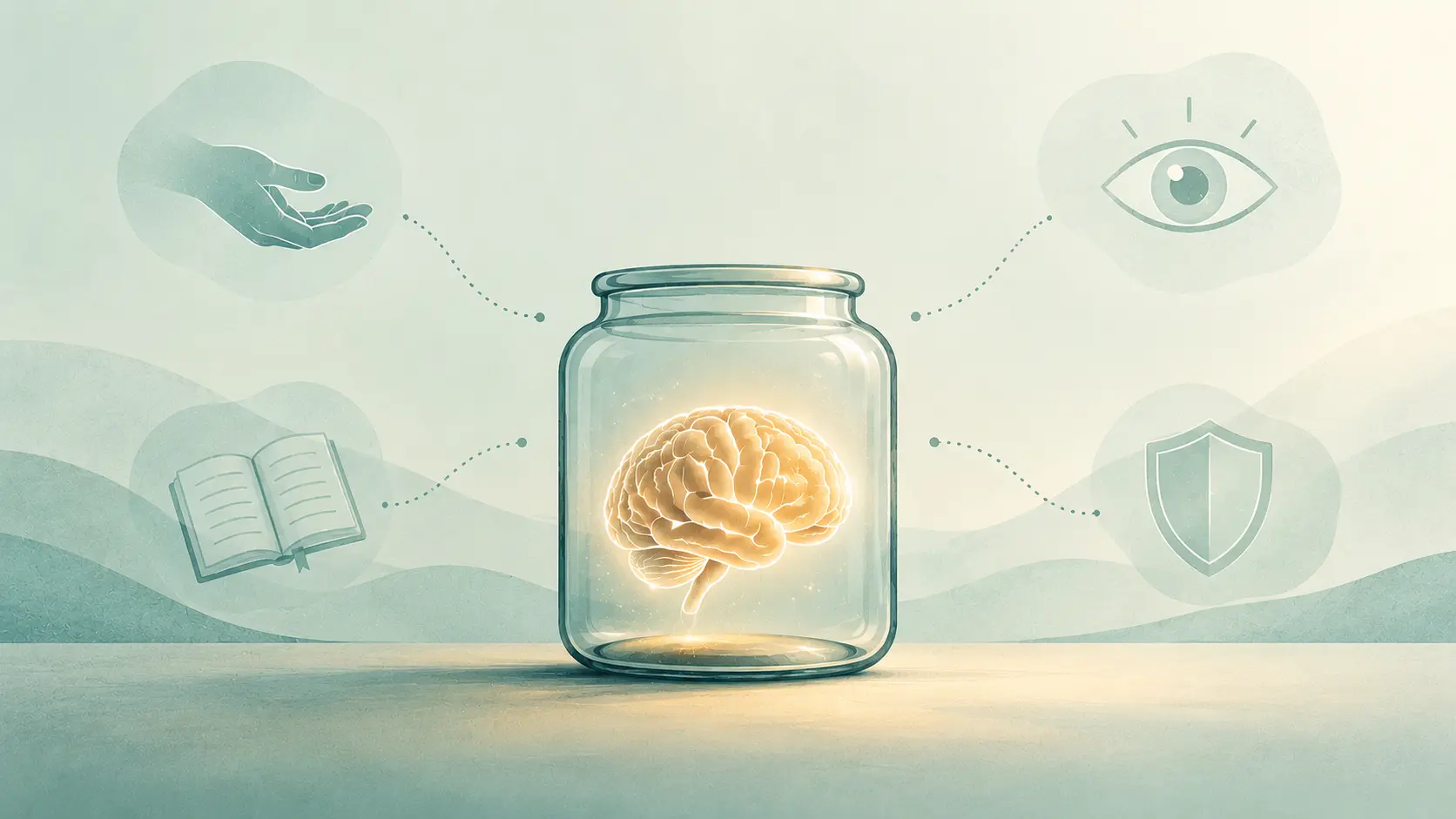
A brain in a jar can give great advice. It cannot do a day's work.
So, what is an agent harness?
An agent harness is the body around the AI brain. It is all the software that lets the brain see, act, remember, stay safe and finish real work.
Put simply:
AI Agent = Brain (the LLM) + Body (the harness)
The brain decides what to do. The body makes sure it actually gets done, the right way.
Think about your own body for a second. Your brain is amazing, but on its own it cannot pick up a cup of tea. It needs eyes to find the cup, hands to hold it, balance to stay upright, and reflexes to let go if it is too hot. A strong, well-trained body lets the same brain do far more.
AI works the same way. Two companies can use the exact same LLM. The one with the better harness gets the better results.
The anatomy of an agent harness
Let's walk through the body, one part at a time. For each part, I'll give you the body version first, then the technical name you may hear in meetings.
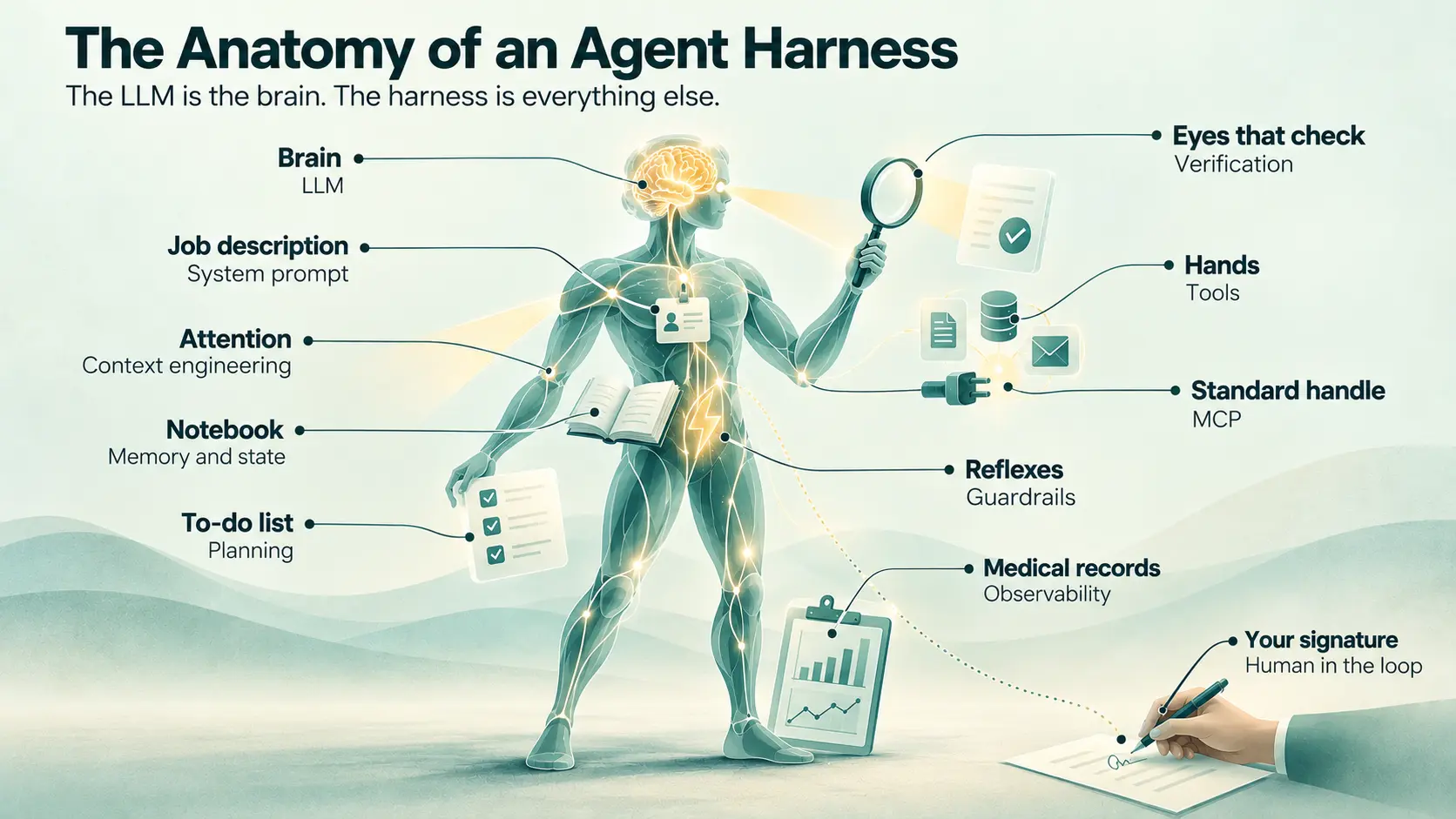
1. Upbringing and job description (system prompt)
Before you start a new job, you already carry values from your upbringing. On day one, you also get a job description: who you are here, what you are responsible for, and what you must never do.
The harness gives the AI brain the same thing every time it wakes up. A standing set of instructions that says: you are an accounts assistant, you work for this company, you follow these rules. Technical teams call this the system prompt.
2. Attention (context engineering)
Right now, you are not noticing the chair under you or the hum of the air conditioner. Your brain filters out almost everything so you can focus on what matters.
The AI brain can only hold a limited amount of information at once. Give it too much and it gets confused, just like a person reading fifty open files at the same time. So the harness acts like attention. It decides what the brain sees right now, and what it can safely ignore. This is called context engineering, and the space the brain can hold at once is its context window.
3. Hands (tools)
Thinking about sending an email does not send it. Your hands do.
In a harness, the hands are tools: connections that let the AI actually do things. Look up an order in the ERP. Read a PDF. Search the web. Update a ticket. Send a message. The brain decides which tool to use. The harness is what actually moves the hand.
4. A standard handle that fits any hand (MCP)
Imagine if every cup, door and pen in the world had a completely different kind of handle. You would need to learn each one from scratch.
For a long time, that was the AI world. Every tool needed its own custom connection. MCP (Model Context Protocol) is like a standard handle. Once a system offers an MCP connection, any compatible AI agent can pick it up and use it. Less custom wiring, faster connections to your business systems.
5. A notebook (memory and state)
Here is where the AI brain is different from yours. Your brain forms new memories. The AI brain does not. It is like a brilliant colleague who wakes up every morning with no memory of yesterday.
So the harness gives it a notebook. It writes down what it has done, what it learned, and where it stopped. Next time, it reads the notebook first and picks up from there. Technical teams call this memory and state management. Without it, an AI cannot handle any task that takes more than one sitting.
6. A to-do list on the fridge (planning and decomposition)
Nobody renovates a house in one move. You make a list. Fix the plumbing. Then the walls. Then the paint. One step at a time, ticking things off.
Big business tasks are the same. The harness helps the brain break a large job into small steps, and then keeps it working through them in order. This is called planning and decomposition. Without it, AI tries to do everything at once and often gets it half right.
7. Eyes that check the work (verification)
You lock the door, then you look back at it to be sure. You do not just trust that it worked.
A good harness does not trust the AI's first answer either. It checks. Do the invoice totals add up? Did the record actually update? Does the answer match the source document? If something is off, it sends the brain back to fix it. This is verification, and it is one of the biggest reasons a harness makes AI dependable.
8. Reflexes (guardrails)
Touch a hot stove and your hand pulls back before your brain even thinks about it. That is a reflex. It does not ask for the brain's opinion. It simply fires.
Guardrails are the harness's reflexes. They are hard rules the AI brain cannot argue its way past, no matter how convincing its reasoning sounds. "Never share customer data outside the company." "Never pay more than the approved amount." "Never delete records." The brain can be clever. The reflex does not care.
9. Medical records (observability)
When something goes wrong with your health, your doctor looks at your records. What happened, when, and what was done about it.
A good harness keeps the same kind of record for every action the AI takes: what it saw, what it decided, what it did and why. This is called observability. For leaders, it means you can always answer the question, "Why did the AI do that?" For regulated industries, it is often a must-have for audits.
10. Where the body analogy stops: your signature (human in the loop)
No part of your body asks your manager for permission. But this body works for you, and some decisions are too important to leave to anyone acting alone.
Think of how a cheque above a certain amount needs a second signature. The harness does the same. For high-stakes actions, like paying a large invoice, emailing an important client, or changing a contract, it pauses and waits for a person to review and approve. This is called human in the loop. The AI does the work. A human keeps the final say.
The whole body at a glance
| Body part | Harness part | What it does for your business |
|---|---|---|
| Brain | LLM | Reads, reasons and decides |
| Upbringing and job description | System prompt | Tells the AI who it is and what rules it follows |
| Attention | Context engineering | Shows the AI only what matters right now |
| Hands | Tools | Lets the AI actually do things in your systems |
| Standard handle | MCP | Connects new systems faster, with less custom work |
| Notebook | Memory and state | Lets work continue across steps, hours and days |
| To-do list | Planning and decomposition | Breaks big jobs into small, ordered steps |
| Eyes that check | Verification | Catches mistakes before they reach you |
| Reflexes | Guardrails | Hard rules the AI can never break |
| Medical records | Observability | Shows what the AI did, and why |
| Your signature | Human in the loop | Keeps people in charge of high-stakes decisions |
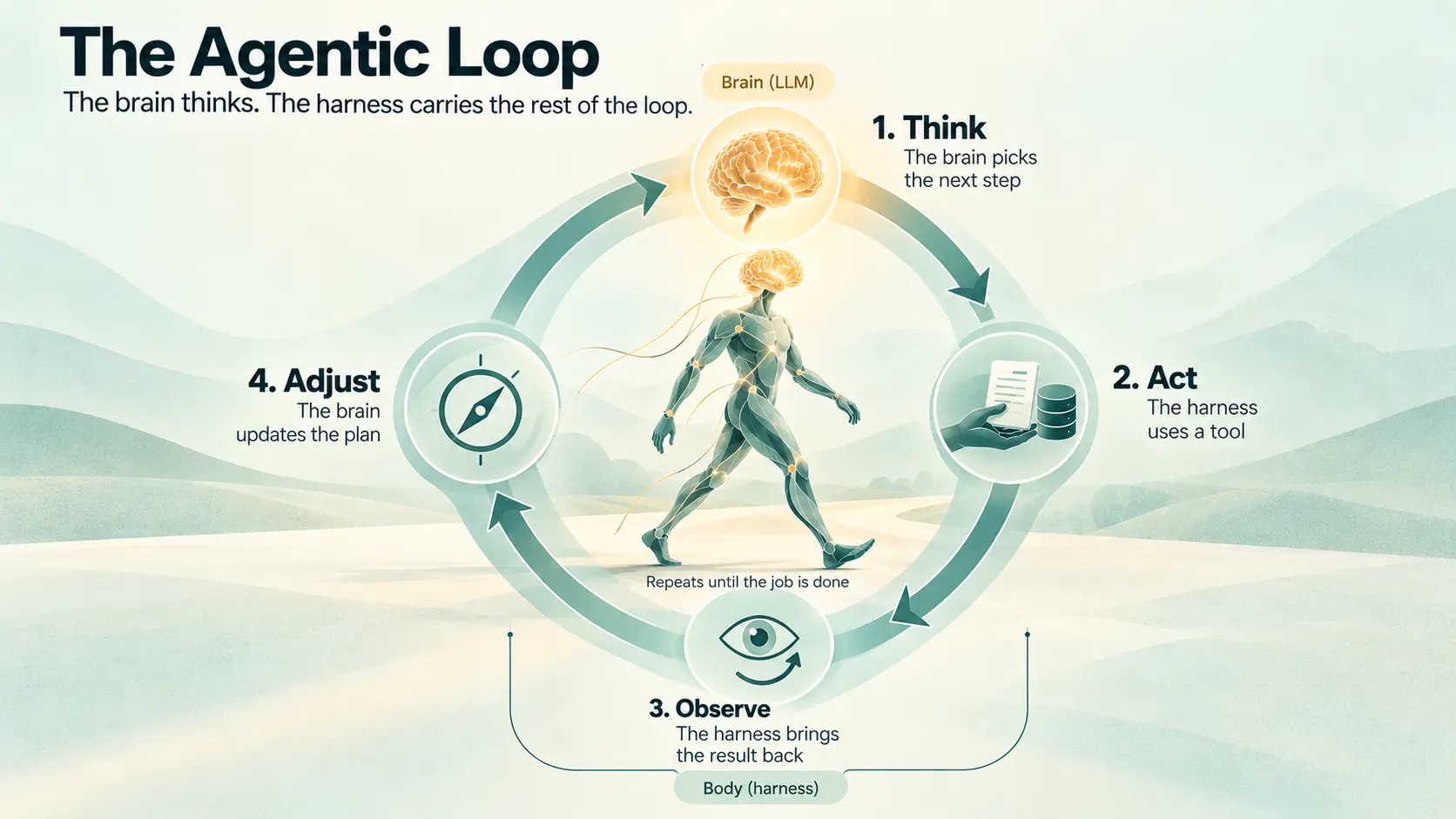
How it all works together: the agentic loop
Walking looks simple, but every step is a small loop. Your brain decides to step. Your legs move. Your eyes and inner ear report how it went. Your brain adjusts. Then the next step.
An AI agent works in the same loop, over and over, until the job is done:
- Think. The brain looks at the goal and what it knows, and decides the next step.
- Act. The harness uses a tool to carry out that step.
- Observe. The harness brings the result back to the brain.
- Adjust. The brain decides what to do next, based on what happened.
Technical teams call this the agentic loop. The brain does the thinking. The harness does everything else in the loop.
One example: a supplier invoice
Let's follow a single supplier invoice through an AI agent in accounts payable.
- Job description. The agent knows it is an accounts payable assistant, and knows the company's payment rules.
- Planning. It breaks the job down: read the invoice, find the purchase order, check the goods were received, match the amounts, then prepare the payment.
- Hands. It opens the invoice PDF and looks up the matching purchase order in the ERP.
- Attention. It focuses only on this supplier, this order and this invoice. Not the thousands of other records in the system.
- Eyes. It checks that quantities, prices and totals actually match. They don't: the invoice is 3% higher than the purchase order. It flags the difference instead of guessing.
- Notebook. It writes down what it found and where it stopped, so the work is not lost if the supplier replies tomorrow.
- Reflexes. A hard rule says it can never pay more than the approved amount. However convincing its reasoning, it cannot release this payment on its own.
- Your signature. It sends the case to the finance manager with a clear summary. The manager approves the corrected amount in one click.
- Medical records. Every step is logged. At audit time, anyone can see exactly what happened and who approved what.
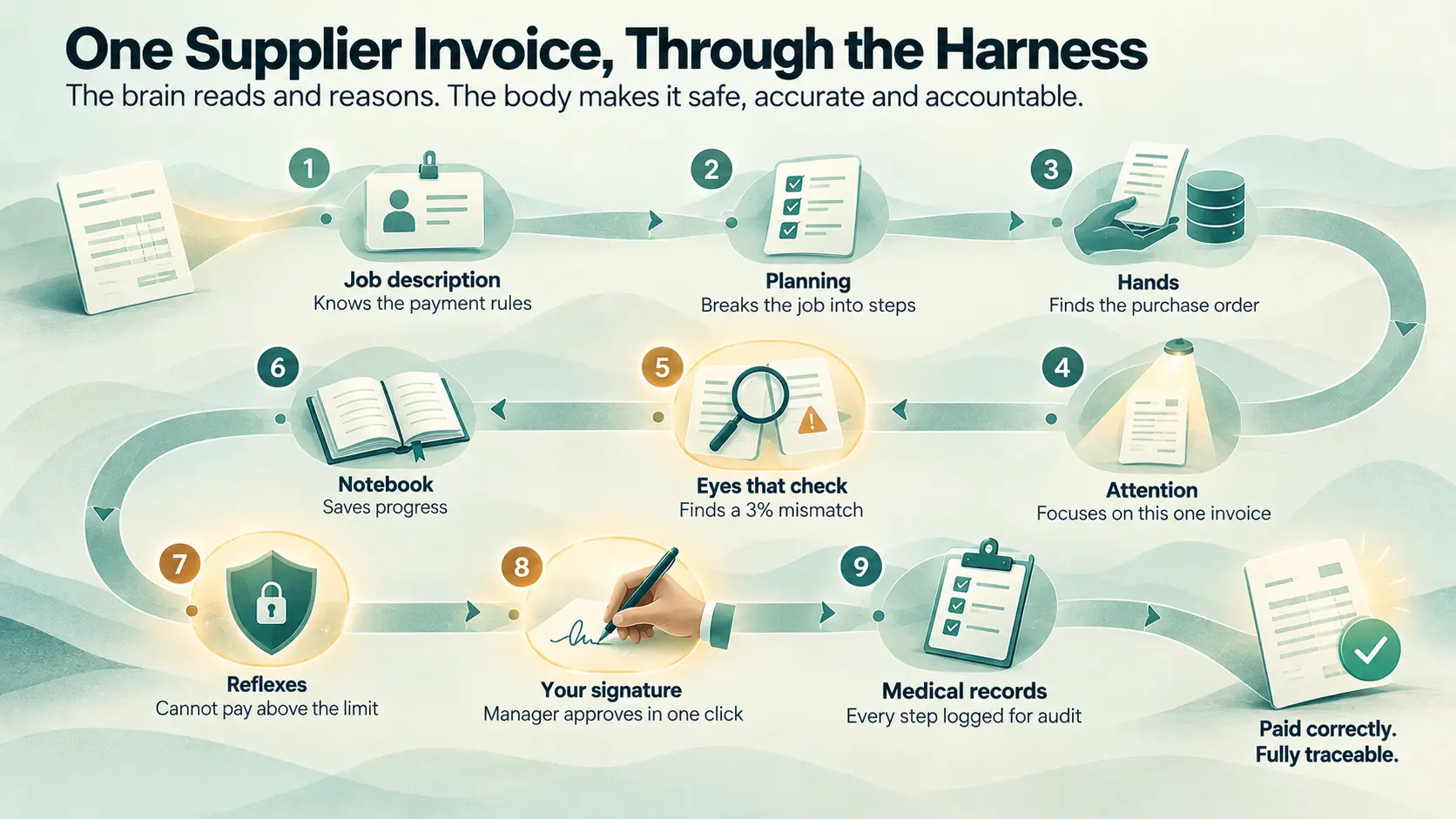
Notice how little of that was the brain alone. The brain read and reasoned. The body made it safe, accurate and accountable.
Why this matters to you as a business leader
The brain is becoming a commodity. The body is where your results come from.
Every few months, a new and smarter model is released. Your competitors can rent it the same day you can. So the model alone will rarely be your advantage. How well it is put to work will be.
Here is what a strong harness gives you:
- Reliability. Verification and planning turn "usually right" into "right, or flagged for a human".
- Safety. Guardrails and human approvals mean the AI cannot take risky actions on its own.
- Accountability. Every action is recorded. You can always explain what happened and why.
- Cost control. Good attention and memory mean the AI reads only what it needs, which keeps usage costs down.
- Freedom to switch brains. A well-built body can take a newer or cheaper model later, without rebuilding everything around it.
This is not just theory. Researchers have tested the same AI model, with no changes, with and without a harness around it. With the harness, it performed consistently better. Same brain. Better body. Better results.
The reverse is also true. When an AI project fails in production, the brain is often not the problem. It is a missing reflex, a forgotten notebook, or no one checking the work.
Five questions to ask before you buy or build an AI agent
You don't need to understand the code to judge a harness. When a vendor or your own team shows you an AI agent, ask these five questions. Each one checks a different part of the body.
- "What does it do when it is not sure?" A good agent flags, asks or stops. A weak one guesses. (Eyes)
- "What can it never do, no matter what?" You should get a clear list of hard rules, not "the AI is very careful". (Reflexes)
- "Which actions need a human to approve?" If the answer is "none", be careful. (Your signature)
- "Can you show me what it did last Tuesday, and why?" If they cannot, you will not be able to explain it to an auditor either. (Medical records)
- "If a better AI model launches tomorrow, what do we have to rebuild?" The right answer is "very little". (A body that outlives the brain)
A polished demo shows you the brain. These questions show you the body.
The bottom line
An LLM is a brilliant brain. An agent harness is the body that lets that brain do real work: hands to act, attention to focus, a notebook to remember, eyes to check, reflexes to stay safe, and a human signature where it matters.
The brain gets the headlines. The body gets the work done.
So the next time someone shows you an impressive AI, don't only ask how smart it is. Ask what kind of body it has.
Look at the AI tools in your business today. Are you investing in a smarter brain, or in a body that can actually carry the work?
Share this article