Build, Buy or Blend? Choosing an AI Platform Under AIRA
How Australia's AI Reference Architecture frames the platform decision, and how to compare the three paths over three years, not one pilot.
 Vivek Satasiya13 min read
Key takeaways
- AIRA frames the choice as buy, build or blend, and says neither integrated platforms nor best-of-breed components are better by default.
- Building gives control, but you own every capability AIRA lists, from evaluation to human oversight, for as long as the system runs.
- Buying is fast, but it can hide lock-in and controls you can't inspect.
- Blending combines a proven platform with an expert team and, often, a local delivery partner. It suits most organisations while the AI stack keeps changing.
- The deciding factors are your use case's risk, your in-house AI skills, how fast you need results, and how easily you can leave.
- Compare total cost over three years, not the cost of the first pilot.
Your engineering team wants to build the AI platform themselves. Procurement wants one big vendor on a multi-year contract. The business wants results this quarter. And whichever path you choose, the AI stack will look different in twelve months.
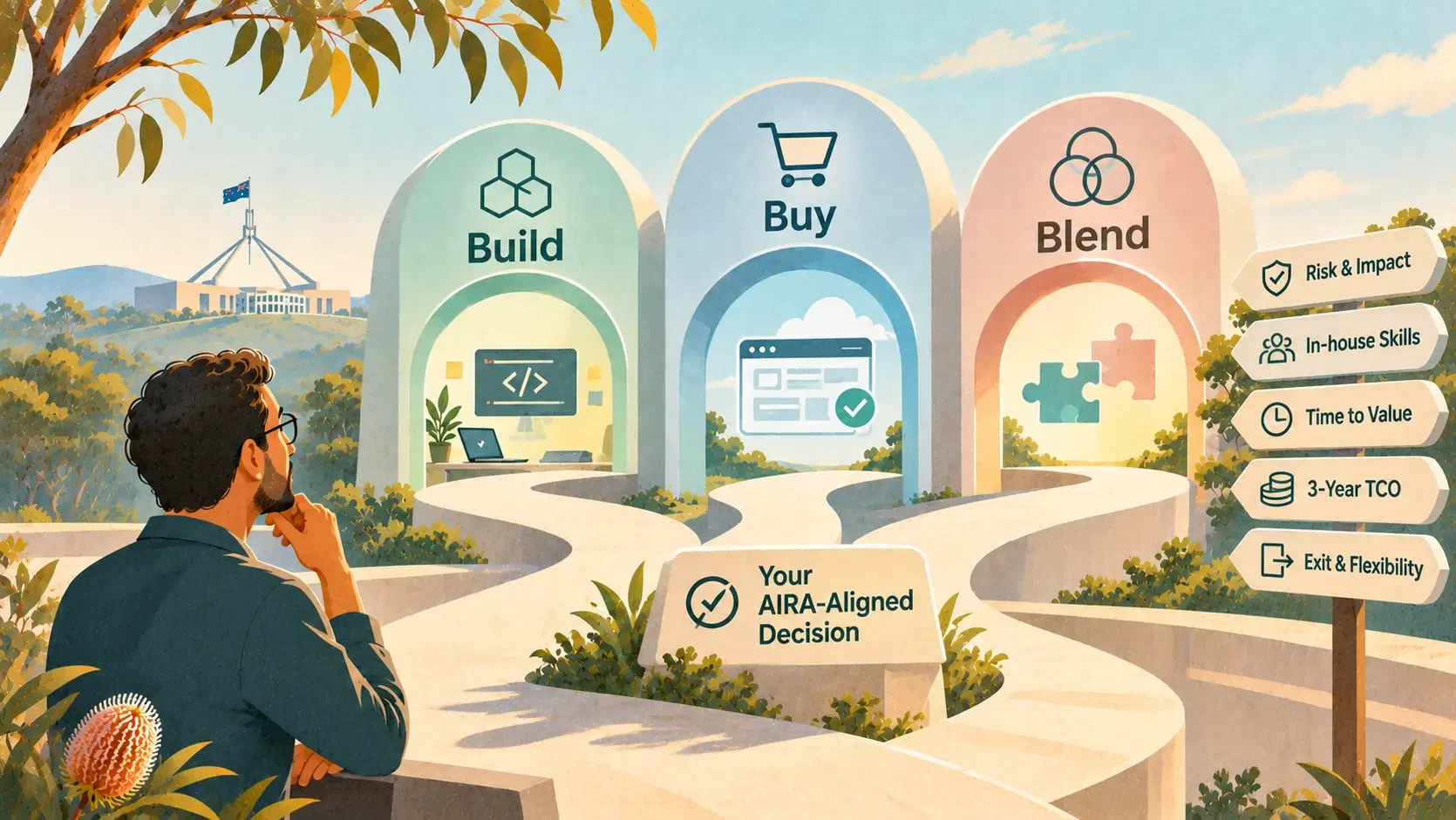
Australia's AI Reference Architecture (AIRA) frames this as a buy, build or blend decision, and it is neutral about the answer. This seventh post in our AIRA series covers how to choose.
What does buy, build or blend mean in AIRA?
AIRA lists informing buy, build and blend decisions as one of the main ways agencies should use it. Build means developing the AI platform and applications yourself. Buy means adopting a vendor's product largely as it comes. Blend means combining a proven platform with your own work, and often with a delivery partner, so you buy the foundations and build what is specific to you.
AIRA is deliberately neutral about which is best. It describes two broad approaches:
- More integrated platforms may speed up delivery, reduce integration effort and simplify operations.
- More modular, best-of-breed approaches may give more flexibility and specialised capability, but add integration, governance and operational complexity.
It says neither is inherently preferable. The architecture's job is to make the trade-offs visible so you can choose deliberately.
AIRA also gives you a tool for the decision itself: its capability map. Instead of asking "should we build or buy an AI platform?", ask the question layer by layer. Which capabilities do we build, which do we buy, and which do we get from a partner?
Don't ask whether to build or buy the platform. Ask it one capability at a time.
What do you really sign up for when you build your own AI platform?
When you build, you sign up to own every capability that makes AI safe and reliable in production, not just the model calls. A working demo is the easy part. The production layer around it is most of the work, and you keep owning it for as long as the system runs.
Here is what a production AI platform needs, mapped to AIRA:
| Capability you would build and run | What it does | Where it sits in AIRA |
|---|---|---|
| Evaluation and release gates | Tests behaviour on real cases before every change | Validity and reliability |
| Retry, recovery and escalation | Handles failed steps and hands off to a person | Application and orchestration; safety |
| Grounded retrieval | Answers from your documents, with sources | Data and metadata |
| Guardrails and access control | Limits what agents can see and do, per user and tool | Security; communication (identity and trust) |
| Human approval and oversight | Routes high-risk actions to people; supervisor tools | Human agency, oversight and control |
| Tracing and audit records | Records what happened and who decided | Observability; traceability |
| Quality and behaviour analytics | Shows whether agents are right across real use | Observability |
| Versioning and rollback | Lets you change safely and undo quickly | Traceability |
| Cost and model controls | Right-sizes models and tracks spend | Sustainability |
| Integrations | Connects to CRM, ERP, email and legacy systems | Communication (legacy integration) |
| Secure hosting | Runs it where your data rules require | Platform and infrastructure |
Earlier posts in this series cover several of these rows in depth: evaluation and release gates, human approval and oversight, tracing, audit records and rollback, and cost, model controls and hosting.
Then there is the work that never finishes:
- Keeping up with models. New models, retired versions and provider changes.
- Security assessment. Every platform change may need another review under your security obligations.
- People. A team with production AI skills, which are still scarce, must stay in place to run it.
Building is the right call for some organisations. Just price in the second and third years, not only the first release. Our post on why AI demos fail in production shows what the gap between demo and production looks like.
The first AI pilot is the cheapest thing you'll ever pay for. Price years two and three before you build.
When does buying make sense, and what does it hide?
Buying makes sense when the use case is common, the product fits your process closely, and you need results quickly. Productivity assistants, meeting summaries and AI features inside software you already use are good examples. The risk is not the purchase. It is what you can't see, change or take with you afterwards.
Buying works well when:
- The task is common across many organisations, such as drafting, summarising or searching documents.
- You're happy to adapt your process to the product.
- The risk tier is low, so the vendor's standard controls are enough.
- Leaving is easy, because little of your data or logic lives inside the product.
What buying can hide:
- Controls you can't inspect. Can you see the traces, change the approval rules or export a decision record?
- A fixed model choice. Many products are tied to one model provider, on the vendor's timeline.
- Data location. Where are prompts, logs and embeddings stored?
- Your logic becomes theirs. Prompts, workflows and evaluation cases built inside a product can be hard to move.
- Fit drift. As your process changes, a packaged product may not follow.
For low-risk productivity uses, these trade-offs are often fine. For workflows that touch customers, citizens or decisions, check them before you sign. Our post on applying AIRA by risk shows how to tell which tier a use case is in.
What does blending look like in practice?
Blending means you buy the production foundations, build what is specific to your organisation, and bring in the expertise you don't have in-house. It typically combines three parties: a platform that already carries the production layer, an expert team that has run it in production, and often a local delivery partner who knows your organisation and how it buys.
The point of blending is a clear split of ownership:
| Area | You (the organisation) | Delivery partner | Platform and expert team |
|---|---|---|---|
| Problem, priorities and risk tier | Owns | Facilitates | Advises |
| Evaluation cases and what "correct" means | Owns | Coordinates | Builds the evaluation tooling |
| Workflows, prompts and business rules | Approves | Co-designs | Builds and tunes |
| Integrations with your systems | Provides access | Leads | Supports |
| Production layer: oversight, tracing, rollback | Sets policy | Configures | Provides and runs |
| Security assessment and procurement | Owns | Leads the paperwork | Supplies evidence |
| Day-to-day operation and improvement | Supervises | Runs or supports | Supports and improves the platform |
What makes a blend work:
- You keep what matters: your data, your evaluation suite, your decisions and the ability to leave.
- Nobody rebuilds the foundations. The production layer is reused, so the effort goes into your workflows.
- Skills transfer is planned. Your team learns to run and improve the system, rather than depending on the partner forever.
- Roles are written down before work starts, including who owns the client relationship and who answers when something goes wrong.
Blending is also how many Australian organisations already buy technology: through a trusted local partner, using proven platforms underneath.
In a blend, you buy the foundations and own what makes you different.
How does the pace of AI change the decision?
The pace of AI change makes long, fixed bets riskier than usual. Models, tools and good practice change every few months, so an 18-month build can be outdated on the day it launches. A multi-year contract can also tie you to a product that has fallen behind. The safest choices are the ones that let you adapt.
Three things move fast:
- Models. Better and cheaper models arrive regularly, and older ones are retired.
- Agent patterns. New ways to connect agents to tools and to each other, such as the Model Context Protocol (MCP), become standard within months.
- Expectations. Australia's responsible use of AI policy, the AI technical standard, its agentic AI addendum and now AIRA have all arrived within about two years.
What this means for each path:
- Build: your team must track all of it continuously, not just at launch. Budget for that permanently.
- Buy: check how often the product updates, and whether you control when and how.
- Blend: the platform keeps pace on the foundations, while you control the parts that are yours.
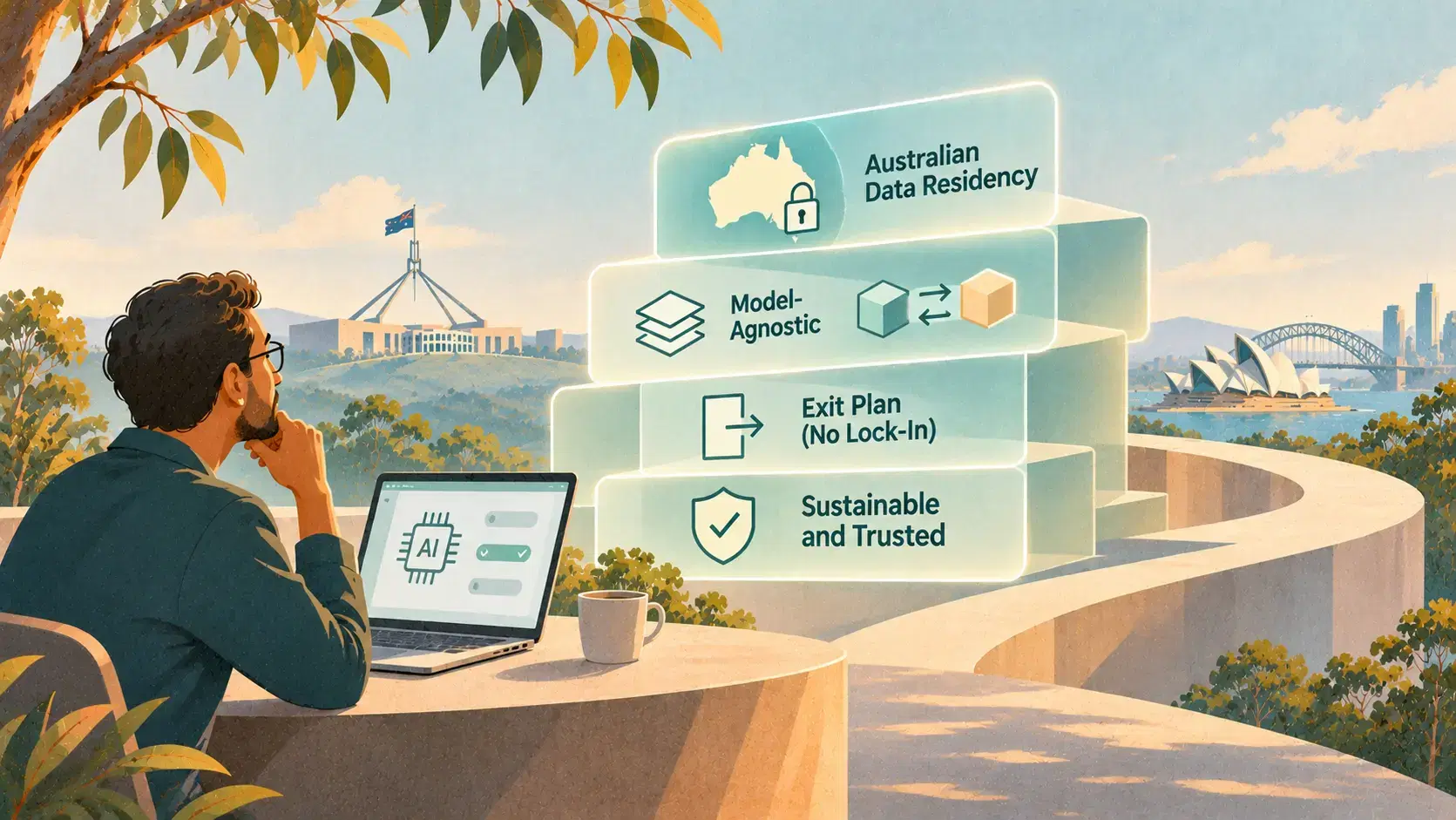
The practical test: can you change your model, add a new agent capability, or meet a new policy requirement within weeks, without a rebuild or a contract renegotiation? Our guide to sovereign AI and avoiding lock-in covers how to keep that option open.
It also helps to start small. One well-scoped workflow in production teaches you more about the right long-term path than any business case.
How do you compare the total cost of building, buying or blending AI?
Compare all three paths over three years, and include the costs that only appear after launch. The first pilot is usually the cheapest part of an AI system. People, ongoing model usage, security reviews, maintenance and keeping up with change often cost more than the initial build, and they look very different on each path.
Cost categories to include for every option:
| Cost category | Build | Buy | Blend |
|---|---|---|---|
| Initial platform build or licence | High | Licence fee | Platform fee, smaller build |
| Your specific workflows and integrations | You build | Limited by the product | Built on the platform |
| Specialist AI team | You hire and keep | Small | Shared with the partner |
| Model and infrastructure usage | You manage | Often bundled, less visible | Visible and tunable |
| Security assessment and re-assessment | Full | Vendor evidence, plus your review | Shared evidence |
| Keeping up with models and practice | Ongoing, yours | Vendor's roadmap | Platform's roadmap |
| Time to first production result | Longest | Shortest, if it fits | Short |
| Cost to exit or switch | Low (you own it) | Can be high | Depends on the exit terms |
Three tips:
- Measure cost per outcome, such as cost per resolved case or per document processed, not cost per seat.
- Count the cost of delay. Months without a working system cost money too, especially when a Chief AI Officer has been asked to show results.
- Price the exit before you sign, while you still have leverage.
Which path fits your situation?
The right path depends mainly on two things: how much production AI capability you have in-house, and how specific and risky the use case is. Strong in-house teams with unique, high-risk needs lean towards building. Common, low-risk uses lean towards buying. Most organisations sit in between, where blending fits best.
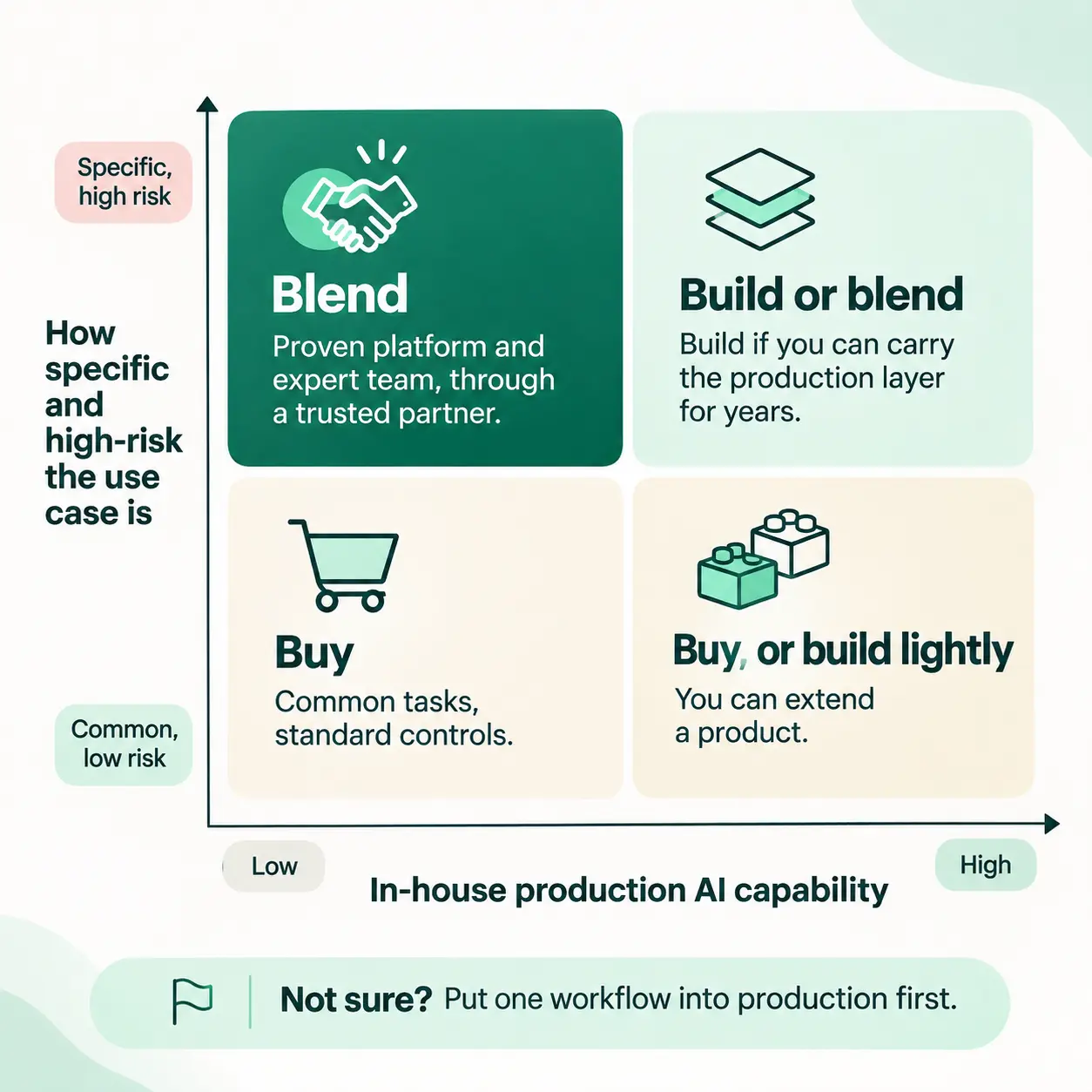
| If this sounds like you | Lean towards | Why |
|---|---|---|
| You need AI for common tasks like drafting, summarising or searching, at low risk | Buy | Fast, proven, and the vendor's controls are enough |
| You have a large, experienced AI engineering team and a long-term, highly specific need | Build | You can carry the production layer and the ongoing work |
| Your workflow is specific to your organisation, touches customers or decisions, and you need results within months | Blend | Reuse proven foundations and build only what is yours |
| You have little in-house AI capability and limited time | Blend, through a trusted partner | Expertise and platform arrive together |
| You're unsure | Start with one workflow | Learn from one production use case before committing |
You can also mix paths across use cases. Buy a productivity assistant for staff, blend for customer-facing agents, and build only where you truly have something unique.
Not sure? Put one workflow into production first.
How we blend with Avesta AgentOS
At Avesta Labs, we built the production layer once, in Avesta AgentOS, so each new engagement starts from it rather than from scratch. It covers evaluation and release gates, retry and recovery, grounded retrieval, guardrails and access control, human approval, tracing, behaviour analytics, versioning and cost controls.
That changes the economics of a blend:
- Speed. Evaluations are written from the customer's real cases before the agent is built, so one workflow typically goes from demo to production in two to four weeks, including testing and integration.
- Experience. AgentOS runs agents in production for customers such as India Avenue, Life Insurance Direct and CHAIRS Global. Avesta Labs is a Claude Select Services Partner and an OpenAI Select Partner, and our team includes more than ten Claude Certified Architects.
- Partner-friendly by design. As an AI tech partner, we can build a pilot under a partner's brand, so the partner keeps the client relationship and the IP. Or we act as the ongoing engineering layer that keeps agents reliable while the client keeps product direction.
In Australia, we worked with OnlyFacts, a nonpartisan fact tank, to build grounded, cited AI agents for its climate data. Its CEO and co-founder, Juliette O'Brien OAM, says Avesta has "become a collaborative and trusted extension of our team."
Questions to ask before you choose a path
- Which AIRA capabilities would we have to build and run ourselves, and for how long?
- Who owns the evaluation suite, the agent definitions and the data at the end?
- How do we change models, and who decides when?
- How long until one workflow is in production, with evaluations and oversight in place?
- Who staffs the run phase, and how do our people learn to operate it?
- What does it cost, and what does it involve, to leave?
If you're weighing build, buy or blend for an AI use case, book a discovery call and we'll map the options with you.
Sources
- Digital Transformation Agency, AI Reference Architecture, Version 1.0, 2026 (CC BY 4.0), sections "Using AIRA in your agency" and "Understanding architectural trade-offs", available at digital.gov.au
- Department of Finance, GovAI Hosting
- Avesta Labs, The AI Demo Worked. Production Didn't. Here's Why
- Avesta Labs, OnlyFacts case study
Frequently asked questions
- How long does it take to build an enterprise AI platform?
- A working demo can take days. A production platform, with evaluation, oversight, tracing, security, integrations and cost controls, typically takes many months to build and then needs a permanent team to run and update it. On an existing production platform, a single well-scoped workflow can reach production in weeks.
- Should a government agency build or buy an AI platform?
- AIRA doesn't prescribe either. It asks agencies to make the trade-offs visible and choose deliberately. Most agencies will mix approaches: buying for common productivity uses, and blending or building for workflows specific to their services, depending on risk and in-house capability.
- Is GovAI a build or a buy?
- For Australian Public Service agencies, GovAI is a shared foundation: a chat tool, access to approved models and cloud environments for building AI applications. GovAI Hosting is currently for low-risk use cases. Agencies still build or blend the application layer on top, including workflows, integrations, oversight and evaluation.
- Can we start by buying and move to building later?
- Yes, if you plan for it. Make sure you own your data, evaluation cases and agent definitions in a format you can export. Without those, moving later means starting again.
- What does a delivery partner add over a platform vendor?
- A delivery partner brings knowledge of your organisation, your processes and your procurement path, plus people to design, integrate and support the system. A platform vendor brings the product. In a blend, you get both, with ownership split clearly between you, the partner and the platform.
- How do government procurement panels affect the choice?
- Agencies usually buy through established panels and arrangements. Working through a partner already on the right panel can make a blended approach much faster to procure than a new direct contract.
Share this article