Build vs Buy AI Agents: A Decision Framework
Build what sets you apart, buy what everyone needs, and own the code either way.
 Naresh Tank8 min read
Key takeaways
- Build the parts that set your product apart, buy the standard parts, and partner to start fast when your team has not shipped an AI agent yet.
- For a software company, buy usually means a vendor's agent tool, a platform or a model API.
- An MIT study reported that bought tools and partnerships succeed about 67% of the time, against one-third as often for internal builds. Reports on its method differ.
- Gartner predicts up to 70% of enterprises will abandon vendor-built agents by 2028, because maintenance costs rise and internal teams struggle to change them.
Picture a 50-person software company whose chief executive wants an AI agent in the product by the end of the quarter. An AI agent is software that uses an AI model to finish a task on its own, such as answering a customer's question and then updating the order. The engineers are strong, but none of them has run an agent with real customers.
So the first question is who builds it. Your own team can build it, you can buy a tool or platform, or you can partner with an outside team. This post shows how to choose, using the evidence and one simple rule.
Build vs buy AI agents: which path should a software company choose?
Build the parts that set your product apart. Buy the standard parts. Partner when you must move fast and your team has never shipped an agent. Choose each use case separately, and in every case own the code, the prompts and the evals (the test questions that show whether the agent is still right).
Put simply:
Build what sets you apart. Buy what everyone needs. Partner to start fast.
What does "buy" mean?
For a software company, buying usually means one of three things:
- A ready-made agent tool from a vendor, set up for one job such as ticket triage.
- A platform that supplies memory, tool connections and logs, while you write the agent's rules.
- A model API, the AI model you call over the internet, with your own code around it.
Calling a model is quick to start. The hard part is the tests, guardrails, logs and rules for when a person steps in. That work lands on your team whichever path you take.
How do build, buy and partner compare?
The table compares what matters after launch, not just the first demo.
| Question | Build in-house | Buy a tool or platform | Partner with an outside team |
|---|---|---|---|
| Who owns the code and prompts? | Your company | Often the vendor's platform, so check export terms | Your company, written into the contract |
| Who owns the evals (the test questions that show whether answers are right)? | Your company | Often the vendor, so ask whether you can export them | Your company |
| How fast is the first working agent? | Slowest if your team has never shipped one | Fastest for standard jobs | Fast, if the partner has run agents in production |
| Who changes it after launch? | Your team | Mostly the vendor's roadmap, plus your settings | Your team, once the handover is done |
| What does it cost? | Salaries and time, most of it up front and ongoing | A subscription, plus integration work | A project fee, then running costs |
| How do you exit? | Not needed | Hard if your data and rules live in the vendor | Must be planned in the contract |
What do the numbers say?
Two studies come up often. Both need care.
MIT's NANDA group reported that bought tools and partnerships succeed about 67% of the time, against one-third as often for internal builds. The report is based on 150 interviews, a survey of 350 employees and 300 public AI deployments, as Fortune reported it. Reports on its method differ, so treat the gap as a warning, not a law.
Gartner, the research firm, predicts that by 2028, up to 70% of enterprises will abandon agents built for them by a vendor's own engineers, when internal teams cannot change them. Gartner calls this vendor-assisted or forward-deployed engineering (see our forward-deployed engineers post). Techstrong reported the press release. Gartner's advice is to agree on governance, IP ownership, knowledge transfer and an exit strategy from day one.
Put simply:
Both studies point to one risk: who can run the agent after launch.
That reading is ours. Neither study says a partner always wins.
How do you decide for each use case?
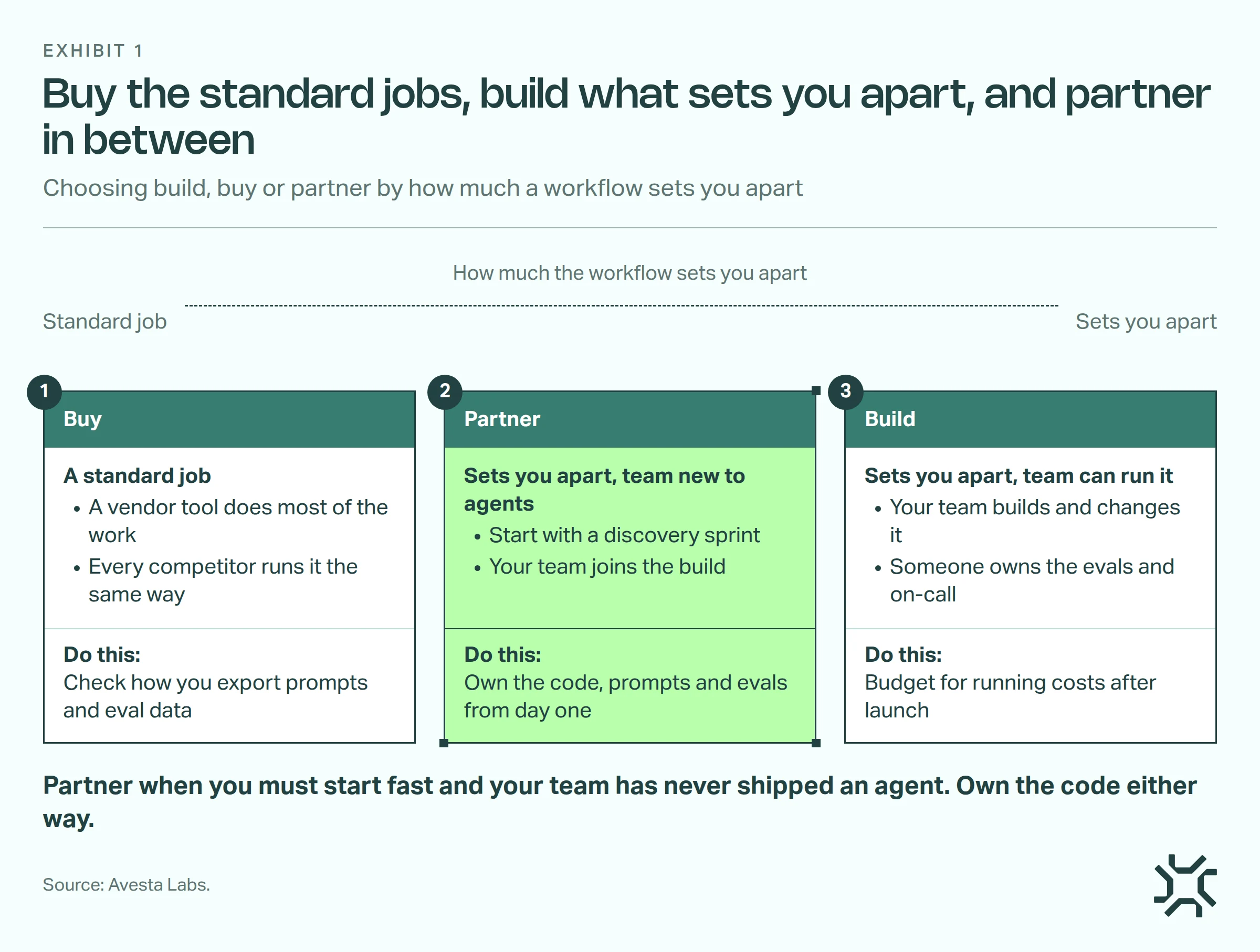
- Buy the standard jobs.
- Partner when the job sets you apart and your team is new to agents.
- Build when the job sets you apart and your team can run it.
Then ask five questions about each use case:
- Does it set you apart? Build if customers choose you for it. Buy if every competitor does it the same way.
- Does it depend on private data or rules only you know? If yes, build it, or partner with a team you trust with that data.
- Is the job standard? If a vendor tool already does most of it, buy.
- Who will run it a year from now? If your team could not change the agent without the outside team, you are renting it.
- How fast do you need a working version? If you need one in a quarter and have never shipped an agent, partner first and plan the handover.
When not to build
Building first is costly when your team has never shipped an agent and the use case is not a differentiator. Start with a partner or a vendor.
When not to buy
A cheap start turns expensive when a vendor keeps your prompts, test cases and data, and makes export hard.
How we work on a first agent, and hand it over
The diagram shows what a good handover plan looks like, whichever partner you use.
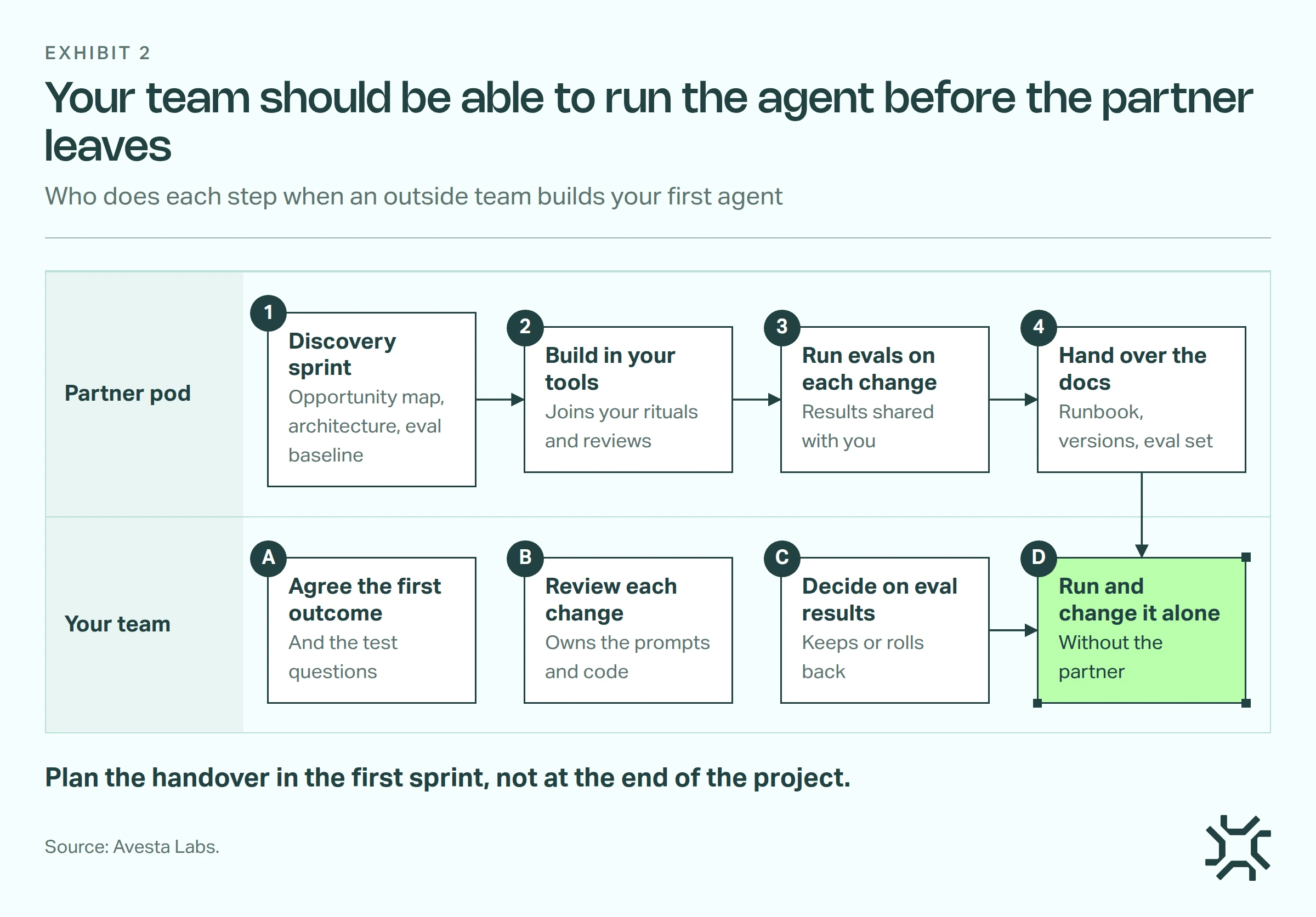
- The partner's team runs a discovery sprint, builds in your tools, runs evals on each change and hands over the documents.
- Your team agrees the first test questions, reviews changes and decides on eval results.
- Your team then runs and changes the agent alone.
Our public offer starts with a short, fixed-scope discovery sprint, which ends with an eval baseline and a build plan. The AI-native product engineering page describes the steps.
Three patterns are worth copying:
1. Set the eval baseline before the build
An eval is a set of test questions with known good answers, run after every change. On the India Avenue case study, the fund supplied 50 real questions and marked the answers, and the assistant passed them. Every change still runs against those 50. An eval set the client owns protects you from a partner, or your own team, quietly making the agent worse.
2. Give the client the code, prompts and test cases from day one
Code, IP and product decisions stay with you from day one. Our public AI-native engineering page states this. Ask for the prompts, test cases and their results in writing too, because a contract that leaves them out is where lock-in starts.
3. Plan the handover in the first sprint
An engagement can end with the partner's team growing, keeping the agent running, or handing the work to your team with full documentation. Handover is a planned outcome, not a failure.
When not to partner: if your team already ships agents and needs help on one use case, a short sprint may be enough.
How do you keep control if you partner?
Put these in the contract before work starts: the code, the prompts and their history, the test cases and results, the run logs, the on-call runbook and the exit terms. For the wider case, read why your outsourcing partner can't build your AI product. This is general guidance, not legal advice, so have counsel review the contract.
The bottom line
Build what sets you apart, buy what everyone needs, and partner when you need a working agent fast. Own the code, prompts and test cases either way, and ask who can run the agent a year from now.
Which of your AI agents could you still run if the team that built it left tomorrow?
If you are weighing a build against a partner for your first agent, we can work through it with you. AI-native product engineering
Get started: hello@avestalabs.ai
Frequently asked questions
- Should a software company build or buy AI agents?
- Usually both, decided one use case at a time. Build the use cases that set your product apart and that your team can run after launch. Buy the standard jobs a vendor's tool already does well. Check the vendor's export terms first, because a cheap start can become an expensive exit.
- Is partnering a good way to add AI agents to a product?
- It can be, when the partner has put agents into production and the contract gives you the code, prompts and test cases from day one. It is a poor fit when the partner only builds demos, or when the knowledge stays with them. Ask for a short discovery phase that ends in a test baseline before you commit to a full build.
- Can I check a vendor's agent tool for lock-in before I sign?
- Yes. Ask whether you can export the prompts, the test questions and the run logs as files, and whether the contract lets you move them to another platform or team. If the answer is a sales promise rather than an export, treat the lock-in as real.
- Do I need an in-house AI team before I can partner?
- No, but you need one person on your side who can read the test results and decide whether to ship. The partner can bring the engineering. Your team keeps the decisions and the results. Without that person, the handover will not work.
Share this article