AI-Native vs Traditional Product Engineering: What Actually Changes
What you build and how you build it, compared side by side, with our own delivery loop as the worked example.
 Vivek Satasiya13 min read
Key takeaways
- AI-native changes two things at once: the product (AI does its core job) and the process (agents write most of the code).
- The user experience shifts from finding features to stating outcomes. Users talk or type what they want, and agents do the work, which removes the usability and discoverability problems of menu-driven software.
- Conversation doesn't replace every screen. The best AI-native products mix chat and voice with buttons, tables and approvals where precision matters.
- When code is cheap, the bottleneck moves to deciding what to build and checking it. Quality moves to tests and acceptance criteria written first, with human sign-off before agents build.
- Traditional product engineering is still the right choice for stable, well-specified software where AI isn't doing the core job.
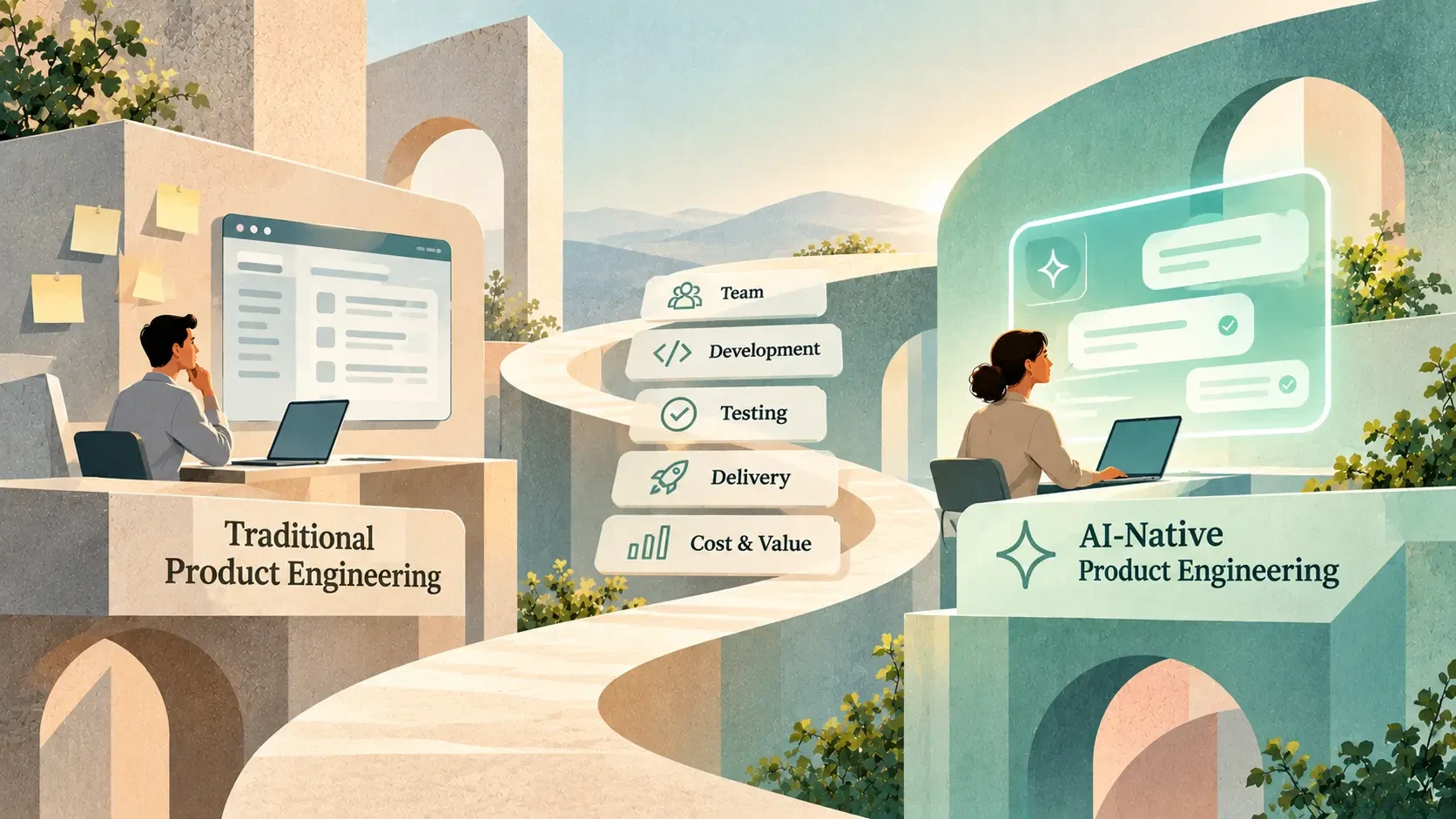
AI-native product engineering differs from traditional product engineering in two ways: what you build and how you build it.
In the product, AI does the core job, so the experience changes completely. Instead of hunting through menus and forms, users say what they want, by chat or by voice, and agents do the work. In the process, AI agents write most of the code, so humans spend their time defining what should be built and checking it. Almost every practice changes as a result: user experience, requirements, team shape, testing, delivery, analytics and cost.
Our team at Avesta has worked this way for about 18 months, building Avesta AgentOS and client products. This is the side-by-side comparison we wish we'd had at the start, with our own delivery loop as the worked example. If you're new to the term, start with What Is AI-Native Product Engineering?
What's the difference between AI-native and traditional product engineering?
What you build. A traditional product follows rules written by engineers, and users operate it through screens, menus and forms. An AI-native product depends on models to do its core job, such as reading documents, answering questions or taking actions, and users increasingly work with it by talking to it. Its behaviour varies, can be confidently wrong, and changes as models, data and users change.
How you build it. A traditional team writes code by hand and hands work between roles: product writes a spec, engineering builds it, QA tests it, operations runs it. An AI-native team has AI agents writing most of the code, with humans directing them, reviewing what they produce, and owning every decision that needs judgement.
You can have one without the other. Plenty of teams use AI coding tools to build traditional products, and some build AI products the old way. Getting the full benefit takes both.
AI-native vs traditional product engineering, side by side
| Traditional product engineering | AI-native product engineering | |
|---|---|---|
| Product logic | Rules written by engineers; predictable | Models do the core job; behaviour varies and must be measured |
| User interface | Menus, forms and screens to navigate | Conversation and voice, with screens where precision matters |
| User's effort | Find the feature and learn the steps | Say what you want; agents find the information and do the work |
| Requirements | Specified upfront, then built | Discovered with real users and data; captured as acceptance criteria and evals |
| Team | Product, engineering, QA and ops hand work between them | One product-engineering team; engineers direct and review agents |
| Writing code | By hand; the slowest, most expensive step | Mostly by agents; the fast, cheap step |
| Where humans spend time | Writing code | Defining intent, reviewing tests, judging output, owning architecture |
| Quality | Unit and integration tests; QA near the end | Acceptance tests first, evals for AI behaviour, code health checked at every commit |
| Delivery | Sprints and release cycles | Small changes shipped daily behind feature flags |
| Learning after launch | Click, page-view and funnel analytics | Plus agent behaviour and conversation analytics |
| Cost | Mostly people, mostly upfront | People plus model costs that grow with every task |
| Maintenance | Fix bugs, add features | Continuous refactoring, re-running evals as models and data change |
How does the user experience change?
This is the change users notice first.
In traditional software, the user's job is to find things. Features sit behind menus, settings live three clicks deep, and getting something done means learning the steps. Usability and discoverability are constant battles: people can't find features that already exist, engagement stays low, and product teams keep redesigning navigation to fix it.
AI-native products flip that. The user says what they want, and the product works out how to do it. Jakob Nielsen of Nielsen Norman Group calls this the first new interaction model in more than 60 years: users specify the outcome they want, not the commands to get there, which reverses who controls the steps.
In practice, that looks like:
- Conversational interfaces. Users ask in their own words, follow up, and refine, instead of filling in forms.
- Voice. Users speak the request and get the work done without clicking at all. That matters most for people whose hands are busy, such as field staff, drivers or warehouse teams.
- Agents that act, not just answer. The agent updates the record, drafts the reply, files the document or kicks off the workflow.
- Answers instead of navigation. Information spread across many screens and systems comes back as one answer, with sources.
- Screens that appear when needed. A table to compare, a form to confirm or an approval button shows up at the moment the task calls for it.
Conversation doesn't replace every screen. Nielsen expects future AI products to combine the new style with familiar graphical elements, and that matches what we see. Precise, repeated or high-risk tasks are often better as a button, a slider or a table. The skill is knowing which parts of a workflow should become conversation and which should stay direct.
Traditional software asks users to find the feature. AI-native software asks what they want done.
What makes it delightful, not just new:
- It responds fast and shows progress on longer tasks, so silence never feels like failure.
- It shows its sources and reasoning, so users can check an answer instead of having to trust it.
- It asks a clarifying question when the request is ambiguous, instead of guessing.
- It confirms before acting on anything that matters, and makes it easy to undo.
- It recovers gracefully when it doesn't understand, and offers a way forward.
- It fits existing habits. It meets users in the tools and moments they already work in, and eases their worry about letting an AI do the job.
Here is what that looks like in a product we built. Talent Carriage runs HR for more than 50 companies. Before, one person carried support duty on top of their own job: answer the phone if they were at their desk, finish the call, then remember to type the query into a list and work out whose job it was. Now a voice agent answers the line at any hour, in Hindi, English or both, and the ticket is written before the caller hangs up. The employee's steps went from six to two: ring the same number, and say what's wrong.
This is also why AI-native products need conversation analytics, not just click analytics. The team needs to see what users ask for, where they rephrase or give up, and which requests the agent handles badly. In the products we build on AgentOS, Relay handles the moments where a person confirms or takes over, and Metricsense shows how conversations and agents are performing.
How do requirements change?
Traditional product engineering assumes you can describe the right answer before you build. For AI behaviour, you usually can't. You don't know how a model will handle a customer's real documents or questions until you try.
So requirements become something you discover and then pin down as tests. At Avesta, every piece of work starts with understanding the user: what motivates them to change, what makes them anxious about a new way, and the habits they'll fall back on. We've written about this product sense gap before. That understanding becomes acceptance criteria and evals built from real, messy cases, before any code is written.
How does the team change?
In a traditional team, roles are separated and work moves through handoffs. Every handoff loses context.
In an AI-native team, the line between product and engineering mostly disappears. Whether an agent should ask for approval before acting is a product decision and an engineering decision at the same moment, and one team owns it.
The engineer's job changes too. Our engineers, juniors included, now manage and review groups of agents rather than writing most code by hand. Their work is keeping those agents aligned with the architecture, the review standards and the tests. That takes more judgement, not less.
How does writing code change?
In traditional engineering, building is the bottleneck, and the whole process is designed around it: estimates, sprints, handoffs. When agents write the code, building takes hours instead of weeks.
Anthropic's AI-native SDLC playbook makes the same point. Once code is no longer the bottleneck, the human-speed steps around it, such as planning, review, testing and deployment, become the constraint.
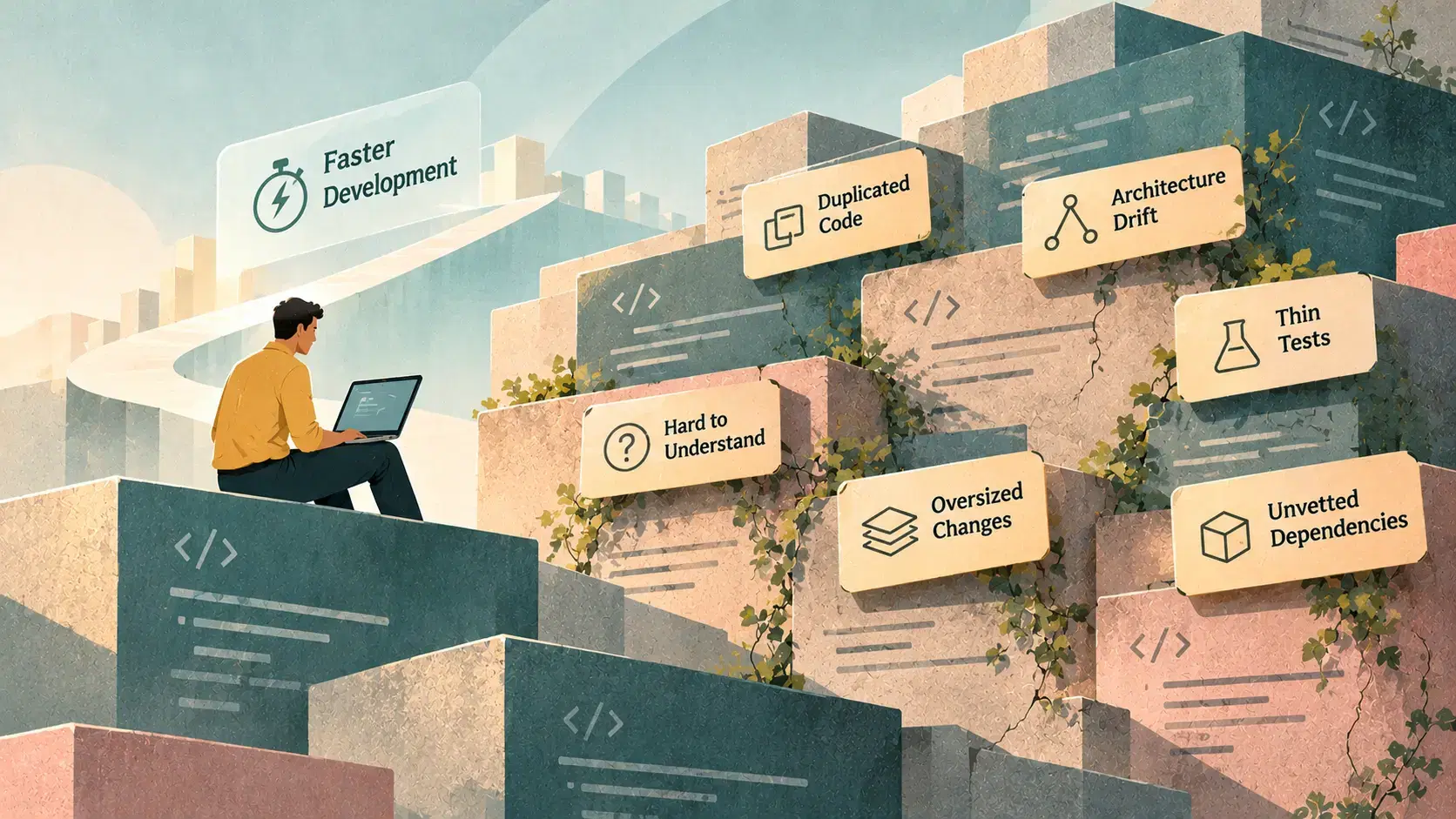
That's the most important shift to understand. Teams that only speed up coding find the work piling up at review and testing. The gains come from redesigning the steps around the code as well. Speed without those checks is how teams end up with the hidden cost of AI-written code.
When code is cheap, the bottleneck moves to deciding what to build and checking it.
How does quality change?
Traditional quality is checked near the end: build, then test, then fix.
Our process runs outside-in and test-first. An agent drafts the acceptance criteria and acceptance tests from the requirement. People review every one of them and sign off before any building starts; nothing goes ahead without that human sign-off. Only then do other agents write the code, and the tests decide whether it's done.
Two more checks run continuously:
- Evals test AI behaviour on real cases, so a prompt or model change can't quietly make things worse. We write them from the first day, demo included.
- Code Clinic reviews code at commit and merge, and monitors the whole codebase for architecture drift, duplication and technical debt, against the architectural rules each team sets.
How does delivery change?
Traditional teams batch work into releases: a feature is built, tested and shipped together, often weeks later.
AI-native delivery works in small changes shipped continuously. We deploy to production every day. Unfinished features ship switched off behind feature flags, so nothing waits in a long-lived branch. Because each change is small, when something goes wrong we see it straight away and know which change caused it. Broad test coverage is the safety net that makes that pace safe. We've told the story of why incremental delivery matters even more with AI-generated code.
How does learning after launch change?
Traditional products learn from user behaviour analytics: clicks, page views, funnels and feature adoption.
AI-native products need that and more, because much of the experience happens inside a conversation or an agent's work, where clicks see nothing. The team needs to know whether agents meet expectations, how often they're wrong, where users had to rephrase or gave up, and what users are actually asking for. We built that into AgentOS as Metricsense, our agent behaviour analytics module, and it drives what we build next.
How does cost change?
Traditional software costs mostly people, mostly upfront. Once it's built, running it is cheap.
AI-native products add model costs that grow with every task, and quality work that never really finishes. In return, building is far faster. The discipline is to measure cost per task from the start, and to use the right-sized model for each job rather than the biggest one by default.
What does an AI-native delivery loop look like?
This is how a piece of work moves through our team. People own every judgement along the way, including the sign-off before anything is built. Agents do most of the drafting and building.
- Discover (people). Understand the user's job, motivation, anxieties and habits, with real cases.
- Draft acceptance criteria and tests (agents). An agent turns the requirement into acceptance criteria and acceptance tests, plus evals for any AI behaviour.
- Review and sign off (people). People review every criterion and test. Nothing is built without this sign-off.
- Build (agents). Agents write the code inside the team's architecture and conventions, until the tests pass.
- Check (automated, reviewed by people). Code Clinic reviews at commit and merge, and evals run on every change.
- Ship daily (automated). Small changes go to production every day, with unfinished work behind feature flags.
- Learn (people, with analytics). Agent behaviour and conversation analytics show what worked with real users, and feed the next round of discovery.
The loop is the point. Traditional delivery is a line from spec to release. AI-native delivery cycles daily, and what agents and users do in production feeds the next round of discovery.
When is traditional product engineering still the right choice?
More often than the hype suggests:
- The product doesn't need AI to do its core job. A booking system, a billing engine or an internal admin tool is often better as predictable software.
- Requirements are stable and well understood. If you can specify the right answer upfront, you don't need the machinery for discovering it.
- The rules are fixed by law or regulation. Where outcomes must be exactly reproducible, deterministic code is the safer choice, with AI kept to supporting tasks.
Even then, the way you build can still be AI-native. Agents writing code under human review, with tests first and code health checked continuously, works for traditional products too.
How do you move from traditional to AI-native product engineering?
Not all at once. A sequence that works:
- Start with tests first. Have acceptance criteria and tests written, and signed off by people, before code is written. This pays off whether humans or agents write the code.
- Measure code health. Set your architectural rules and track drift, duplication and debt before AI multiplies them.
- Shrink changes. Move to small, frequent releases behind feature flags.
- Let agents build inside those guardrails. Expand from one team or one service once the checks are trusted.
- Pick one workflow for an AI-native feature. Write evals from real cases first, then build, and add agent behaviour analytics from day one.
Where to start
Pick one part of your product and map it against the side-by-side table above. The rows where you're still fully traditional are where the next gains are.
If you'd like a team that already works this way, Avesta's AI-native product engineering team brings the loop, the guardrails and AgentOS with it. Book a discovery call and we'll map your product with you.
Sources
- Anthropic, The AI-native SDLC playbook, 2026
- Jakob Nielsen, AI: First New UI Paradigm in 60 Years, Nielsen Norman Group, 2023
Frequently asked questions
- What is the difference between AI-native and traditional product engineering?
- Two things change. What you build: an AI-native product depends on AI to do its core job, so its behaviour must be measured. And how you build it: AI agents write most of the code, while humans define intent, review tests and output, and own the architecture.
- How does user experience change in AI-native products?
- Users stop hunting through menus and forms and instead say what they want, by chat or voice, while agents find the information and do the work. Good AI-native products still keep buttons, tables and approvals where precision matters, and show sources so users can check answers.
- Is using AI coding tools the same as AI-native product engineering?
- No. AI coding tools speed up writing code. AI-native product engineering also redesigns requirements, testing, delivery and analytics around AI, because once code is cheap, the bottleneck moves to deciding what to build and checking it.
- How does testing change in AI-native product engineering?
- It moves to the start. Acceptance criteria and tests are written first and signed off by people before agents build. Evals test AI behaviour on real cases, and code health checks run at every commit.
- What do engineers do in an AI-native team?
- They direct and review AI agents rather than writing most code by hand. Their work is keeping agents aligned with the architecture, review standards and tests, and making the judgement calls agents shouldn't.
- When should you still use traditional product engineering?
- When AI isn't doing the product's core job, requirements are stable and well specified, or outcomes must be exactly reproducible for legal or regulatory reasons. Even then, the build process can use AI agents under human review.
- How do you move from traditional to AI-native product engineering?
- Step by step: write tests first with human sign-off, measure code health, shrink changes and ship them behind feature flags, let agents build inside those guardrails, then build one AI-native feature with evals from day one.
Share this article