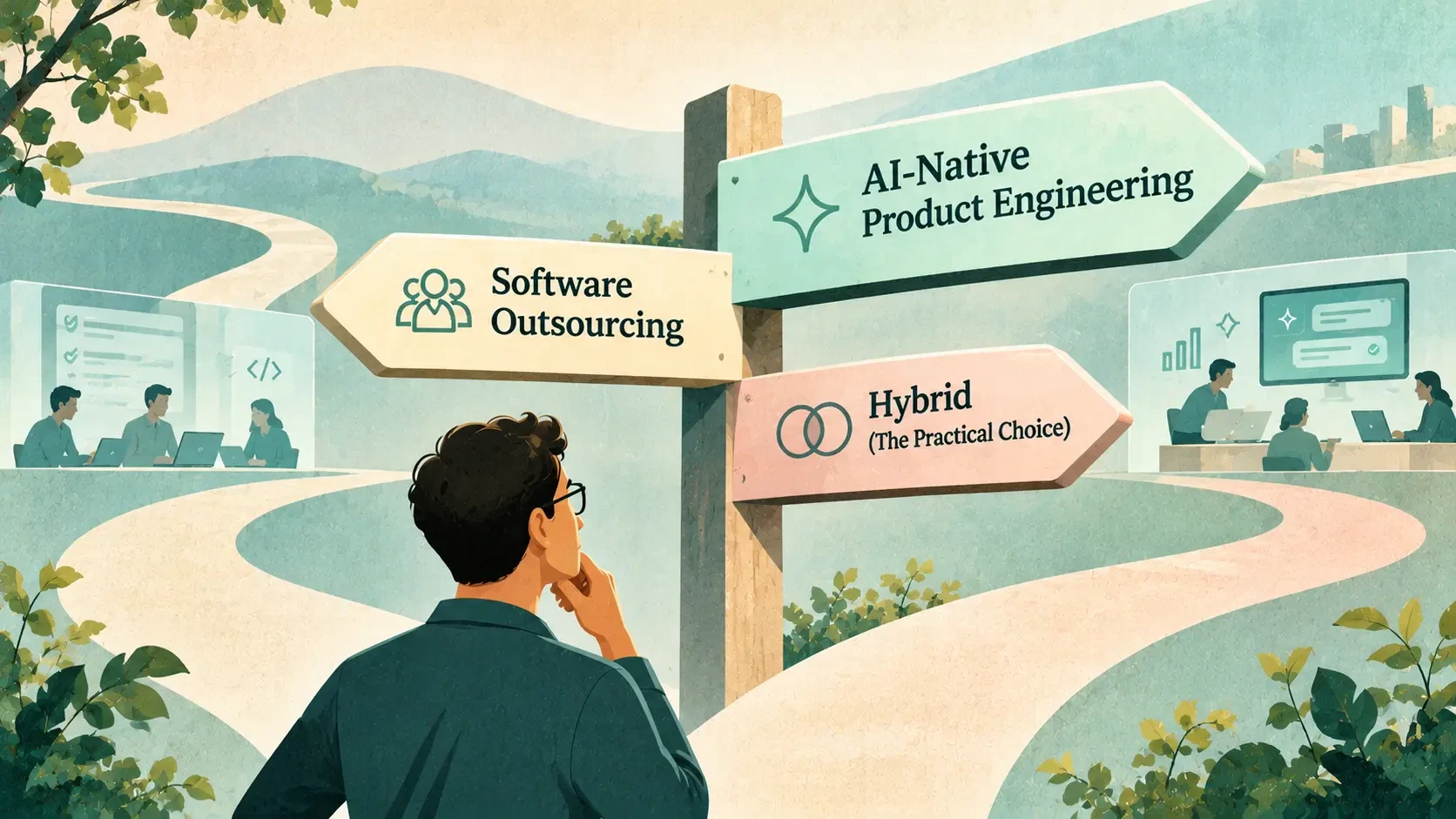
AI-Native Product Engineering vs Software Outsourcing: Which Do You Need?
A fair guide to what each is built for, when to choose which, and how to split the work in a hybrid.
 Vivek Satasiya7 min read
Key takeaways
- Outsourcing is built to deliver a defined scope efficiently. AI-native product engineering is built to discover and improve AI behaviour that can't be fully specified.
- If AI isn't doing the core job and requirements are stable, outsourcing is usually the better and cheaper choice.
- If AI is doing the core job, you need a team with production AI experience, evals and product sense, embedded with your product owner.
- A hybrid is often right: keep your outsourcing partner on core systems, integrations and maintenance, and add an AI-native team for the AI workflows.
- Decide per piece of work, not per company. The decision flow below takes four questions.
Choose software outsourcing when the work can be specified upfront and success means delivering that scope on time and on budget. Choose AI-native product engineering when AI is doing the core job of the product. That work has to be discovered, tested with evals and improved after launch, which fixed-scope outsourcing isn't built for. Many companies need both, split by type of work rather than by vendor loyalty.
We sell AI-native product engineering, so take our view with that in mind. That's also why this guide says plainly where outsourcing is the better choice, and where we turn work away.
What is each model built for?
Software outsourcing is built to turn a clear specification into working software at a good price. You define what you want, and the vendor scopes it, staffs it and delivers it. It works best when the right answer can be written down before the build starts, and its strengths are cost, capacity and predictability. It covers everything from project delivery to dedicated teams and staff augmentation.
AI-native product engineering is built for products where AI does the core job, such as reading documents, answering customers or taking actions in other systems. The right behaviour can't be fully written down upfront. It has to be discovered with real users and data, tested with evals, and improved after launch.
The team embeds with your product owner, works in short cycles, and measures outcomes rather than delivered features. It also builds with AI: agents write most of the code, with people defining intent, signing off tests and owning the architecture. We cover that side in AI-native vs traditional product engineering.
Neither is better in general. They answer different questions.
How do they compare?
| Software outsourcing | AI-native product engineering | |
|---|---|---|
| What you're buying | Delivery of a defined scope | Outcomes for a product where AI does the job |
| Best for | Stable, well-specified software | AI features and AI-native products |
| Requirements | Written upfront, then built | Discovered with users and data, pinned down as acceptance tests and evals |
| How the team works | Separate vendor team, working through tickets | Embedded with your product owner, short cycles |
| How quality is judged | Tests pass, scope delivered | Behaviour meets a measured standard on real cases, in production |
| After launch | Maintenance and change requests | Continuous improvement as models, data and users change |
| Cost model | Fixed price or time and materials | Discovery sprint, embedded team or outcome milestones |
| Main risk | Building the wrong thing exactly to spec | Paying for a team that hasn't run AI in production |
Outsourcing's main risk is building the wrong thing exactly to spec. AI-native's is paying for a team that hasn't run AI in production.
What are companies actually doing?
Most are already mixing models. Deloitte's 2024 Global Outsourcing Survey of more than 500 executives found access to talent had become the top reason to outsource, ahead of cost. It also found 67% of executives using outcome-based outsourcing, a shift away from traditional staff augmentation. And 70% of executives had brought some previously outsourced work back in-house over the last five years.
In other words, buyers are already choosing per type of work, and paying for results rather than hours. The question for AI work is which model matches it.
When should you choose software outsourcing?
- AI isn't doing the core job. A booking flow, billing, an admin panel or a reporting module is ordinary software, and outsourcing handles it well.
- Requirements are stable. If you can write the right answer down before the build, you don't need the machinery for discovering it.
- The work is integrations, migrations or maintenance. Well-defined, repeatable work suits fixed scope.
- Cost and capacity are the constraints. When you know what to build and need more hands, outsourcing is efficient.
If this describes the work, an AI-native team would be the more expensive way to get the same result.
Sometimes the right answer is: outsource it.
When should you choose AI-native product engineering?
- AI is doing the core job. The product reads, decides, answers or acts, and its value depends on how well the AI does that.
- You can't specify the right behaviour upfront. You'll learn what works only by testing with real users and data.
- A demo works but production doesn't. You need evals, guardrails, observability and agent behaviour analytics, built by people who've run agents in production. We cover this in The AI Demo Worked. Production Didn't.
- The user experience is changing. Users will talk to the product, by chat or voice, instead of navigating it. Here's how that changes the experience.
- Your current partner is stalling on AI. We've written up the signs and the five gaps to check.
What does a hybrid model look like?
Often the best answer is both, divided by type of work:
| Work | Who does it |
|---|---|
| Core platform, billing, admin, reporting | Outsourcing partner or in-house team |
| Integrations with ERP, CRM and other systems | Either; shared ownership of the interfaces |
| AI workflows, agents and conversational experiences | AI-native team, embedded with your product owner |
| Evals, guardrails and agent behaviour analytics | AI-native team |
| Maintenance of stable features | Outsourcing partner |
The hybrid works when the boundary is clear: who owns which services, who owns the interfaces between them, and whose tests decide whether a change is done. It fails when two vendors share one codebase with no agreed architecture, which is exactly where architecture drift starts.
How do you decide?
Run these four questions for each piece of work, not once for the whole company:
- Is AI doing the core job of this work? If not, go to question 2. If it is, go to question 3.
- Can you fully specify it upfront? If yes, outsource it. If not, it needs a product engineering team that can discover it.
- Does your current partner already run AI agents in production? If yes, keep them and change the engagement: make evals the acceptance criteria and fund a short discovery phase. If not, go to question 4.
- Do you also need ongoing work on core systems? If yes, go hybrid. If not, bring in an AI-native team for the whole product.
The four questions lead to four answers: outsource it, change the engagement with your current partner, go hybrid, or bring in an AI-native team.
When isn't Avesta Labs the right fit?
We'd rather say this upfront. We're usually not the right choice when:
- The work is well-specified software with no AI at its core. An outsourcing partner will do it for less.
- You only need extra developers to work through a fixed backlog under your direction. That's staff augmentation, and it's a different engagement from product engineering.
- There's no product owner on your side who can make decisions every week. Our model depends on that.
How does Avesta Labs work when we are the right fit?
We embed a small AI-native product engineering pod with your team: a product engineering lead who is a Claude Certified Architect, AI product engineers, and an evals and quality engineer. They work with your product owner, on your stack, and bring the production layer we've built and run in Avesta AgentOS.
There are three ways to start:
- A discovery sprint to map where AI changes the job and set an eval baseline.
- An embedded pod for ongoing product work.
- Outcome milestones tied to measurable results.
If you already have an outsourcing partner, we can work alongside them in a hybrid.
Where to start
List the next three pieces of work on your roadmap and run each through the four questions. If any land on "AI-native team" or "hybrid", that's the conversation to have.
Book a discovery call and we'll tell you honestly which model fits, including if it isn't us.
Sources
- Deloitte, Global Outsourcing Survey 2024 report (PDF), 2024
- Deloitte, Global Outsourcing Survey 2024: key findings, 2024
Frequently asked questions
- What is the difference between AI-native product engineering and software outsourcing?
- Software outsourcing delivers a defined scope efficiently. AI-native product engineering builds products where AI does the core job, so the behaviour has to be discovered with real users and data, tested with evals and improved after launch, by a team embedded with the client's product owner.
- Should I outsource AI development?
- Outsource it only to a partner that already runs AI in production, writes evals and treats requirements as something to discover. If the work is ordinary software with stable requirements, conventional outsourcing is usually cheaper and works well.
- When is software outsourcing the better choice?
- When AI isn't doing the core job, requirements are stable and well specified, or the work is integrations, migrations or maintenance. In those cases outsourcing delivers the same result for less.
- What is a hybrid outsourcing model for AI products?
- Your outsourcing partner keeps core systems, integrations and maintenance, while an AI-native team builds the AI workflows, evals and agent analytics. It works when the boundary between them, including ownership of interfaces and tests, is clearly agreed.
- Can my current outsourcing partner build my AI product?
- Yes, if they already run AI agents in production and can show evals for your product. If they can, change the engagement so evals become the acceptance criteria. If they can't, consider a hybrid or an AI-native team for the AI work.
- How do I decide which model fits?
- Ask four questions per piece of work: is AI doing the core job, can it be fully specified upfront, does your partner run AI in production, and do you also need ongoing core-systems work. The answers point to outsourcing, an AI-native team, a hybrid, or changing the engagement.
Share this article