OOS investigation: Phase I vs Phase II explained
What the FDA guidance really asks for when a test result falls outside its limits.
 Jeet Adeshara9 min read
Key takeaways
- Every OOS result needs a written investigation under 21 CFR 211.192, even when the batch is rejected anyway.
- Phase I asks one question: is there a clear, documented lab error? If not, the investigation moves to Phase II, a full review of production led by the quality unit (your QA team).
- A result can be invalidated (thrown out as wrong) only when the lab investigation clearly finds a lab root cause. Passing retests alone are not a reason.
- Write the maximum number of retests into an SOP before you need it, and don't change it because of the results. Any rare exception needs a justified protocol approved by the quality unit.
- Never average the OOS result with retest results. An average can pass while the single numbers show something is wrong.
An assay (the test that measures how much medicine is in a tablet) comes back at 88.5%. The allowed range is 90.0 to 110.0%. It is tempting to blame the lab and simply run the test again.
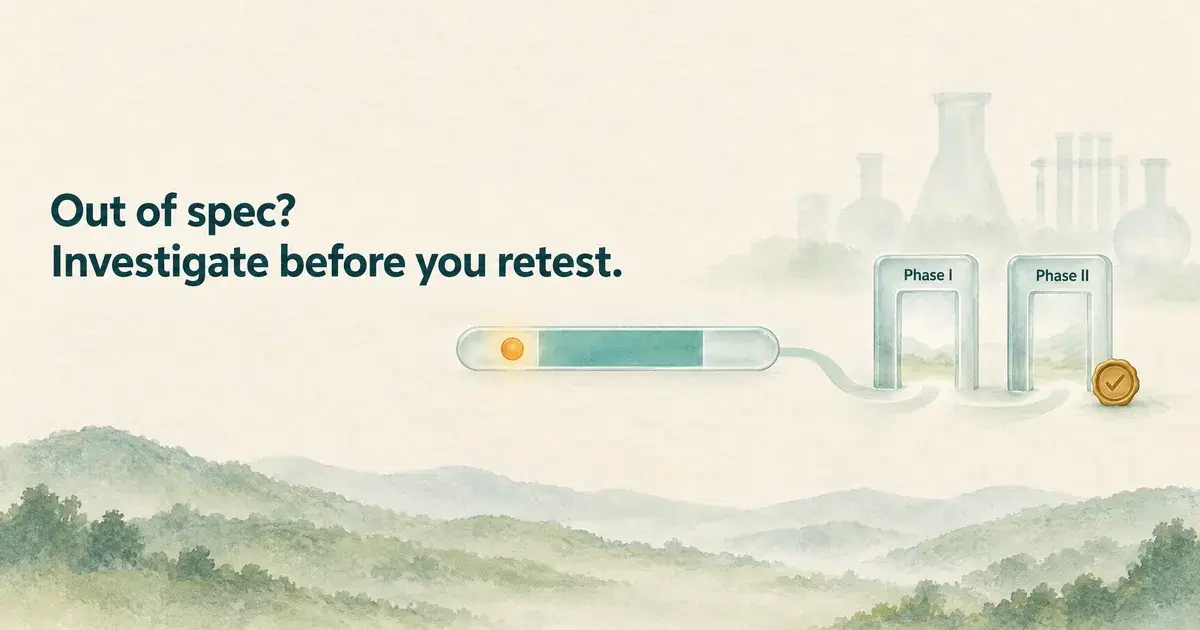
FDA's guidance on investigating out-of-specification (OOS) results is there to slow that reflex down. It splits the investigation into two phases, often written Phase 1 and Phase 2. It sets a clear rule for when a result can be thrown out. And it draws a firm line around retesting.
What is an OOS result, and why must it be investigated?
An OOS (out of specification) result is a test result outside the allowed limits. Those limits are the specifications or acceptance criteria in your drug application, drug master file, official compendia (such as the pharmacopoeia) or your own specifications. In-process lab tests (tests done during production) outside their limits count too.
21 CFR 211.192 requires a written investigation, with conclusions and follow-up. The guidance adds a point that often gets skipped: rejecting the batch does not remove the need to investigate. The cause may affect other batches or other products.
What do Indian and Australian GMP rules say about OOS results?
The FDA guidance is the most detailed public description of how to run an OOS investigation, so this post follows it. But if you make medicines for India or Australia, your own GMP (good manufacturing practice) code already makes the investigation a must.
In India, Revised Schedule M (Part I, section 19.6.7) says OOS results "shall be investigated in accordance with an approved procedure and record shall be maintained". For APIs (active pharmaceutical ingredients, the medicine itself), Part XII adds that OOS reports are reviewed as part of the batch record before release.
In Australia, the TGA applies the PIC/S Guide to GMP. Its chapter 6 says OOS results and significant unusual trends "should be investigated". It also asks for a written procedure that covers both OOS and OOT (out of trend) results. A confirmed OOS result that affects batches already on the market should be reported to the regulator.
Neither code spells out the phase-by-phase method. That is where the FDA guidance helps as a reference. Sites that export to the US have to meet it anyway.
What happens in Phase I, the laboratory investigation?
Phase I asks one question: is there a clear, documented lab error?
Ideally the check happens before the test preparations are thrown away. That way, any theory about an error can be tested on the same material. The guidance gives the analyst and the supervisor separate jobs. Some firms also split Phase I in two. Phase Ia is a quick check for obvious errors, and Phase Ib is a fuller lab investigation. Those labels are industry practice, not FDA terms.
Did the analyst follow the method and get the calculations right? Was the instrument calibrated? Did it pass system suitability (a check that the instrument works properly before the run)? Were the standards and reagents the right lot and in date? Was the sample handled and stored properly?
The guidance is direct about when you can invalidate a result, meaning throw it out as wrong:
"OOS test results should not be attributed to analytical error without completing an investigation that clearly establishes a laboratory root cause." FDA, Investigating OOS Test Results, 2022
So do not blame the lab without proof.
If the error is clear, the result is invalidated. The retest result takes its place, and the original data is kept with an explanation. If the evidence is unclear, Phase I is over and Phase II begins.
When does an investigation move to Phase II?
When Phase I finds no clear lab error and the result looks accurate. Phase II is a full-scale investigation that follows a procedure set in advance. The quality unit (your quality team, which makes the release decision) leads it. The guidance says it should get the highest priority.
| Phase I | Phase II | |
|---|---|---|
| Question | Did the lab cause this? | If not the lab, what did? |
| Led by | Analyst and lab supervisor | The quality unit |
| Who's involved | QC (quality control) lab | Manufacturing, process development, maintenance, engineering |
| Looks at | Raw data, instrument, standards, how the sample was handled | Batch records, process settings, sampling, other batches |
| Extra testing | Checks on the original preparations, such as running the same solution again | Retesting and resampling (taking a fresh sample) under a plan set in advance |
| Can it throw out the result? | Yes, if a lab error is clearly proven | Only if it documents a test or sampling event that caused the result |
Phase II also has to check the impact on batches already sent out. At that point the question is no longer only about one sample in the lab.
What is testing into compliance?
This is the guidance's sharpest line:
"This practice of 'testing into compliance' is unscientific and objectionable under CGMP." FDA, Investigating OOS Test Results, 2022
CGMP means current good manufacturing practice, the US GMP rules. Testing into compliance means retesting until a passing number appears. The OOS result is then set aside without a scientific reason. The guidance blocks it in three ways.
- The maximum number of retests goes into an SOP (a written standard procedure) before you need it. It is based on how much the test method varies. The guidance adds that it is often important for a second analyst to do the retest. That analyst should be at least as experienced and qualified as the first.
- That number does not change based on the results you get. When you reach it, the batch is evaluated. If the results are not good enough, the batch is rejected or held for further investigation (21 CFR 211.165(f)). Going outside the SOP should be rare. It needs a justified protocol (written plan) approved by the quality unit before any extra retesting starts.
- Passing retests do not cancel a valid result. If no lab or calculation error was found, there is no scientific basis for throwing out the original OOS result. Every result gets reported.
Think of it like agreeing the rules of a match before kick-off, not at half-time, when you already know the score.
Outlier tests (statistical tests that flag one number as unusual) don't get you out either. The guidance says they should not be used to invalidate chemical assays. It cites the 1993 United States v. Barr Laboratories court ruling.
Why can't you just average the results?
Because an average can pass while the single results show a problem. Averaging is fine where the test method itself defines one reported result as an average. Repeat injections of the same solution are one example. What the guidance rules out is averaging the original OOS result with retest or resample results. Here is its own example for a 90 to 110% specification:
| Results | Average | What they really say |
|---|---|---|
| 89%, 90%, 91% | 90% | Retests tend to confirm the original OOS result |
| 80%, 85%, 105% | 90% | Results vary a lot and may not be reliable |
Both averages "meet specification", and neither one tells you the batch is fine. In cases like these, the guidance says product quality is judged on the single results, not the average.
Who decides at the end?
The quality unit reads the investigation, judges batch quality and makes the release or rejection decision. An OOS result doesn't automatically mean the batch fails. But no decision is made until the investigation is done. Every result, passing and failing, goes into it.
How is an OOS result different from an OOT result?
FDA doesn't formally define OOT. In industry use, an OOT result is still inside the specification but breaks the pattern of the product's own earlier results. Take an assay that has sat at 99 to 101% for two years. Then it reads 95.5% against a 95 to 105% limit. It has passed, but it is out of trend.
The FDA guidance is written for OOS results. But a footnote says much of it may be useful for OOT results too. Catching an OOT result early can mean you deal with a drift before it becomes an OOS.
Where can an AI co-worker help, and where must it stop?
Most of the effort in an OOS investigation goes into discipline. You follow the steps in order, record every check and cite the rule behind each step. And you make sure nobody reruns a sample off the record.
That is what the OOS co-worker in our AI co-workers for pharma quality is for. It checks whether the result is out of specification with a fixed calculation, not AI model judgement. It sends Phase I to the lab head and Phase II to the production head. When they report back, it drafts the 5-Why (a simple root cause method) and the impact assessment. It also drafts the CAPA (corrective and preventive actions) and the proposed disposition (the decision to release or reject the batch). It will not invalidate a result unless Phase I documented a real lab error. It will not go past the SOP retest limit.
Its limits matter just as much. It cannot see the instrument or the granulator, so it asks people for evidence instead of guessing. It never makes the release decision either. The QA head signs, and the co-worker records who signed and when. Before a co-worker like this goes live, it has to be tested on real cases. Our guide to AI evaluation covers how.
The bottom line
Investigate every OOS result, even when the batch is already rejected. Phase I looks for a clear lab error. If there isn't one, Phase II takes over under the quality unit. Write the retest limit down before you need it, and don't change it because of what the results say. Never average the OOS result with retests to get a pass. The release decision belongs to the quality unit, and the investigation is there to support it.
If your site is preparing for a Revised Schedule M inspection, our self-inspection checklist covers the records worth checking before an inspector arrives.
Want every OOS investigation run the same way, phase by phase, with the audit trail to prove it? See our OOS investigation co-worker, with your QA team signing every decision.
Get started: hello@avestalabs.ai
Frequently asked questions
- What is an OOS result?
- An OOS (out of specification) result is any test result outside its specifications or acceptance criteria. These are set in the drug application, drug master file, official compendia (such as the pharmacopoeia), or by the manufacturer. It also covers in-process lab tests (tests done during production) that fall outside their set limits.
- Do Indian and Australian GMP rules require OOS investigations?
- Yes. In India, Revised Schedule M (Part I, section 19.6.7) says OOS results must be investigated under an approved procedure, with records kept. In Australia, the TGA applies the PIC/S Guide to GMP. It says OOS results and significant unusual trends should be investigated, and asks for a written procedure for them. Neither sets out the phase-by-phase method in detail. So the FDA guidance is a useful reference for how to run the investigation.
- What is the difference between a Phase I and a Phase II OOS investigation?
- Phase I is the lab investigation. The analyst and supervisor check whether a clear lab error caused the result. If they cannot find one, Phase II begins. This is a full investigation led by the quality unit. It reviews production and sampling, often adds more lab testing, and checks the impact on other batches.
- Can an OOS result be invalidated if the retest passes?
- Not for that reason alone. FDA guidance is clear. If no lab or calculation error is found in the first test, there is no scientific basis for throwing out the OOS result in favour of passing retests. All results, passing and suspect, are reported and considered in the release decision.
- How many retests are allowed in an OOS investigation?
- The guidance gives no single number. Write the maximum number of retests into an SOP in advance, based on how much the test method varies. Do not change it based on the results you get. When you reach that number, the batch is evaluated.
- What is testing into compliance?
- Testing into compliance means retesting until a passing result appears, then ignoring the OOS result without scientific justification. FDA guidance calls it unscientific and objectionable under CGMP (the US rules for making medicines).
- What is the difference between OOS and OOT?
- An OOS result falls outside the specification. An OOT (out of trend) result is still inside the specification, but it breaks the pattern of the product's earlier results. FDA's OOS guidance notes that much of its approach may also be useful for investigating OOT results.
- How long should an OOS investigation take?
- FDA guidance does not set a fixed number of days. It says the investigation should be timely, thorough and well documented, and that a full-scale investigation should get the highest priority. Set a target in your own SOP. Allow a documented extension for cases where the root cause takes longer to find. One clock is fixed. It applies to a distributed batch of an FDA-approved product (NDA or ANDA, the US approval types for new and generic drugs). For that batch, a Field Alert Report (an early warning to the FDA) is due within 3 working days, unless the OOS result is found invalid in that time.
- Who decides whether the batch is released after an OOS investigation?
- The quality unit. It reads the investigation results, judges batch quality and makes the release or rejection decision (21 CFR 211.22 and 211.165). A first OOS result does not automatically mean the batch fails. But it must be investigated before any decision.
Share this article