
AI Assistant for Travel Agents: A Flight Enquiry Example
Notes from building an AI assistant for a flight booking consultancy. It read the customer's first message, asked only for what was missing, then handed over to a person.
 Vinay Bhinde11 min read
Key takeaways
- A flight enquiry usually arrives with two or three details. A consultant needs many more before searching a fare, which is why so many enquiries turn into rounds of emails.
- Long enquiry forms and scripted chatbots both ask every customer the same questions, including what the customer already said in their first message.
- In our build, the AI assistant read the first message, saved every detail in it, and then asked only for what was missing, in small forms of up to five fields.
- The assistant never booked anything. It gathered the details, showed up to three flight options and emailed the complete enquiry to a human consultant.
- This was one build for one consultancy. It is a pattern to try, not a complete answer to enquiry handling.
A customer writes in: "Looking for return flights to London in March. Two adults and a seven-year-old." It reads like a request. For a consultant, it is the start of several rounds of emails before they can even search for a fare.
A flight booking consultancy brought us this problem. They sell international, long-haul flights, and their consultants were spending too much time going back and forth with customers by email. We built them an AI assistant that collected the trip details before a consultant picked up the enquiry.
What should an AI assistant for travel agents do with a flight enquiry?
In our build, an AI assistant for travel agents handled flight enquiries in four steps. It read the customer's first message and saved every detail in it. It asked only for what was still missing. It showed a few flight options. Then it handed the complete enquiry to a human consultant, without booking anything.
Put simply:
Read what the customer said. Ask only what's missing. Hand the complete enquiry to a person.
What does a consultant need before searching a fare?
To quote a long-haul international trip properly, a consultant needs far more than a destination and a month. When we mapped it out with the consultancy, the details fell into seven groups.
| Group | What the consultant needs to know |
|---|---|
| Trip structure | One-way, return or multi-city; where from and where to |
| Dates | Exact dates, or how flexible the customer can be |
| Travellers | How many adults, children and infants, and the children's ages |
| Cabin | Economy, premium economy, business or first |
| Airlines | Any preferred airlines, or ones to avoid |
| Routing | Direct only, or happy with stops; any layover preferences |
| Seats, bags and meals | Seat needs, checked bags, dietary requests |
Each group changes what the consultant searches for and what the fare comes to. Children's ages are a good example. Qantas, for instance, treats an infant as under two and a child as two to eleven. On its international fares, an infant without a seat travels for 10% of the adult fare, plus taxes and surcharges. Miss the age, and the options sent back may be wrong.
Why do flight enquiries take so many emails?
Nobody is doing anything wrong. The missing details come from how people naturally ask for travel:
- Customers write the way they think, not in fields. A first message usually covers two or three details: where, roughly when, and who.
- Answers lead to more questions. "We might stop in Dubai on the way back" turns a return trip into a multi-city one, with new dates to pin down.
- Customers don't know what matters. Few people realise a child's age changes the fare, or that being flexible on stops can open up cheaper options.
- Every round waits on a reply. Each question can sit in an inbox for hours, sometimes days.
The cost rarely shows up on a report. Expert time goes on clerical work, replies get slower, and every extra email is another point where a customer can lose interest.
Why don't a long enquiry form or a scripted chatbot fix it?
The obvious fixes each solve one problem and create another. A scripted chatbot here means one that follows a fixed list of questions in a fixed order.
| Approach | What it gets right | Where it falls short |
|---|---|---|
| Long enquiry form | Collects everything in one go | Asks every customer every question, even ones that don't apply. Can't capture "flexible by a few days, but back before school starts" |
| Scripted chatbot | Feels like a conversation | Asks for the destination even when the first line named it |
| AI assistant that reads first (what we built) | Asks only what this trip still needs | Needs a clear map of the fields before any AI is built |
A scripted chatbot is, in practice, a long form typed out one question at a time.
Both fixes ignore what the customer has already said. A good consultant never does.
A quick test for any AI assistant you are considering: give it a first message with three details, and see whether it asks for any of them again.
How we built the AI assistant for flight enquiries in Avesta AgentOS
The consultancy's brief was narrow: take enquiries for international long-haul flights, gather what a consultant needs, and hand it over. That scope shaped every choice below.
We built it on Avesta AgentOS, our platform for building and running AI agents. In one case, customers met the assistant as a widget built into the website. In another, they met it as a voice agent.
The assistant started by reading the customer's first message and saving every detail in it. Then it looped:
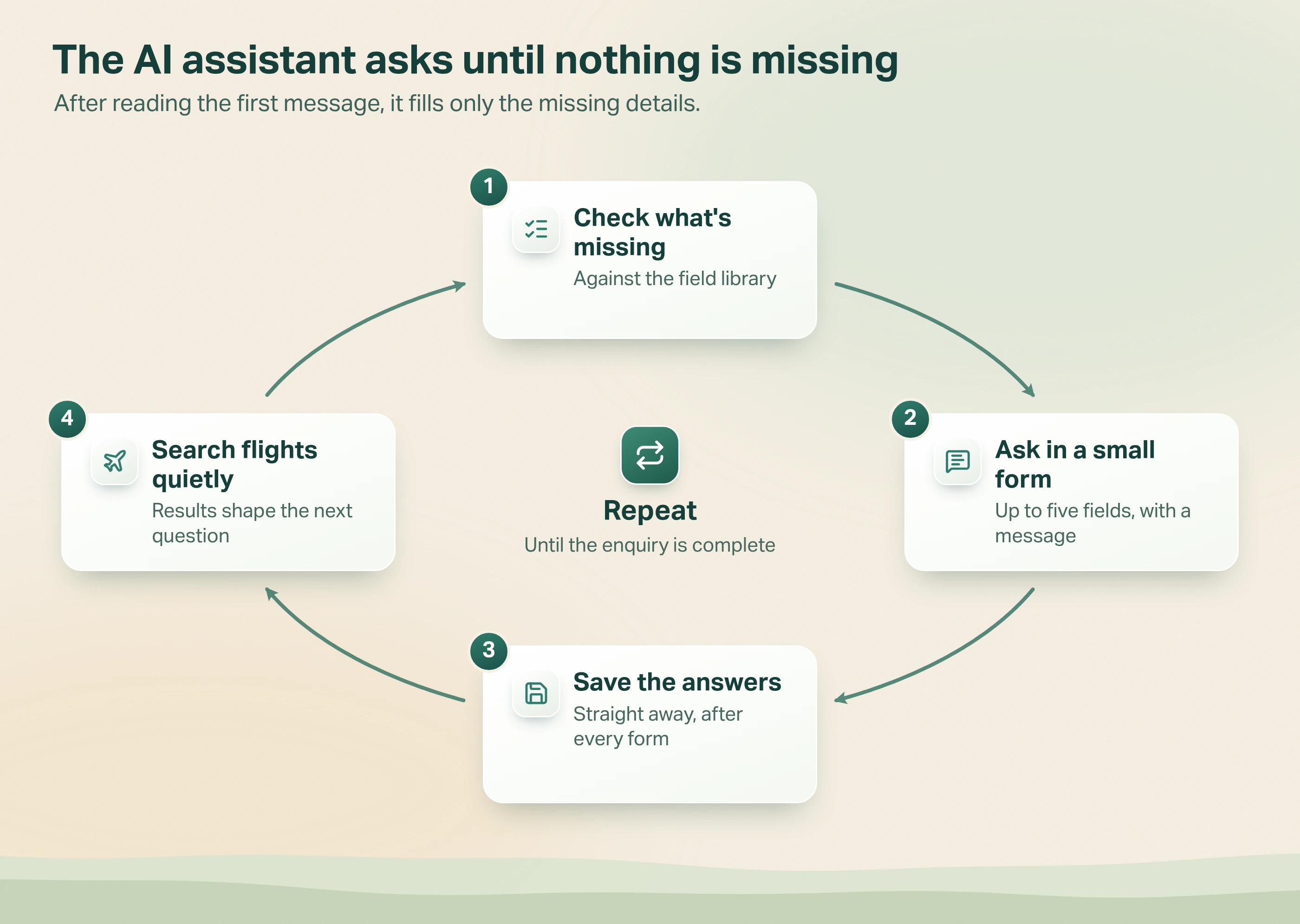
- Check what's missing, against the field library (our list of everything a consultant might need) for this kind of trip.
- Ask in a small form, up to five fields, with a line saying why.
- Save the answers straight away, after every form.
- Search flights quietly, and let the results shape the next question.
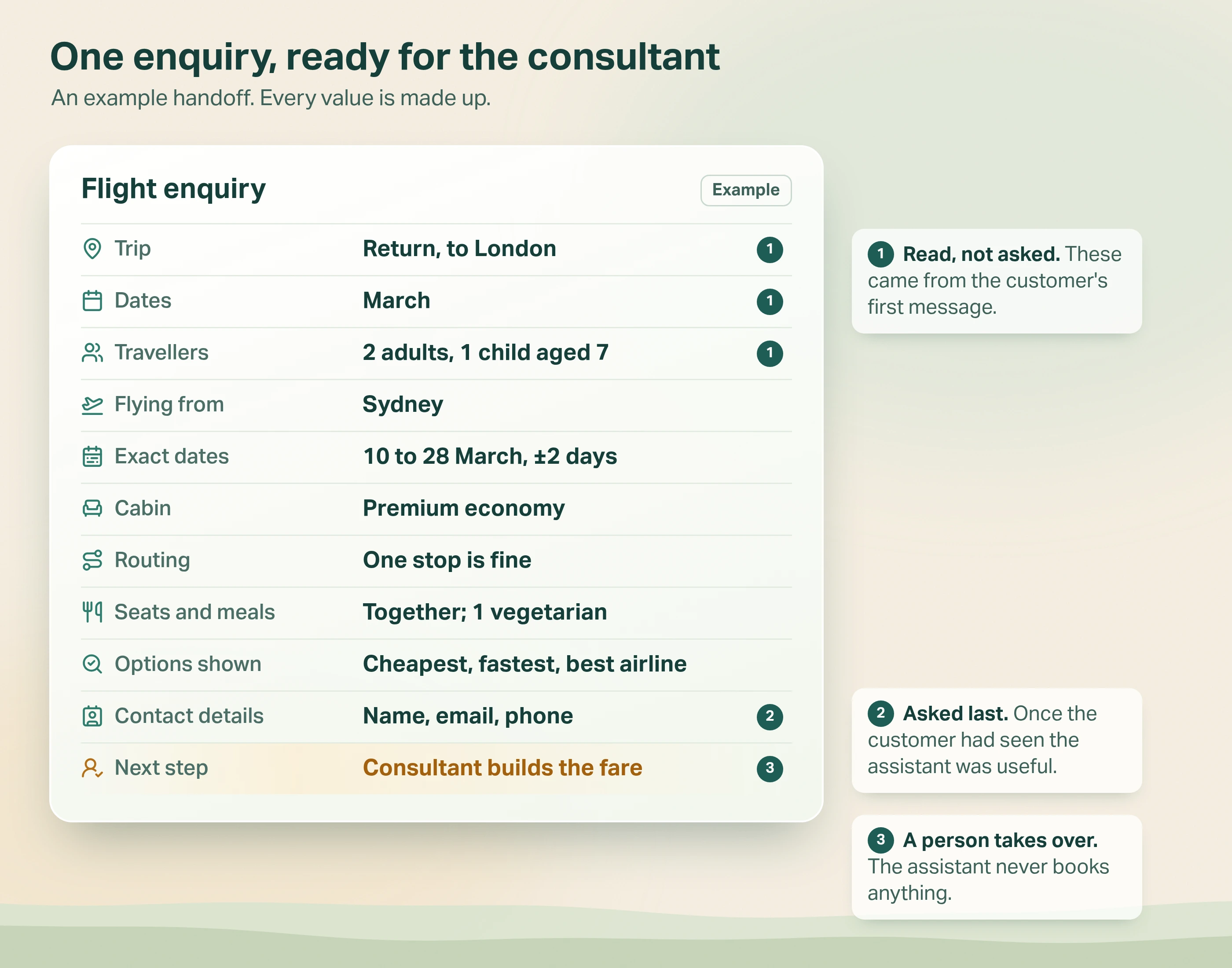
When the trip details were complete, it showed up to three options and asked for contact details. Then it showed a summary for the customer to check, and emailed the complete enquiry to a consultant.
A field library, not a checklist
The first thing we built wasn't AI at all. It was the field library, covering the seven groups in the table above. The assistant used it to know what could matter, not as a list to march through. A one-way economy trip for one adult needs a fraction of what a multi-city family trip in business class needs.
Read first, ask second
Take the opening message: "Return flights to London in March. Two adults and a seven-year-old." That one line fills in the trip structure, destination, rough dates and travellers. The assistant saved all of it, then worked out what was missing: where they were flying from, the exact dates, the cabin and so on.
Small forms, always with a message
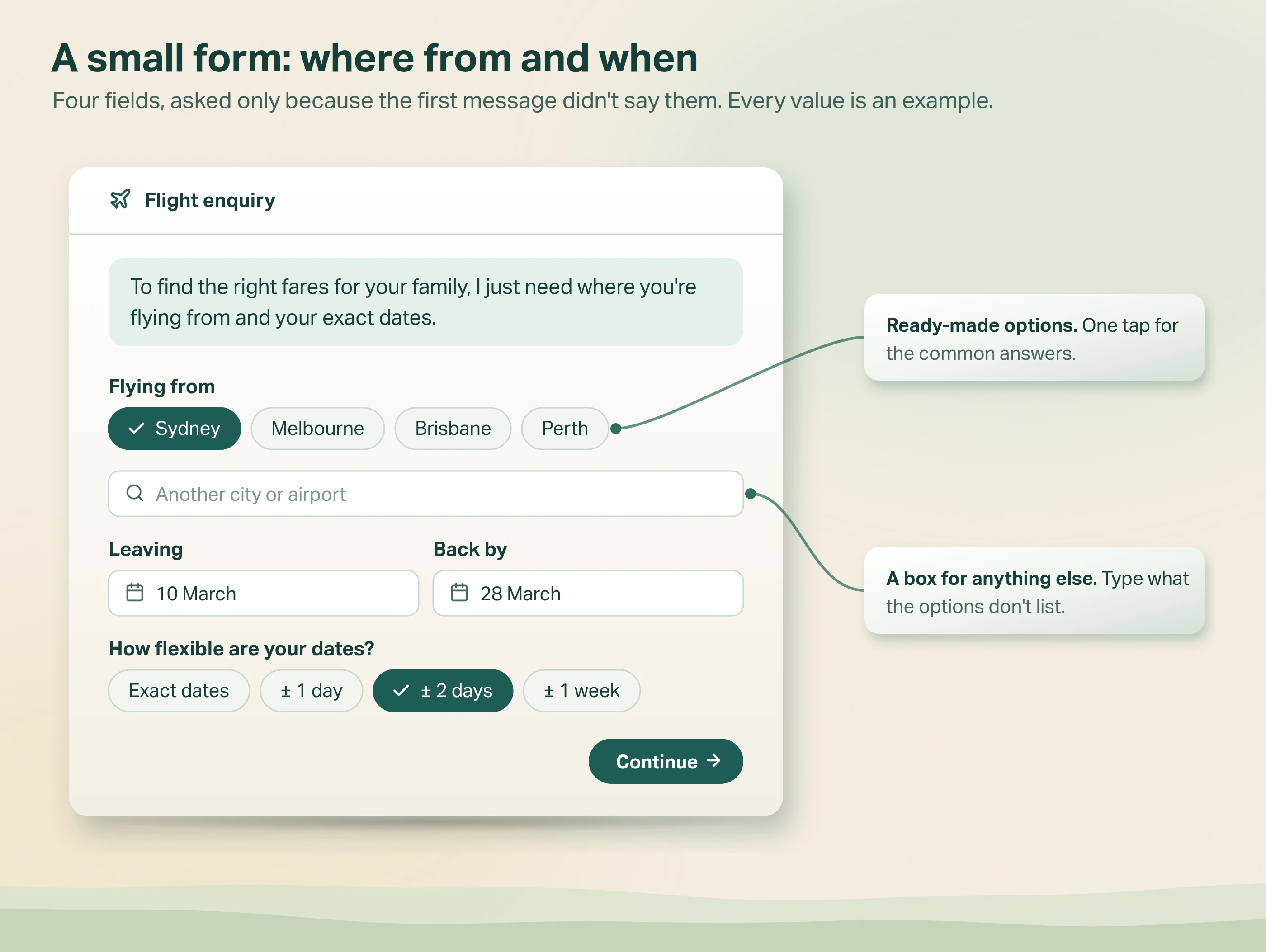
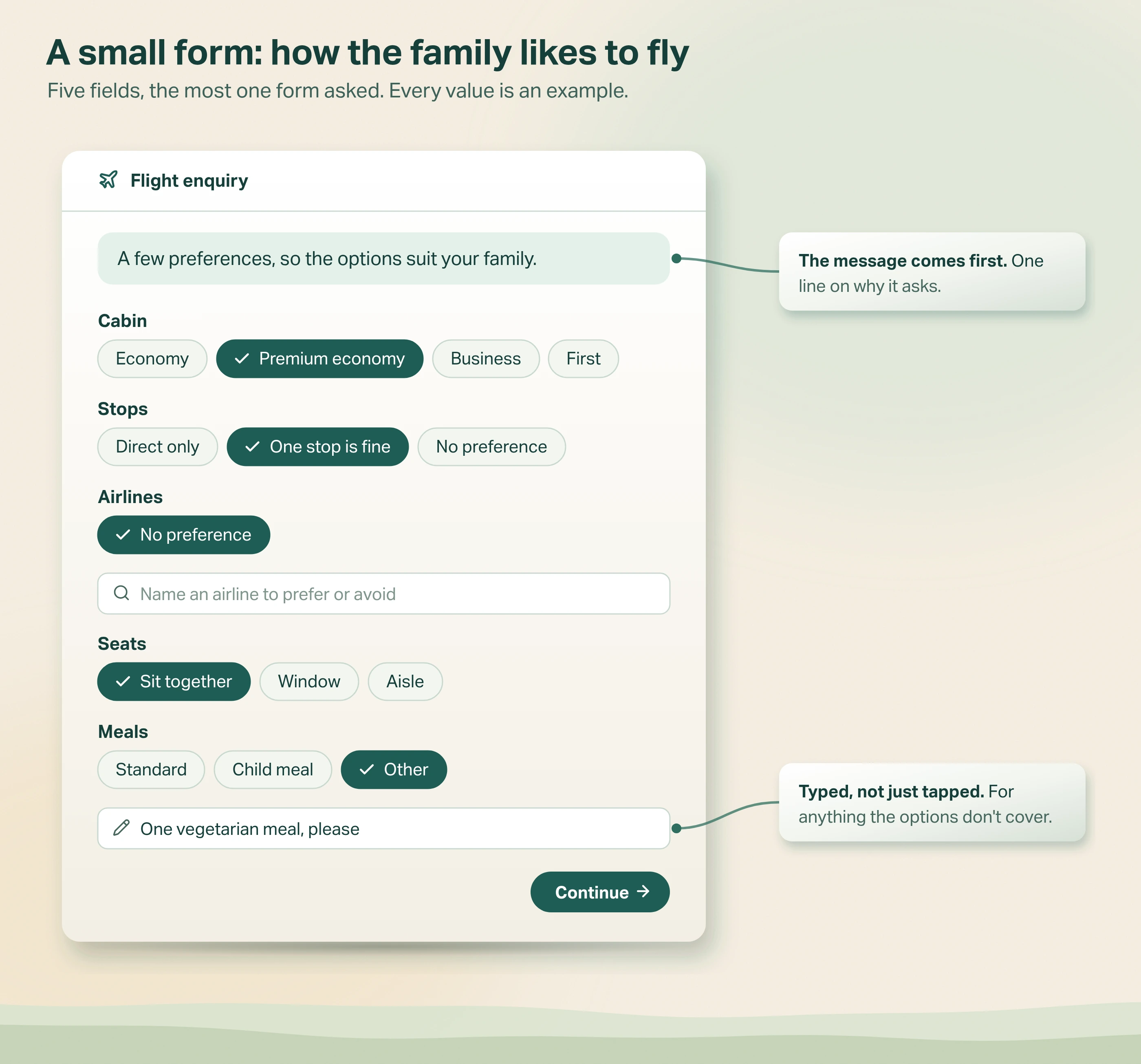
On the website, missing details came through small forms built for each trip, at most five fields at a time. A family trip might get a form for children's ages and seating; a business trip, one for cabin and preferred airlines. Most fields offered ready-made options to tap. Where those might not fit, there was also a box to type in.
Each form opened with a short line saying why it was needed. Structured fields gave clean data, with dates as dates and counts as numbers. The message kept it a conversation. Here are two example forms for the family above.
Quiet flight searches that shape the questions
While collecting details, the assistant searched for flights in the background, through Amadeus or Sabre. These are global distribution systems (GDS), the booking networks agencies use to search fares. If a route had no direct flights, asking "direct only?" wasn't useful. Asking how the customer felt about one stop was. If a search failed, it retried instead of showing an error.
At the end it showed up to three options: the cheapest, the fastest and the best airline. Three was enough to show real progress and let the customer signal what mattered most, without turning the assistant into a booking engine.
Contact details last
Contact details came last, once the customer had seen the assistant was useful. Asking only for what the enquiry needs is also good privacy practice. Australia's privacy rules, for example, say the organisations they cover should collect only the personal information they reasonably need (Australian Privacy Principle 3).
What stays with the consultant?
The assistant never booked anything. Building the final fare, advising on trade-offs and closing the sale all stayed with the consultant. Its job was narrower: when a consultant opened an enquiry, everything they needed was already there.
That narrow scope was deliberate. An assistant that only gathers and hands over is easier to trust, easier to test, and can't make an expensive booking mistake. If you later want it to act, decide first which steps need human approval. We drew the same line in our agency debit memo checks: the AI recommends, a person decides.
When is an AI assistant for travel agents not worth it?
This was one build, for one consultancy selling long-haul flights. Here is where we would be careful:
- Simple trips. If most of your enquiries are one adult, one way, a short form may be enough.
- Low volume. If consultants handle a few enquiries a day, the back-and-forth may not justify a build.
- Enquiries that arrive elsewhere. We built a website widget in one case and a voice agent in another. Email or messaging enquiries would need their own design.
- No field map yet. Without a clear list of what consultants need, the assistant can't know what's missing. Start there.
The bottom line
In our experience, much of the back-and-forth in a flight enquiry happens before a consultant can even search a fare. Two lessons stood out. The field library was the foundation. And reading the first message properly mattered more than any clever question.
Our guide to AI agent human approval covers which decisions should always wait for a person.
How many emails did your last ten enquiries take before a consultant could search a fare?
Spending more consultant time collecting details than advising? We'd be glad to compare notes on your enquiries.
See how we build AI agents for travel businesses
Get started: hello@avestalabs.ai
Frequently asked questions
- Can I use AI as a travel agent?
- For parts of an enquiry, in our experience. In our build, an AI assistant read the customer's message, asked for the missing details in short forms and ran flight searches in the background. What it handed over was a complete enquiry, not a booking. The work that needs a consultant's judgment started from there.
- How is AI being used in travel agencies?
- In our own work, mostly on the clerical steps before a person decides. We have written up two: this enquiry assistant, and a proof of concept that checks bookings for agency debit memo risks before tickets are issued. In the second, plain software ran most checks and the AI read only the cases that needed judgment. In both, a person decided. Treat them as examples, not a survey.
- Is there an AI tool specifically for travel agents?
- Yes, though many AI travel tools that show up in search are trip planners for travellers. A tool for agencies works for the agency, not the traveller. In our build, an AI assistant on Avesta AgentOS took flight enquiries, collected the missing details and handed a complete enquiry to a consultant. We built it for one consultancy, so we can't rank the off-the-shelf options.
- What should a travel agent enquiry form ask?
- Ask in small groups rather than all at once. In our build, each form had at most five fields and opened with one line saying why the details were needed. Only the groups this trip still needed were asked. Dates went into date fields and passenger counts into number fields, so the consultant got clean data.
- Should an AI assistant for travel agents book flights?
- Ours didn't: the consultancy's brief was that it never books. If you want an assistant that books, first list what a person would need to check before any booking, such as the fare, the names as they appear on passports, and the children's ages. Those checks are where an approval step belongs.
- What happens if the customer stops halfway through the chat?
- In our build, each completed form was saved straight away, so stopping halfway did not lose what the customer had already filled in. The catch: because contact details came last, a half-finished enquiry may have no way to reach the customer.
Share this article