What an AI-Native Product Team Looks Like
The roles, rituals and working model of a small team where agents produce and people decide.
 Vivek Satasiya8 min read
Key takeaways
- Three core roles: a product engineering lead, AI product engineers and an evals and quality engineer, working with your product owner and domain experts.
- Every engineer, juniors included, directs and reviews agents rather than writing most code by hand. The job is judgement, not typing.
- User focus is not optional. Google's DORA research found AI adoption can hurt team performance when teams lack a user-centric focus.
- Weekly rituals keep the team honest: acceptance-criteria sign-off, eval reviews, agent behaviour reviews and code health reviews, with daily releases.
- A good team plans its own exit: evals, architecture rules and context files are handed over so your team can carry on.
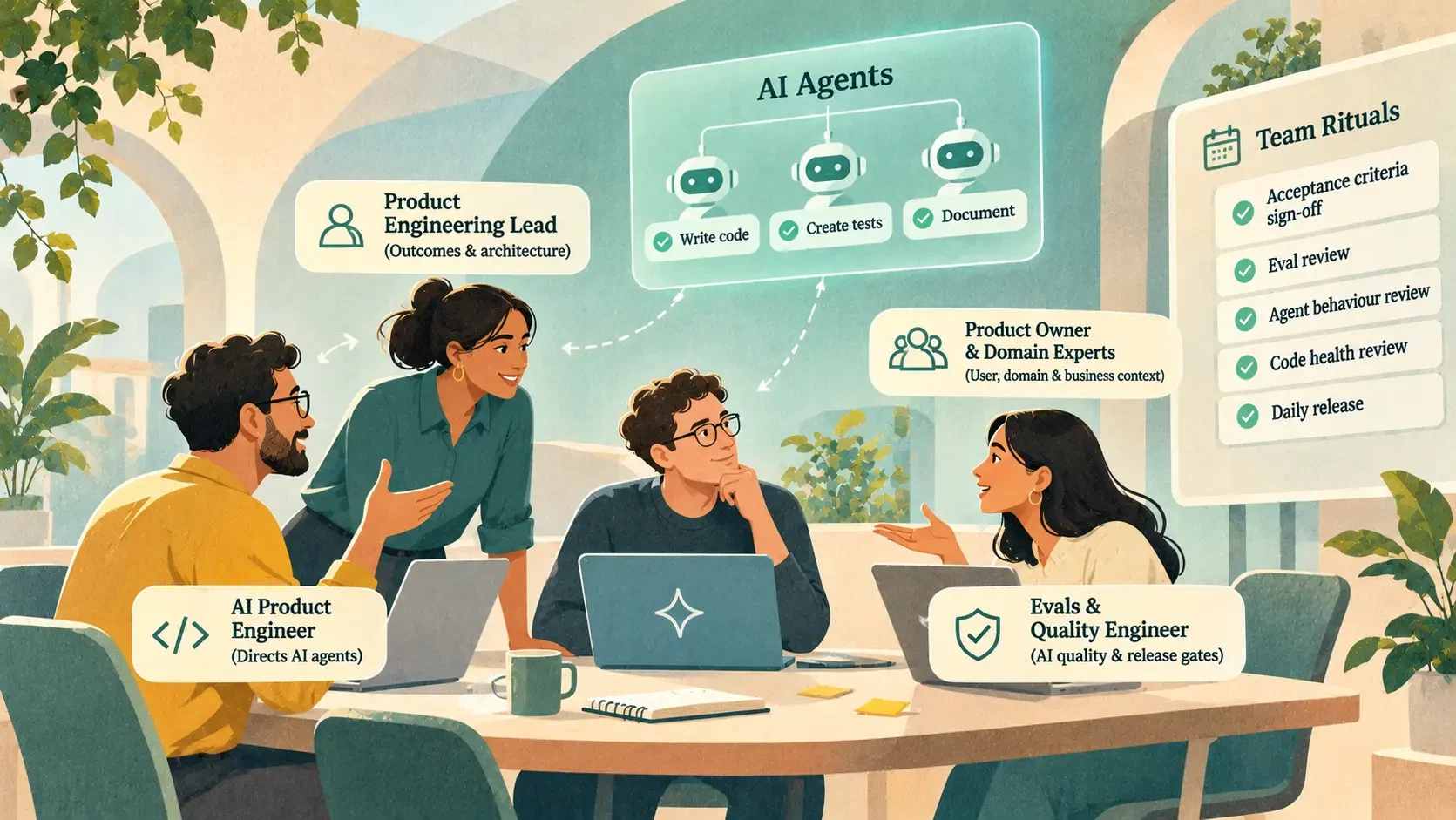
An AI-native product team is small and cross-functional: a product engineering lead who owns outcomes and architecture, AI product engineers who each direct groups of AI agents, and an engineer who owns evals and release quality. Agents write most of the code, tests and documentation. People decide what to build, sign off what "done" means, review what agents produce, and own every judgement call. The team works embedded with the client's product owner, in short cycles, with users at the centre.
This is how our own team at Avesta Labs has worked for about 18 months, building Avesta AgentOS and client products. Here's who does what, how the team fits alongside yours, and the rituals that keep it honest. For the two traits that make this work, product sense and production experience, see What Is AI-Native Product Engineering?
Why does team shape matter more for AI products?
In traditional software, a spec can travel from product to engineering to QA without losing much. In AI products it can't, because the right behaviour is discovered as you go. Every handoff loses the context of why a decision was made, and AI work is mostly those decisions. We cover how the team changes in our comparison with traditional product engineering.
Team shape also decides whether AI speeds you up in the right direction. Google's 2025 DORA AI Capabilities Model, drawn from a survey of almost 5,000 technology professionals, found that a strong user-centric focus amplifies the benefits of AI for team performance. Without it, AI adoption can make team performance worse. The same research found that working in small batches and using rollback freely help AI-assisted teams perform better.
That's the design brief for an AI-native team: small, close to users, shipping in small reversible steps.
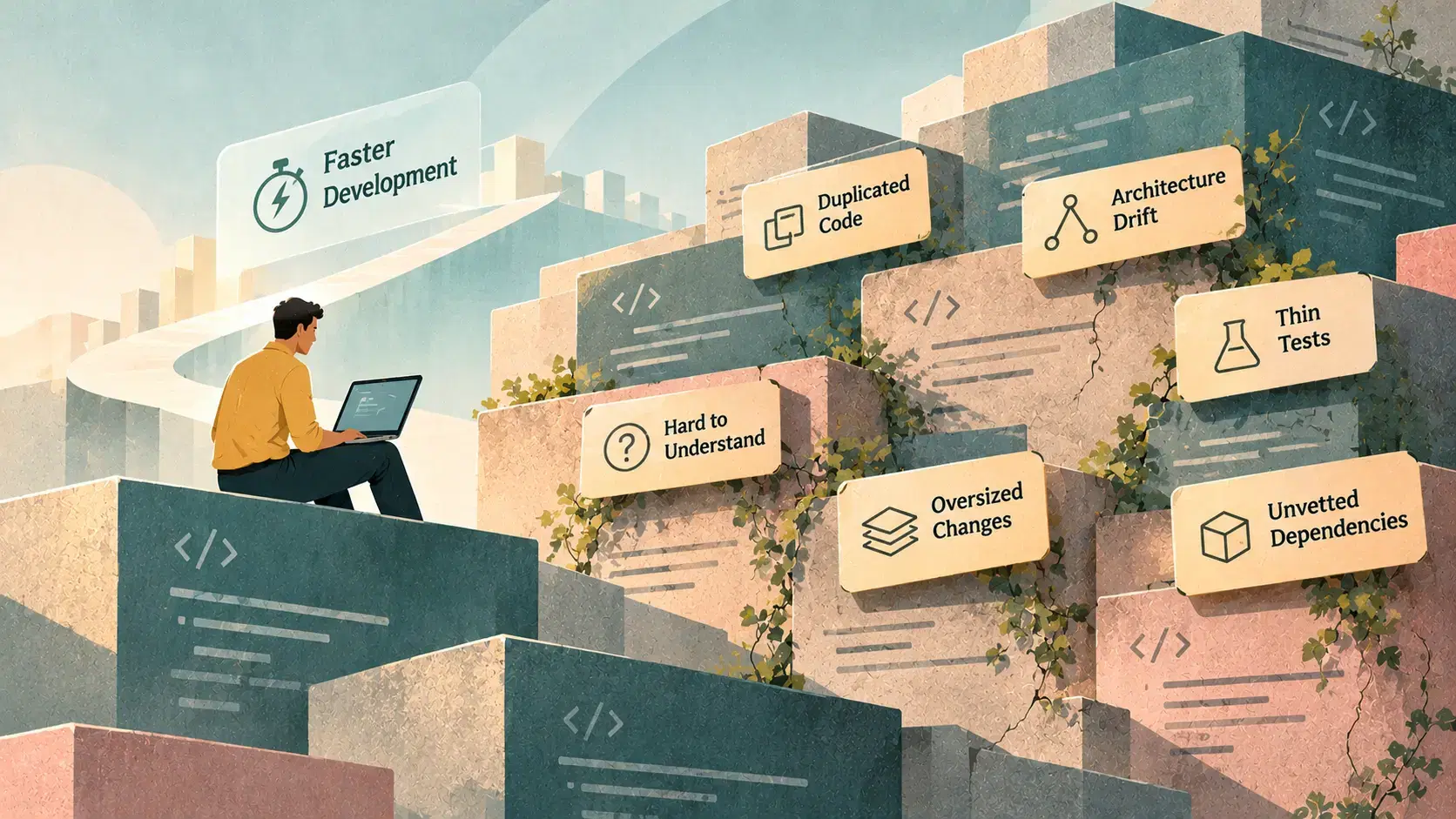
Without a focus on users, AI just helps a team move faster in the wrong direction.
Who is on an AI-native product team?
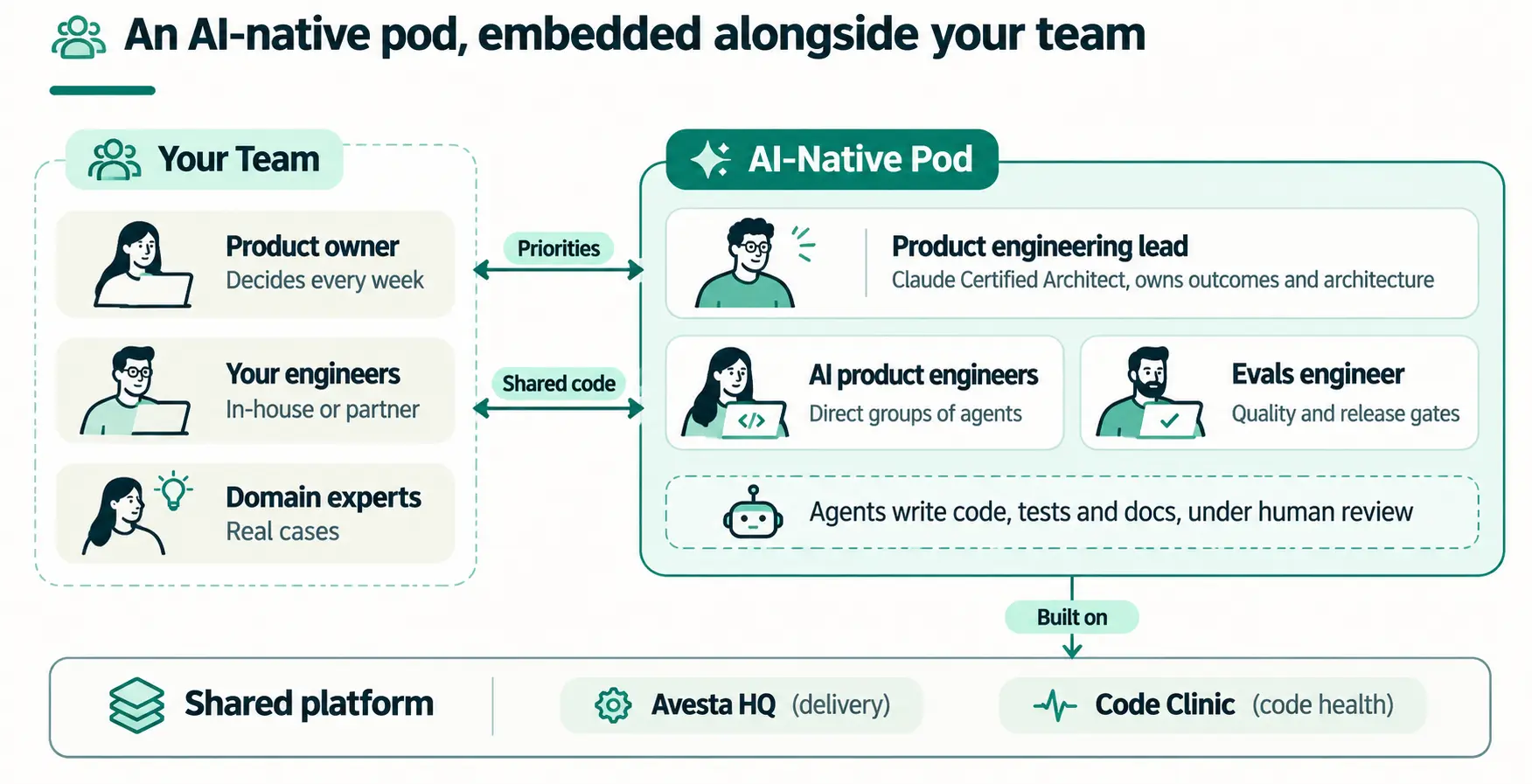
Product engineering lead. Owns the outcome, not just the delivery. They hold the architecture, make the product calls with your product owner, and decide what the agents should and shouldn't do. At Avesta Labs, this person is a Claude Certified Architect.
AI product engineers. Engineers who work across the whole stack and the AI stack: APIs and data, plus models, retrieval, agents and guardrails. Each one directs a group of agents that write code, tests and documentation, and reviews everything those agents produce. Their skill is keeping agents aligned with the architecture, the review standards and the tests, so the codebase doesn't drift from its intended structure.
Evals and quality engineer. Owns quality for AI behaviour. They build and grow the eval suite from real cases, run the release gates, and watch agent behaviour analytics in production. When a change makes agents worse on real cases, this person stops it. It's the same discipline we describe in writing evals from the first day.
On your side. A product owner who can make decisions every week, domain experts who supply real cases (including the messy ones), and your own engineers or outsourcing partner, who keep owning the systems the AI work connects to.
Who isn't on it by default. Data scientists and machine-learning platform engineers are essential when you train your own models. Most AI-native products today build on existing models with retrieval, agents and evals, and don't need them full time.
What do agents do, and what do people do?
| Work | Agents | People |
|---|---|---|
| Understanding users | Summarise interviews, tickets and conversations | Run discovery, name the motivations, anxieties and habits, decide what matters |
| Acceptance criteria and tests | Draft them from the requirement | Review every one and sign off before building starts |
| Writing code | Most of it, inside the agreed architecture | Set the architecture and conventions, review what agents produce |
| Evals | Help generate cases and run them | Choose the real cases, set the standard, decide when a release passes |
| Code health | Flag drift, duplication and debt | Decide what to refactor and when |
| Production | Trace runs and surface patterns | Read agent behaviour analytics, decide what to fix next |
The pattern is consistent: agents produce, people decide. That's why one engineer can now move as fast as a much larger traditional team, and why judgement, not typing speed, is the skill that matters.
Agents produce. People decide.
How does the team work with yours?
Embedded, not handed off. The team works on your stack, in your repositories and tools, with your product owner in the loop every week. There's no separate vendor backlog and no spec thrown over a wall.
The boundary with your own engineers or outsourcing partner is agreed upfront: who owns which services, who owns the interfaces between them, and whose tests decide whether a change is done. That boundary is what stops two teams from slowly pulling the architecture in different directions. It's the same boundary that makes a hybrid model work.
What are the team's rituals?
| Ritual | How often | What it's for |
|---|---|---|
| Discovery with users | Continuous | Understand motivations, problems, anxieties and habits before deciding what to build |
| Acceptance-criteria sign-off | Every piece of work | People review and approve what "done" means before agents build |
| Release to production | Daily | Small changes behind feature flags, easy to roll back |
| Eval review | Weekly | Which real cases got better or worse, and why |
| Agent behaviour review | Weekly | What users asked, where they rephrased or gave up, where agents fell short |
| Code health review | Weekly | Architecture drift, duplication and debt from Code Clinic; what to refactor |
| Outcome review with your product owner | Every few weeks | Are we moving the measure that matters, and what's next |
None of these are long meetings. Most are a short look at a dashboard and a decision. What matters is that they happen every time.
The agent behaviour review runs on agent behaviour analytics: the view of what users asked and how agents handled it that click analytics can't give you.
What skills matter most?
- Product sense. Knowing which job AI should do for the user, and designing for the habits and anxieties that stop people adopting something new. Our whole team is trained in Jobs-to-be-Done for this reason.
- Production experience with AI. Having built and run agents with real users, not just prototypes.
- Judgement in review. Spotting what's wrong in code and behaviour that look right.
- Architecture discipline. Keeping the structure clean when agents can add code faster than anyone can read it.
- Clear writing. Agents follow written context. Engineers who write clear intent, conventions and acceptance criteria get better work from them.
At Avesta Labs, more than ten of our engineers are Claude Certified Architects, and we're a Claude Select Services Partner and an OpenAI Select Partner.
How big should an AI-native product team be?
Small enough that everyone understands the whole product and talks to the product owner directly. Because agents do most of the building, a small team covers far more ground than it used to.
When the product grows, add another small team for a new product area rather than making one team bigger, and keep them on the same platform and architecture rules.
How does the team scale or hand over?
Scaling. Each new team owns a clear area of the product and shares the same platform, architecture rules in Code Clinic, and eval standards. That keeps several teams from drifting apart.
Handing over. A good team plans its exit from the start. What gets handed over:
- The eval suite, so your team knows immediately if a change makes things worse.
- The architecture rules, so drift is still caught after the handover.
- The context files and conventions agents work from, so your engineers can direct agents the same way.
- Runbooks for production issues, and a period of working side by side.
Where to start
Look at your current team and ask three questions:
- Does someone own the outcome, not just delivery?
- Does someone own evals and release quality?
- Does every engineer review agent output against agreed architecture and tests?
Any "no" is the gap to close first.
If you'd rather start with a team that already works this way, that's what the Avesta Labs product engineering pod is. Book a discovery call and we'll show you how it would fit alongside your team.
Sources
- Google Cloud, Introducing DORA's inaugural AI Capabilities Model, September 23, 2025
Frequently asked questions
- What roles are on an AI-native product team?
- Three core roles: a product engineering lead who owns outcomes and architecture, AI product engineers who direct and review AI agents, and an evals and quality engineer who owns AI quality and release gates. They work with the client's product owner and domain experts.
- How is an AI-native product team different from a traditional one?
- It's smaller and has no handoffs between product, engineering and QA. Agents write most of the code, tests and documentation, while people decide what to build, sign off acceptance criteria, review output and own the architecture.
- What do engineers do when AI agents write the code?
- They direct groups of agents, keep them aligned with the architecture and conventions, review everything they produce, and make the judgement calls agents shouldn't. Clear writing and review judgement matter more than typing speed.
- Does an AI-native product team need data scientists?
- Only if you're training your own models. Most AI-native products build on existing models with retrieval, agents and evals, where AI product engineers and an evals and quality engineer cover the work.
- How big should an AI-native product team be?
- Small enough that everyone understands the whole product and works with the product owner directly. As the product grows, add another small team for a new area rather than enlarging one team.
- What should be handed over at the end of an engagement?
- The eval suite, the architecture rules, the context files and conventions agents work from, and runbooks for production issues, plus a period of working side by side so your team can carry on.
Share this article