AI Agent Cost for Manufacturers: Running Cost and ROI
Work out what an agent will cost you, and what it pays back, from your own order volume.
 Kishan Chandravadia8 min read
Key takeaways
- AI agent cost has three parts: a one-time build cost, a monthly running cost, and your own people's time on exceptions and checks. Vendor quotes usually show only the first two.
- On the cheapest model, model usage can be a small part of the running cost. As of November 2026, the same order can cost about 20 times more on Claude Sonnet 5.5 than on Claude Haiku 5.5.
- Work out ROI from hours freed on the order desk: orders a month, times minutes per order, times the share the agent completes on its own.
- The most you should pay for a build is your net monthly saving times the payback period you will accept.
- If you take fewer orders than one person can comfortably handle, or every order is different, an AI agent is probably not worth the cost yet.
It's 9 pm and forty dealer messages are waiting. Your order desk went home at seven. Tomorrow morning, two people will use the first hours of their day to type yesterday's orders into the ERP (the system that holds your stock and orders).
So you search for how much an AI agent costs.
Here, an AI agent means software that reads each dealer's message, checks your stock and places the order in the ERP itself. The price guides you find give answers that are miles apart, and none of them knows how many orders you take.
What is the real AI agent cost for a manufacturer?
AI agent cost for a manufacturer has three parts. There's a one-time build cost: rules, the ERP connection, testing and rollout. There's a monthly running cost: model usage, messages, hosting and support. And there's your own people's time on exceptions (the orders the agent passes to a person) and checks. Judge the total against the hours it frees on your order desk.
Cost is what you pay plus the time your team still puts in. Return is the hours the agent gives back.
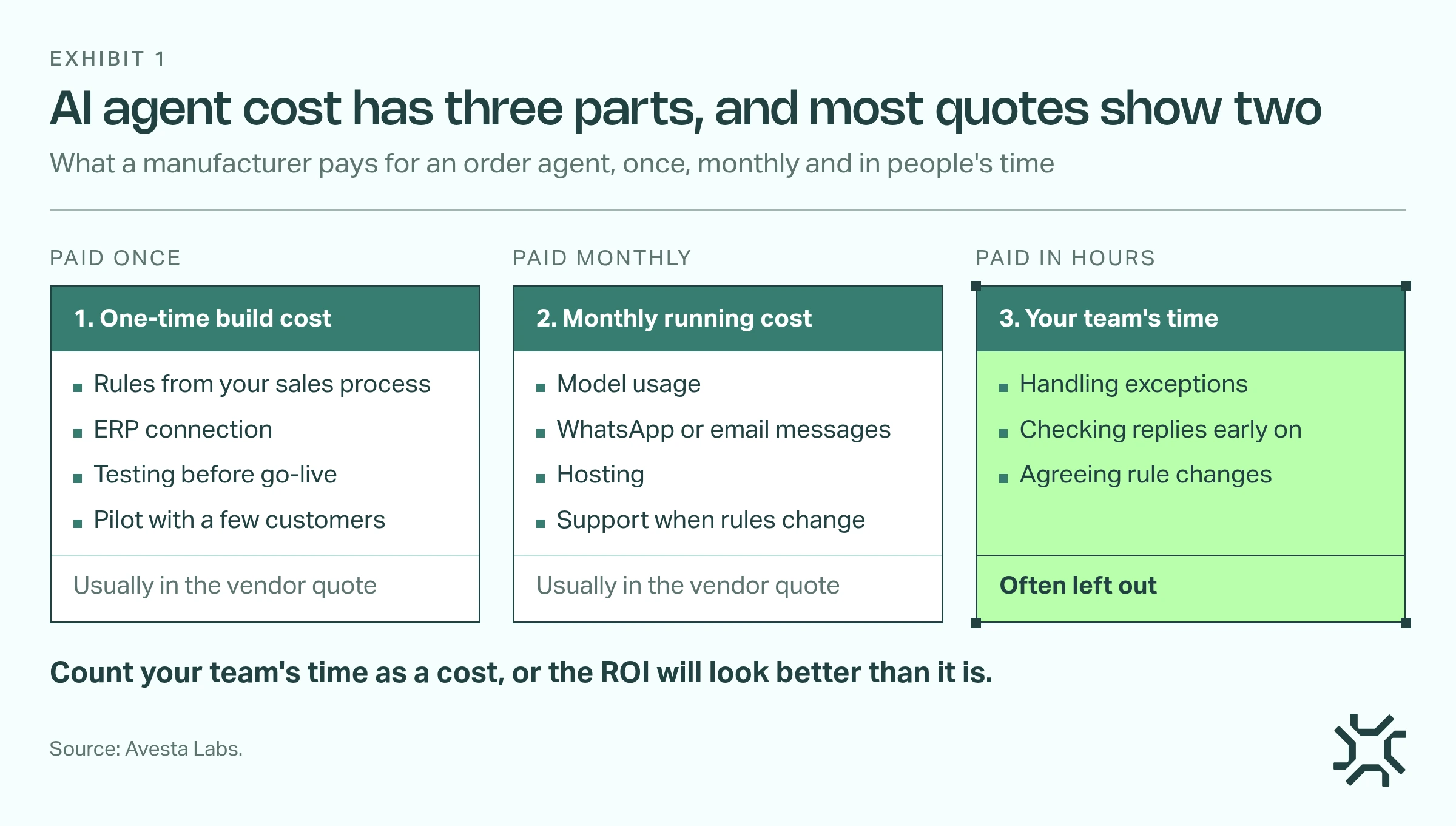
Vendor quotes usually show the build cost and the running cost, and leave out your team's time.
What goes into the build cost?
The build cost is mostly people's time: the vendor's and yours. The table shows where it goes, and what drives it up.
| Cost line | What it pays for | What makes it bigger |
|---|---|---|
| Rules | Writing down how your team decides: customer types, stock rules, when to pass an order to a person | Rules that live only in senior people's heads |
| ERP connection | Letting the agent read stock and place orders safely | An older ERP with no ready connection, or custom fields |
| Testing | Realistic test orders run on a copy of your ERP before any customer sees the agent | Many product types, lots or price lists |
| Pilot and rollout | A few trusted customers first, with your team watching | Many channels at once (WhatsApp, email, phone) |
Testing is the easiest line to cut from a quote to make it look cheaper. It is also the line that decides whether your team will trust the agent. We cover what good testing looks like in our post on WhatsApp order automation.
How much does an AI agent cost to run per month?
The running cost is what you pay per month once the agent is live. For an order agent, it has three lines. Your team's hours sit outside them: people still handle credit holds, custom items and changes to placed orders, and early on they read a sample of replies.
1. Model usage
You pay for the AI model by tokens, the small pieces of text it reads and writes. As of November 2026, Anthropic's price list charges $0.10 per million input tokens for Claude Haiku 5.5, its cheapest model, for prompts up to 100,000 tokens.
Claude Sonnet 5.5, a higher-performance model, costs $2 for the same million input tokens. Output costs $0.50 per million on Haiku and $10 on Sonnet.
In this made-up example, one order takes 40,000 tokens in and 2,000 out across the whole chat. That is about half a US cent per order on Haiku and about 10 cents on Sonnet. At 10,000 orders a month, that's roughly $50 against $1,000.
Test whether the cheaper model handles your orders before paying for the more capable one.
Our post on cutting AI costs with smart prompt design covers more ways to bring this line down.
2. Messages
If dealers order on WhatsApp, Meta charges per message delivered. Meta's pricing says it does not charge for messages from customers to businesses.
Each business number gets 1,000 free replies to customer messages (Meta calls them service messages) a month, and Meta charges from the 1,001st.
From 1 October 2026, utility messages such as order confirmations are charged even inside the customer service window, the 24 hours after a customer messages you. Check Meta's rate card for India before you budget.
3. Hosting and support
Hosting, monitoring and fixes when your rules, products or ERP change. Ask the vendor what is included, and what a rule change costs.
How do you work out AI agent ROI for your order desk?
AI agent ROI (return on investment) comes from the hours the agent gives back, minus everything it costs. Most of the numbers come from your own records. The share the agent completes comes from the pilot, and the running cost from the quote. The numbers below are a made-up example; yours will differ.
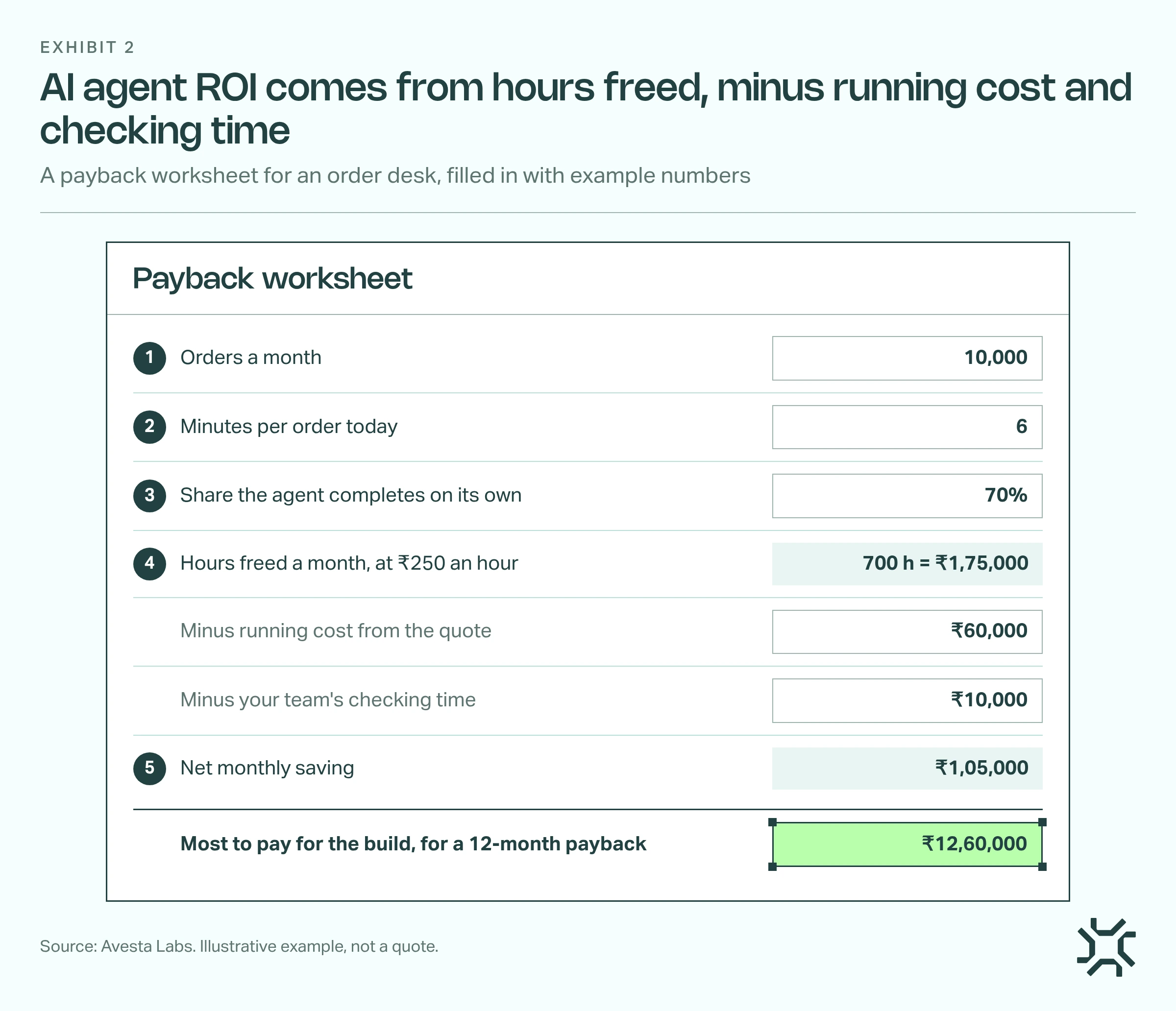
- Orders a month. Count them from the ERP: 10,000 in this example.
- Minutes per order today. Time the whole job, from reading the message to sending the order number back: 6 minutes.
- Share the agent completes on its own. Use the pilot's real figure, not the vendor's hope: 70%.
- Hours freed and their value. 10,000 × 70% × 6 minutes is 700 hours. At ₹250 an hour, your own cost of order-desk time, that is ₹1,75,000 a month.
- Net monthly saving. Subtract the running cost from the quote (₹60,000 here, assuming the cheaper model) and your team's checking time (₹10,000). That leaves ₹1,05,000.
Then set your own limit. The most you should pay for the build is your net monthly saving times the payback period you will accept. For a 12-month payback here, that is ₹12,60,000.
Orders taken at night or on Sundays may add sales you'd otherwise lose. Count them only if you can measure them.
What we learned about cost running an order agent in Avesta AgentOS
We built and run an order agent for a textile manufacturer in India on Avesta AgentOS. Before it, the team watched about 1,000 dealer WhatsApp groups by hand.
Since going live on 21 September 2026, it has handled 500–1,000 orders a day (as of October 2026), and a person still handles every exception.
It took 5–6 weeks from start to production. Three cost lessons from that build:
- Cost per order is not flat. The agent checks stock for each item, so a 15-line order uses many times the model work of a one-line order. Budget from your real mix of orders, not an average message.
- Your IT team's time is part of the build. Going live needed the manufacturer's own team to grant ERP access and install a small ERP add-on. Put a named person on your side in the plan, or the last week slips.
- Testing never stops. Every change to the agent is replayed in Avesta AgentOS on its 147 test scenarios before it reaches a dealer. That re-testing is an ongoing cost, so ask who pays for it after go-live.
When is an AI agent not worth the cost?
An AI agent is not worth it when the work is too small or too varied to pay back.
- Low volume. If one person handles your orders comfortably in part of their day, the saving won't cover the build.
- Every order is a project. Custom quotes, drawings or negotiation need a person. Help that person instead.
- Your ERP data is unreliable. If stock in the system is often wrong, fix that first. An agent will repeat the errors faster.
- No one will own it. Without someone on your side to answer questions and check early replies, the pilot stalls.
The bottom line
A quote only means something next to your own numbers. If the worksheet shows no payback at your order volume, wait until the volume grows.
For what a person should still approve once the agent is live, read AI agent human approval.
Is your net monthly saving, times the payback you'd accept, more than the quote on your desk?
Want to see the payback on your own orders before you commit? Our AI Kickoff is a 3-day discovery workshop and a 4-week pilot build. It ends in a production plan. See what agents do for manufacturers on our manufacturing page.
Get started: hello@avestalabs.ai
Frequently asked questions
- How much should an AI agent cost?
- There is no fair single number, because the cost follows your order volume, your ERP and your rules. Compare quotes on the same basis instead: the build, the running cost at your monthly volume, and what support includes after go-live.
- Does it cost money to run an AI agent?
- Yes, every month, and the cost moves with your volume. Ask any vendor for a cost per order at your volume and your mix of order sizes, not a flat monthly figure. A long order costs more to process than a one-line one, so a flat figure hides what your real mix of orders will cost.
- How much would it cost to run 5 AI agents?
- Often less than five times one agent. The connection to your ERP, the hosting and the testing setup are shared, so each new agent mainly adds its own rules, tests and model usage. Price each agent on its own payback, and start with the one that frees the most hours.
- Can you buy an AI agent?
- You can buy general chat tools off the shelf, but an agent that places orders in your ERP has to follow your rules: your customer types, your stock and your approval limits. That part is always built or set up for your business, even on a ready-made platform. Ask any vendor how long that setup takes.
Share this article