
AI Receptionist for Dental Clinics: Answer Patient Questions
Patient questions piling up while the dentist is busy? Start with the written ones, answered from your own website and documents.
 Dhruvin Khant6 min read
Key takeaways
- Many written patient questions, about treatments, preparing for a visit, after-care and fees, are already answered on a dental clinic's own website and documents.
- An AI receptionist for dental clinics should answer only from the clinic's own pages and documents, and show the page each answer came from.
- Pain, swelling, medication and anything about a patient's own mouth is left to the dentist, not the AI receptionist.
- Written questions are a safer first step than the phone: the patient can read the answer again and check the page behind it.
An AI receptionist for a dental clinic is software that answers patients' questions for the front desk. It doesn't have to start on the phone, even though most of the ones you'll find online are voice systems that answer calls and book appointments.
The easier place to start is the questions patients type in a chat on your website or on WhatsApp. "Do you do clear aligners?" "Roughly what does a check-up and clean cost?"
The answers are already on your website or in a document. Today the front desk types them out between check-ins, while the dentist is in surgery.
What is an AI receptionist for dental clinics, and what can it answer?
An AI receptionist for dental clinics answers patients' written questions only from the clinic's own website pages and documents. That covers treatments you offer, preparing for a visit, after-care, practical details and published fee ranges. It should show the page each answer came from. Pain, swelling, medication and anything about a patient's own mouth is left to the dentist.
The AI receptionist answers questions about your clinic, never questions about a patient's mouth.
Which patient questions can an AI receptionist answer safely?
Most written questions fall into a few kinds. Some are answered on a page you have already written. Others need a dentist, the front desk or your booking system.
| Kind of question | Example | Where the answer is | Who should answer |
|---|---|---|---|
| Treatments you offer | "Do you do clear aligners?" | Treatment pages | AI receptionist |
| Preparing for a visit | "Can I eat before my extraction?" | Pre-appointment document | AI receptionist |
| After-care | "When can I brush after a filling?" | After-care document | AI receptionist |
| Fees | "Roughly what does a check-up and clean cost?" | Published fee guide | AI receptionist gives the range; an exact quote needs an exam |
| Practical details | "Is there parking, and do you take my health fund?" | Contact and payments pages | AI receptionist |
| Appointments | "Can I move Thursday's appointment?" | Booking system | Front desk or online booking |
| Symptoms and medication | "My face is swollen. Is that normal?" | The patient's own mouth | Dentist, or urgent care |
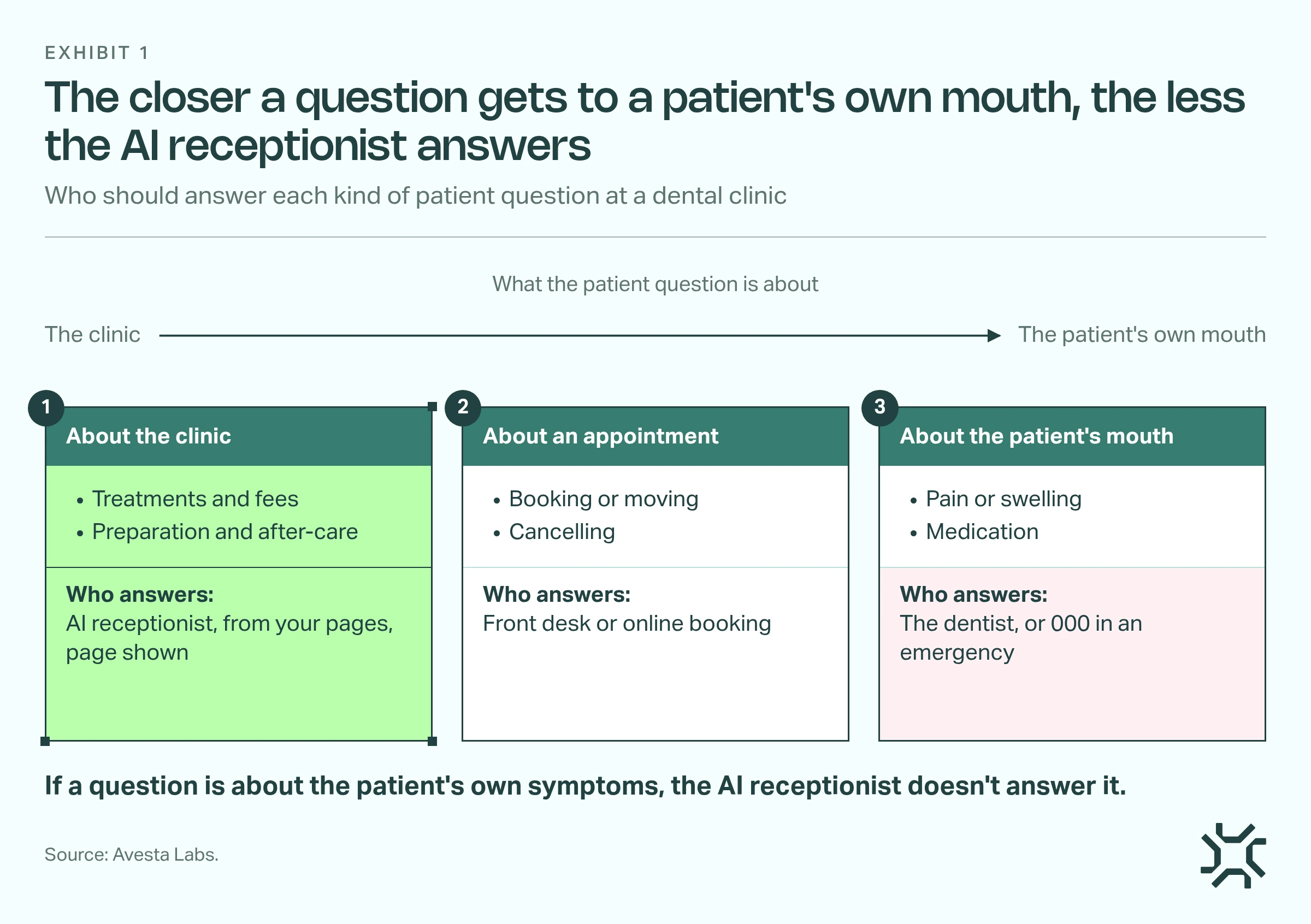
- About the clinic: the first five rows. Each is answered on a page you have already written.
- About an appointment: these need your booking system or the front desk.
- About the patient's own mouth: the last row, where a wrong answer can hurt someone. A question that depends on the patient's own treatment, even an after-care one, belongs here too.
When a patient may need urgent care
healthdirect is the Australian government's health information service. It says to get emergency care if toothache or gum swelling causes "problems with breathing", "problems with speaking", or "swelling around your eye or neck". An AI receptionist should never try to judge which of these a patient has. Set it to tell them to call the clinic, or 000, Australia's emergency number.
When your pages don't have the answer
The reply should say so plainly: "That isn't on our website. Please call the clinic." It's the same idea as teaching AI to say "I don't know".
Why should an AI receptionist answer only from your clinic's own pages?
A general-purpose AI tool answers from what it learned on the internet. It doesn't know which treatments you offer, what your after-care document says or what you charge.
Asked about your clinic, it fills the gaps with what clinics usually do.
For an Australian practice, that runs into the rules on what a dentist may say in public. Ahpra (the national regulator for dentists and other health practitioners) says in its advertising guidelines: "Advertisers must not make false, misleading or deceptive claims". Advertising must also not "create an unreasonable expectation of beneficial treatment". The guidelines count websites as advertising.
Treat every AI receptionist reply as if it were printed on your website, because patients will read it that way.
Answering only from pages your clinic has already approved keeps the AI receptionist inside what you already say in public.
It should also ask for no more than it needs. The Office of the Australian Information Commissioner's guide for health service providers says that, with patients' consent, you can collect health information "when it is reasonably necessary for your activities". A question about parking doesn't need a medical history.
How we built an AI receptionist in Avesta AgentOS with IngestIQ
We have built this kind of AI receptionist for a dental clinic. Patients were asking about treatments and quotes while the dentist was busy. The AI receptionist leaves serious cases to the dentist.
It answers written questions only. Patients type them in a chat box on the clinic's website, and the same assistant can sit in WhatsApp too. It does not answer the phone.
It isn't trained on the clinic's pages. It looks the answer up each time, the way a new receptionist checks the after-care document before replying.
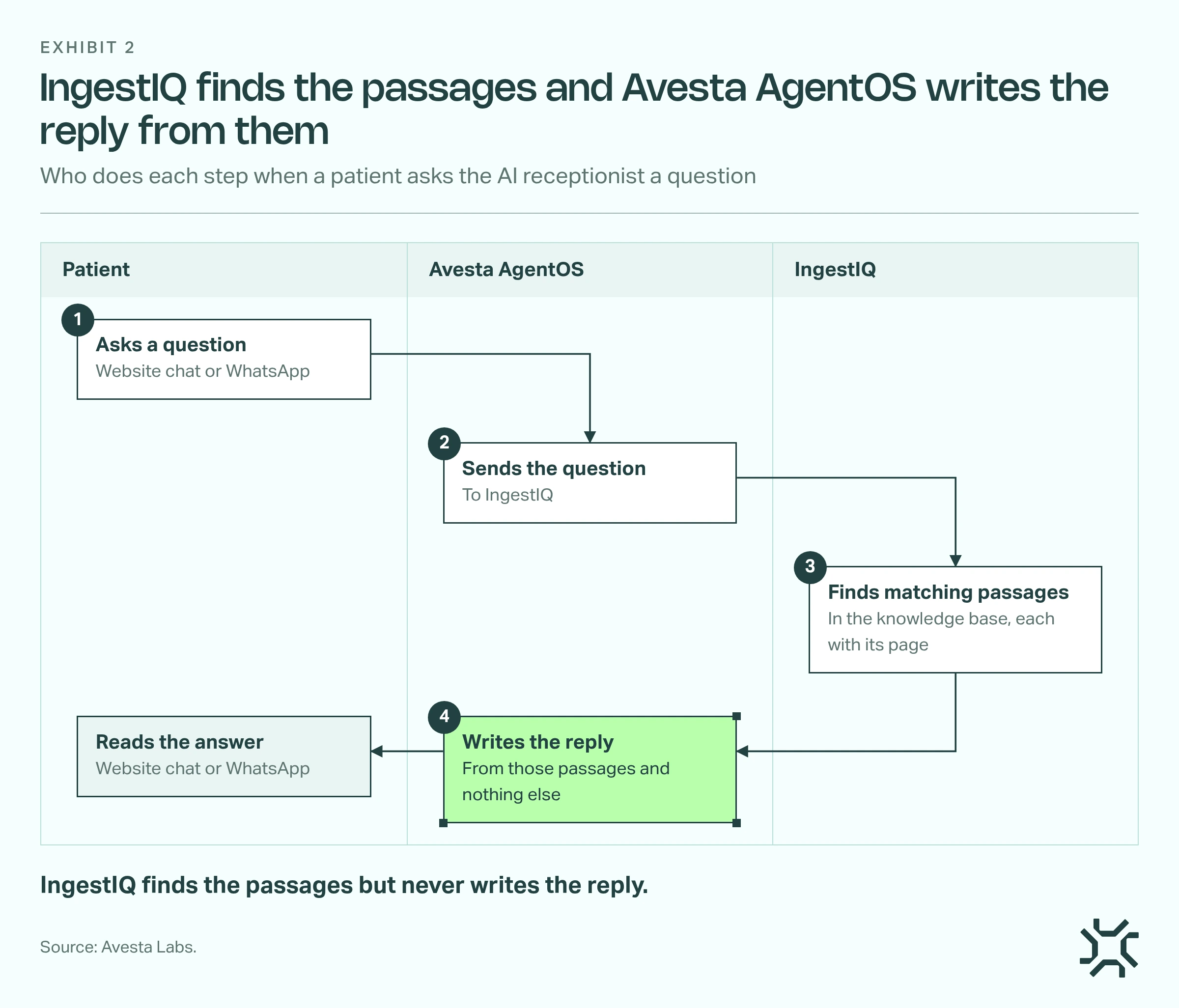
- The patient asks a question in the chat on the clinic's website, or on WhatsApp.
- Avesta AgentOS, our platform for running AI agents, sends the question to IngestIQ.
- IngestIQ searches the clinic's knowledge base (a searchable store of the clinic's own pages and documents) and returns the passages that best match, each with its page. It doesn't write the reply.
- Avesta AgentOS writes the reply. We set it up to use those passages and nothing else.
Treatment pages and documents go in, nothing else
IngestIQ can read the clinic's website pages and its PDF documents. When a PDF is added, an AI model that can see the pages cuts it into passages, so a fee table stays whole with its headings. That happens once, at upload, not when a patient asks.
When a document changes, delete the old one so its passages go too, and add the new one.
Every passage keeps its page
Each passage keeps where it came from: the document and page number, or the web address. So a reply about after-care can point to the after-care document, and the front desk can check it in seconds. It's the same approach we used for the India Avenue investor assistant, which answers only from the fund's own documents.
When is an AI receptionist the wrong first step for a clinic?
Four signs to wait:
- You get a handful of written questions a week. A clear FAQ page answers them for less.
- Your website and documents disagree. If the fee guide says one thing and a treatment page another, fix that first. The AI receptionist will repeat whichever it finds.
- Most messages are about bookings. An online booking system is the better buy.
- Nobody answers when patients call. If "please call the clinic" leads to a phone that rings out, the patient is worse off than with a simple contact form.
If it's the phone itself that overwhelms the front desk, a voice system is a different project with its own testing. Read how we test voice agents before you buy one.
The bottom line
Start where the answers already exist and the risk is lowest. Your inbox already shows which questions those are. A few weeks of written questions, answered from pages you have approved, also shows you which questions a phone system would really need to handle. For a business with a similar inbox, see the AI travel assistant we built for tour operators.
How many of your last 30 patient emails were already answered on your website, how many were about a booking, and how many needed a dentist?
Want an AI receptionist that answers patients from your own pages, and leaves the clinical questions to your dentists?
See how we start with an AI Kickoff.
Get started: hello@avestalabs.ai
Frequently asked questions
- Can a dental chatbot on my website book appointments?
- Some can, but the AI receptionist described here doesn't. Booking needs live availability and the patient's details, so keep it in your online booking system or with the front desk. Let the AI receptionist answer questions about the clinic, and point patients who are ready to book to the booking page.
- Can an AI dental receptionist give a quote for treatment?
- It can share the fee ranges your clinic already publishes, such as a typical range for a check-up and clean. It shouldn't quote for a particular patient's treatment. That needs an examination, and the dentist is the one who decides what is needed. A good reply gives the published range and suggests an appointment.
- Does an AI receptionist need patients' health details?
- Not to answer questions about the clinic. Questions about treatments, preparation, after-care and fees don't need a name or a medical history. Set it up to ask for as little as possible, and to suggest the patient calls the clinic when a question is really about their own health.
- Will an AI receptionist replace my front desk?
- No. It takes the repeat written questions so the front desk can look after the patients in front of them and the calls that need a person. Check-ins, bookings, payments, worried patients and anything clinical stay with your team and your dentists.
Share this article