AI Travel Assistant: Answers Straight From Your Brochure
Are travellers asking what's already in your brochure? An AI travel assistant can answer from it, and show them the page.
 Dhruvin Khant7 min read
Key takeaways
- Many questions travellers send a tour operator are already answered in its brochures, itinerary PDFs and tour pages.
- A useful AI travel assistant answers only from that material, and shows the brochure page or web page it used.
- Bookings, prices, health and entry rules such as visas should go to a person, not the assistant.
- The assistant is only as current as the documents behind it, so remove last season's brochures before it can quote them.
A tour brochure answers questions before anyone asks them. Lunch on day four, the walking each day, the difference between the 10-day and the 14-day tour: it's all printed. Travellers still write in to ask.
Each reply takes a person away from travellers who are ready to book. An AI travel assistant can answer these questions at any hour.
There's a catch. One that hasn't read your brochure will guess what tours usually include, and a guess about your tour is often wrong.
What is an AI travel assistant, and what should it answer?
An AI travel assistant answers travellers' questions only from your own brochures, itinerary PDFs and tour pages. It shows the brochure page or web page each answer came from. Questions about bookings, prices, health or entry rules such as visas go to a person. So does any question your material doesn't answer.
If it isn't in your brochure, your assistant doesn't say it.
What do travellers ask that your brochure already answers?
Traveller questions fall into a few kinds. Some have their answer on a page you've already written. Others need a person or your booking system.
| Kind of question | Example | Where the answer is | Who should answer |
|---|---|---|---|
| What's included | "Is lunch included on day four?" | Day-by-day itinerary | Assistant |
| Fitness and walking | "How much walking is there each day?" | Trip grade or activity notes | Assistant; a person if a health condition is mentioned |
| Comparing tours | "What's the difference between the 10-day and 14-day tour?" | Tour pages or brochure | Assistant |
| Getting ready | "What should I pack?" | Packing list or FAQ page | Assistant |
| Dates and seats | "Are there two seats left on 3 March?" | Booking system, not the brochure | A person or the booking system |
| Prices | "What would it cost for four of us?" | Your price list and rules | A person |
| Health and entry rules | "Do I need a visa?" or "Can I go after knee surgery?" | Official sources and the traveller's doctor | A person |
The first four rows are where an assistant saves time. The last three are where a wrong answer costs the most.
Why does a general chatbot get tour questions wrong?
A general-purpose chatbot answers from what it learned on the internet. It has never seen your brochure. Two things follow:
- It doesn't know your tour. "Lunch is usually included" is not the same as "lunch is included on day four of this tour".
- There's no page to check. Neither the traveller nor your team can see where the answer came from.
An assistant built on your own brochures fixes both, if the brochures go in with care. Two problems appear when they don't:
- Itineraries live in tables. If a day-by-day table is cut in the wrong place, a meal or a hotel ends up attached to the wrong day.
- Old brochures stay around. Last season's PDF can answer this season's question with last season's hotel.
In Australia, the consumer regulator says information a business gives about its services must be "accurate, truthful and based on reasonable grounds". A reply on your website comes from your business, whoever typed it.
Treat every assistant reply as if your own staff had written it.
How does an AI travel assistant answer from your own brochures?
The assistant doesn't need to "learn" your brochures. It looks them up each time, the way a new staff member would flip to the right page.
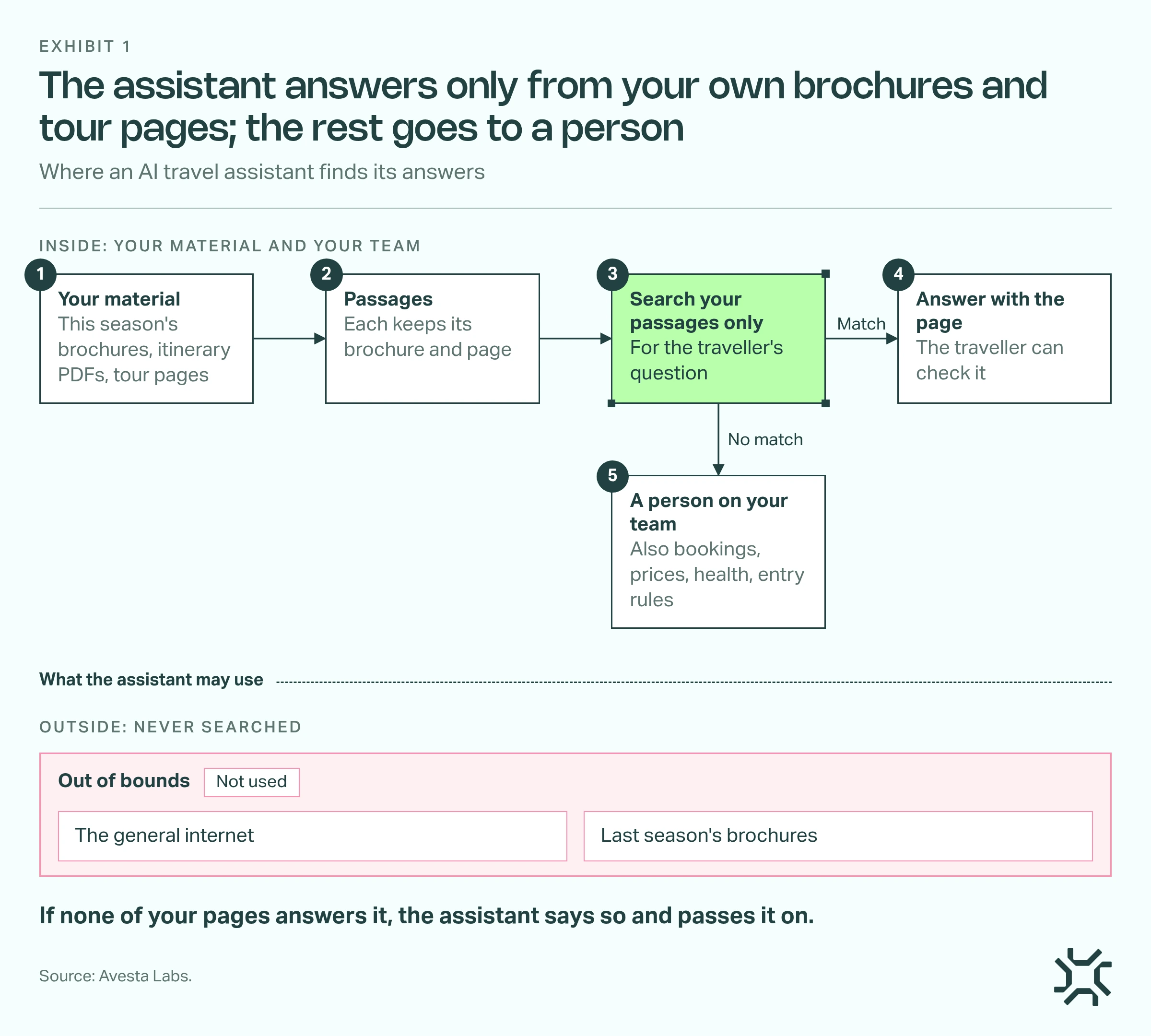
- Your material goes in. This season's brochures, itinerary PDFs and tour pages are added to the assistant's knowledge base: the set of documents it is allowed to search. Nothing else is.
- Each document is split into passages. Each passage keeps where it came from: the brochure and page, or the web address.
- A traveller asks a question. The assistant searches only your passages for the ones closest to the question.
- It answers from those passages and shows the page. The traveller can open the brochure page to check.
- Everything else goes to a person. That means no matching passage, or a question about bookings, prices, health or entry rules. A clear "I'll pass you to our team" beats a confident guess, as we argue in why your AI's most valuable answer isn't yes.
How IngestIQ and Avesta AgentOS answer from your brochures
We have built this kind of assistant for a tour operator whose answers sat in brochures, PDFs and web pages. Two of our products split the work:
- IngestIQ prepares your material. It turns brochures, PDFs and tour pages into passages in a knowledge base.
- IngestIQ finds the passages. When a traveller asks, it returns the passages that best match the question. It doesn't write the answer.
- Avesta AgentOS writes the reply. It takes the question and those passages, answers only from them and shows the page.
It's the same idea behind the India Avenue investor assistant, which answers only from the fund's own documents. Here is what IngestIQ does to brochures along the way.
1. At upload, it reads each PDF the way a person sees it
Brochures are designed to be looked at, with tables, columns and maps. When you add a PDF, IngestIQ uses an AI model that can see the pages to cut it into passages, rather than just pulling out the text. This happens once, at upload, not when a traveller asks.
By default it keeps each table whole with its headings, so day four's meals stay with day four. It also turns charts into small tables, so the facts in them can be found later.
2. It keeps the page with every PDF passage
A passage from a PDF keeps its document name and page number. A passage from a web page keeps its address. So a reply can end with the brochure and page, as in this made-up example, and your team can check it in seconds.
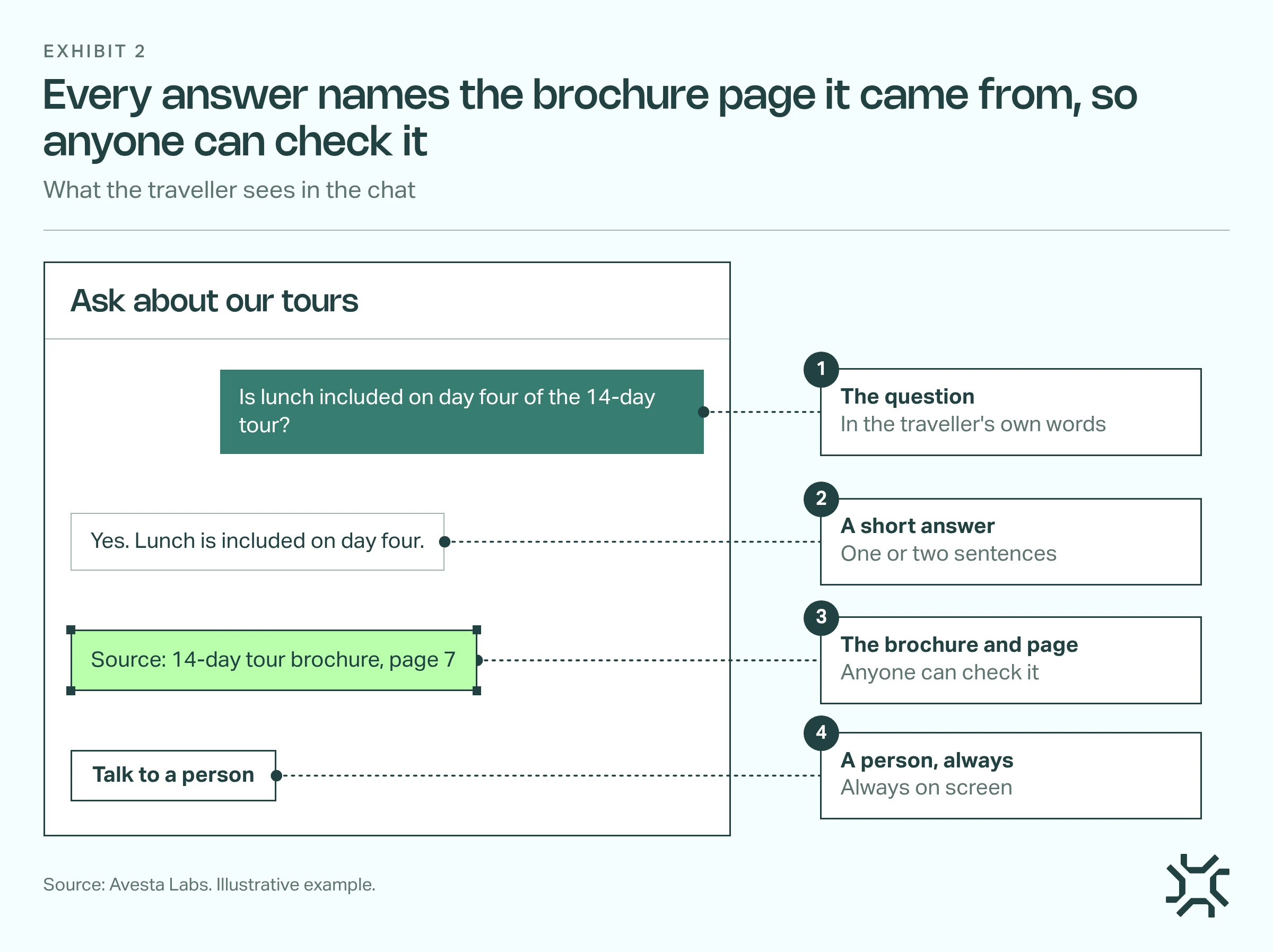
- The traveller asks one question in their own words.
- The reply answers it in one or two sentences.
- The source line names the brochure and the page, so anyone can check it.
- A way to reach a person is always on screen.
3. It can stay in step with your brochure folder
Keep a separate knowledge base for customer-facing material, with this season's brochures only. If those brochures live in a Google Drive or SharePoint folder, IngestIQ can sync it on a schedule. New and edited files are processed, and files deleted from the folder are removed from the knowledge base.
Website pages work differently. IngestIQ can add new pages from your sitemap (the list of pages your website publishes for search engines). It doesn't re-read a page that has changed, so replace an edited tour page in the knowledge base yourself.
When a tour ends, delete its brochure and page. Deleting a document removes every passage it had.
When should a tour operator skip the AI travel assistant?
An AI travel assistant isn't the right first step for every tour business:
- You run a handful of tours and get a few questions a week. A clear FAQ page and a quick email reply cost less.
- Your brochure and website disagree. Fix that first. An assistant will repeat whichever one it finds.
- Most questions are about live seats and prices. That's a job for your booking system, not a document assistant.
- Nobody can pick up the hand-overs. If a "pass to a person" message waits three days, the traveller is worse off than with no assistant at all.
The bottom line
An AI travel assistant that answers from your own brochures takes the repeat questions off your team, at any hour, and leaves the bookings and judgement calls with people. Most of the work is keeping the brochures behind it current, and testing it on your travellers' real questions before launch.
You wouldn't be early. A NAB survey of Australian small businesses found 42% using AI in late 2025. If your enquiries are about flights rather than tours, see how we built an AI assistant for travel agents.
How many of the questions your team answered this season could a traveller have found on a brochure page?
Want an AI travel assistant that answers travellers from your own brochures and tour pages?
See how we help travel businesses with AI for travel.
Get started: hello@avestalabs.ai
Frequently asked questions
- Can I add an AI chatbot to my travel agency website?
- Yes. The chat box on the page is the small part. The work is behind it: preparing your brochures and tour pages so the assistant can search them, deciding which questions it may answer, and choosing who on your team picks up the hand-overs. Get those right before you choose how the chat box looks.
- How do I check an AI travel assistant before travellers use it?
- Collect a set of real questions your team has answered, with the right answer for each. Ask the assistant every one and mark the replies. Run the same set again whenever you add or replace a brochure, so a new file can't quietly change an answer that used to be right.
- Should an AI travel assistant take bookings?
- Not at the start. Bookings need live availability, the right price for the group and names exactly as they appear on passports. Those belong in your booking system and with your reservations team. Let the assistant answer questions about the tours, then hand over a traveller who is ready to book.
- Will an AI travel assistant replace my reservations team?
- No. It takes the repeat questions, such as what is included, how much walking there is and what to pack. Your team still handles bookings, changes, complaints and anything that needs judgement. The aim is that people spend their time on travellers who are ready to book, not on questions the brochure already answers.
Share this article