
AI for MSME Manufacturers: A Step-by-Step Budget Plan
Start with one job. Spend only as much as it saves you.
 Kishan Chandravadia7 min read
Key takeaways
- An AI agent is software that does a repeated job for you. Start with one job. Set up one AI agent for it. Then add the next job. Pay for each step only after the one before it has worked.
- You do not need to write long documents. Give the work you already have to your AI partner, such as last month's orders or supplier messages. Your AI partner is the company that sets up the agent for you. They find the patterns and ask you questions.
- Decide your spending limit before you ask for prices. Rough numbers are enough. Take the money saved each month. Multiply it by the months you can wait to get your money back.
- Wait on an AI agent in four cases. The job is rare. Every case is different. Your records are very messy. Or the one person who knows the rules has no time.
Your sales head wants an AI agent. That is software that reads a message, checks your systems and does the work. Your finance head wants proof before you spend. Nobody in a small factory has time to write long documents. This plan does not ask for any.
What is the cheapest way to start with AI for MSME manufacturers?
AI for MSME manufacturers is cheapest when you start with one job and go step by step. Give your AI partner your last month of work. Your AI partner is the company that sets up the agent for you. Pay for one AI agent on that job. Add the next job only after the first has paid for itself. That means it has saved as much money as it cost.
Prove it on one job first. Then pay for more.
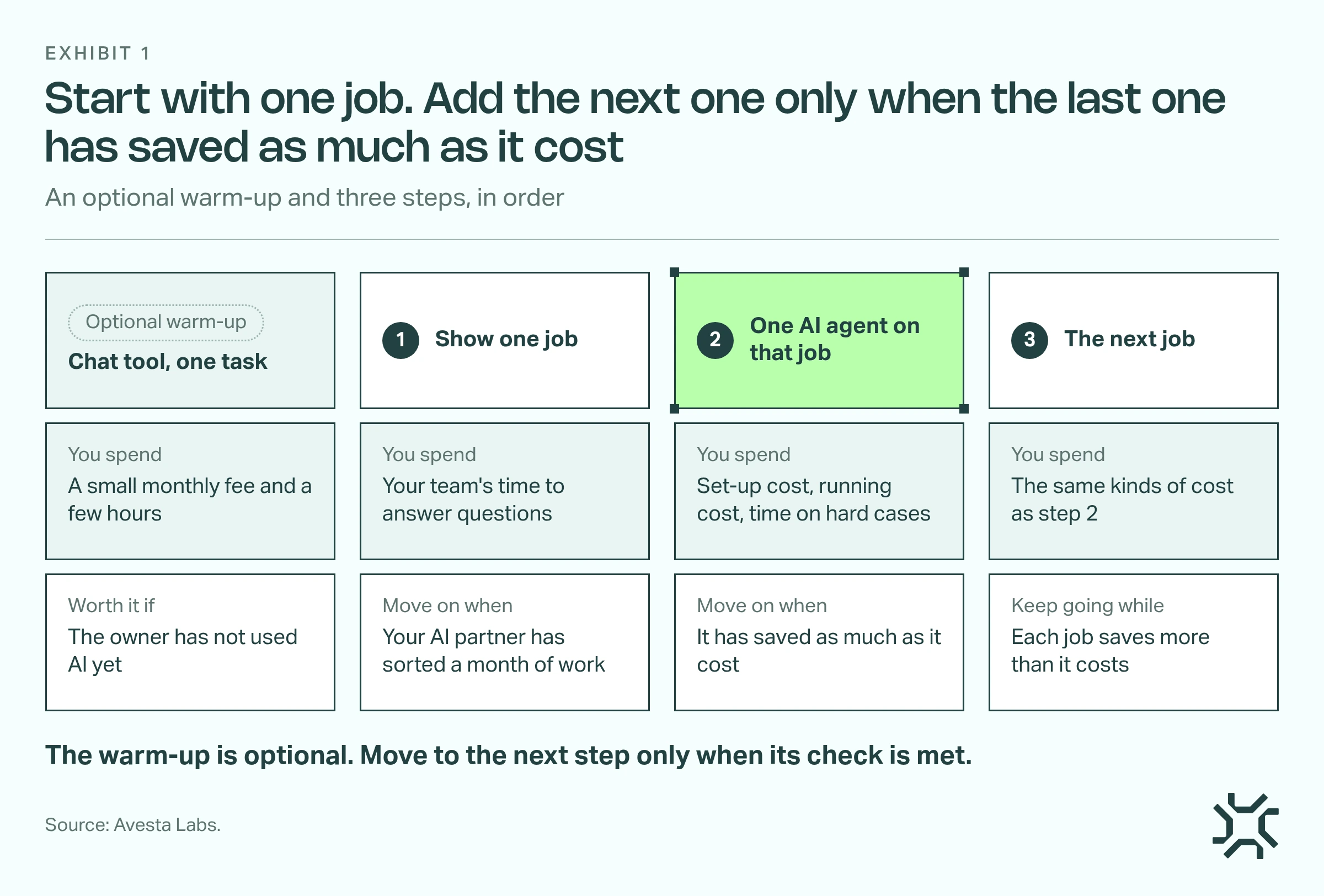
What are the steps, in order?
Optional warm-up: a chat tool on one task. If you have never used AI, try a chat tool like ChatGPT first. The owner can use it to write quotations or emails. It costs little. It shows what AI can do.
- Show one job. Pick the job. Give your AI partner a month of that job's real work. They sort it and ask you questions. Move on when they have sorted it.
- One AI agent on that job. Your AI partner sets it up and tests it. A person on your team handles every case the agent cannot. Move on when it has paid for itself.
- The next job. Repeat steps 1 and 2. Keep going while each job saves more than it costs.
Does your staff have to learn a new tool?
No. Your AI partner builds the agent into the tools your people already use. That can be your WhatsApp, your email or your ERP. An ERP is the software that keeps your stock and orders. Nobody has to learn a new tool. The agent does the routine part of the job. Your people keep the cases that need a person. Your staff do not have to like AI for this to work.
When should you skip or stop?
Most of the money goes on step 2. So the first steps help you decide if you should pay for it. Anthropic gives similar advice to teams that build agents. In its guide to building agents, it says to find the simplest solution first. It says to add more only when needed. Each step below has a point where you should skip it or stop.
| Step | Skip or stop if |
|---|---|
| Optional warm-up | You already know what AI can do. Skip it |
| 1. Show one job | Nobody can say how the job is decided, or your records are too messy to read. Fix that first |
| 2. One AI agent | The hours saved do not cover the cost |
| 3. Next job | A new job costs more than it saves. Stop adding |
What does step 1 look like in a real small factory?
It does not look like a long document. In most small factories, the rules are in the heads of a few experienced people. Those people are also the busiest. So you do not write anything. You hand over the work that already exists. That can be last month's WhatsApp messages, emails, order sheets and ERP records.
Your AI partner sorts these real cases into three types. Some cases follow the usual rule. The agent can do these first. Some cases need a person to decide. These stay with your team. In some cases, your own people give different answers. You must decide those.
If two supervisors handle the same case in two ways, no agent can copy your process yet.
Your time goes on two things. You answer the question, "Why did you do it this way?" And you decide the third type. Ask your AI partner at the start if they charge for this first look. If they do, include it in your spending limit. Later, the same sorted cases become the test for the agent. Our guide to testing an AI agent before go-live shows how.
Which job should a small manufacturer start with?
Many jobs in a small factory could fit. Start with the one where the pain is every day and the job has clear edges. Ask three questions:
- Does someone repeat it every day? For example, retyping orders, chasing suppliers or checking the same fields.
- Does it start and end clearly? For example, a message comes in and an entry is made.
- Does it use tools you already have? For example, your ERP, your WhatsApp or your email. Not something new.
These common MSME jobs often pass the three questions. They are jobs to think about. They are not promises that an agent for each one is ready today.
| Job | What repeats every day |
|---|---|
| Taking customer orders | Reading messages, checking stock, entering the order |
| Chasing suppliers | Asking for delivery dates and writing the answers down |
| Sending quotations | Finding prices and writing the same kind of quotation again |
| Reminding customers about payments | Checking who owes money and sending reminders |
| Checking stock | Finding what is low and telling the buyer |
| Entering invoices and bills | Typing the same details into the system |
| Planning what to make | Putting orders and stock together to decide what comes next |
| Quality and inspection records | Filling in the same forms and checking they are complete |
Orders are one big job in many factories. Our post on WhatsApp order automation shows one case. Following up on purchase orders is another.
How much should you spend before the first agent pays for itself?
Decide your limit before you ask anyone for a price. Rough numbers are enough. You only need to know if a price is in the right range.
Work out your monthly saving. Take the wages of the hours the agent would save. Then subtract what the agent costs to run each month. Your limit is the monthly saving, times the number of months you can wait to get your money back. Our AI agent cost guide for manufacturers shows how to work out the saving.
Here is a made-up example. The agent saves ₹40,000 a month after running costs. You can wait 12 months. Your limit is ₹4.8 lakh. If a price is higher, ask for a smaller job, not a bigger budget.
What an order agent taught us about spending little, in Avesta AgentOS
We built an order agent on Avesta AgentOS for a textile manufacturer in India. Before it, their team handled orders by hand for around 1,000 dealers on WhatsApp. It took 5 to 6 weeks from start to going live. It has been live since 21 September 2026. It handles 500 to 1,000 orders a day. That was the count in October 2026. Orders were our first job. We expect the steps to be the same for other jobs. Three choices from this work suit a small budget:
- Let your AI partner do the digging. Much of how the sales team decides was in their heads. Our team spent time with them to learn it. We then wrote 147 test scenarios from real dealer situations.
- Keep the channel and the system. Dealers kept ordering on WhatsApp. The agent worked with the company's ERP. Dealers did not have to learn a new app.
- Keep a person on every hard case, and test with the people who do the job. The client's own team tested the agent before it went live. A person still handles every case the agent cannot.
When should a small manufacturer wait on an AI agent?
Wait if any of these is true:
- The job happens only a few times a day, so one person can handle it.
- Every case is different, so there is no pattern to find.
- Your stock or customer records are too messy to read. Fix those first.
- The one person who knows the rules has no time to explain them.
In all four cases, the optional warm-up is enough. A chat tool for quotations and emails is cheap. The owner learns what AI can and cannot do.
The bottom line
A small budget is not a reason to wait. It is also not a reason to buy a little of everything. Spend on the cheap steps first, until they show where the money will pay off. If you are not sure which job that is, read why AI pays off for some businesses and not others.
Name the one job your team repeats most, and find out where its past work is kept.
Not sure which job to start with? Our AI Kickoff is a 3-day workshop to choose the job, followed by a 4-week pilot build.
Get started: hello@avestalabs.ai
Frequently asked questions
- How much does AI automation cost in India?
- It depends on how much work you have and how your systems run, so be careful with any single price. Ask every company for three numbers. The one-time cost to set it up. The monthly running cost. And how much of your team's time it still needs. Then compare the total with the hours it saves.
- Can small factories afford AI automation?
- Yes, if they go step by step. A chat tool like ChatGPT costs little and helps the owner learn. An AI agent made for your job costs more. Wait until a month of your real work shows it will save more than it costs. Ask for a smaller job first, not a bigger budget.
- Do I need ERP software for my stock and orders before I use an AI agent?
- An AI agent that checks stock or enters orders needs a place to check and enter them. That place is usually your ERP, the software that keeps your stock and orders. If your records are in notebooks or sheets, you can still start with step 1. Give your AI partner a month of that work to read.
- How long does a first AI agent take to build?
- Our order agent for a textile manufacturer took 5 to 6 weeks, from start to going live. Yours may be faster or slower. It depends on how clear the job is and how many cases need a person. It helps when your AI partner has seen a month of your real work. Then they do not have to guess.
Share this article