How to Choose an AI-Native Product Engineering Partner: A Checklist and 15 Questions
Every vendor now says it does AI. Here's how to find one that has shipped AI to production.
 Vivek Satasiya11 min read
Part 9 of 9 · Building AI-Native Products
Key takeaways
- Almost every software firm now says it does AI. Judge partners on production evidence, not demos or logos.
- Check five areas: production proof, verifiable credentials, quality practice for AI behaviour, how AI-written code is controlled, and product sense.
- Verify what you can independently. Some partner programs publish a public directory of each firm's tier, certified team and production deployments.
- Ask for proof in the meeting: eval results from the last release, the trace of one real agent run, and a failure story.
- The best test is a short paid discovery sprint. You'll learn more in two weeks of working together than in two months of pitches.
Choose an AI-native product engineering partner on evidence, not claims: AI systems they run in production today, credentials you can verify independently, how they test AI behaviour, how they keep AI-written code healthy, and whether they think about your users as well as your tech. This guide gives you a five-part checklist and 15 questions to ask, each with what a good answer sounds like and the red flag to listen for.
You may have arrived here looking for a list of the top AI-native product engineering companies. We don't publish one; we'd be ranking ourselves. Instead, here are the criteria we'd want any buyer to use, including on us. Our own answers are at the end.
If you're still deciding whether you need this kind of partner at all, start with What Is AI-Native Product Engineering? or AI-native product engineering vs software outsourcing.
Why don't vendor lists help?
Because the label is free. Anyone can add "AI" to a services page, and many have. Gartner warned in 2025 about "agent washing", vendors rebranding chatbots and automation tools as agents. It estimated that only about 130 of the thousands of agentic AI vendors were real.
Vendor lists and rankings mostly measure size, marketing and who wrote the list. What decides whether your AI product works is narrower: has this team taken AI to production, can they prove it, and will they build what your users actually adopt?
The label is free. Production evidence isn't.
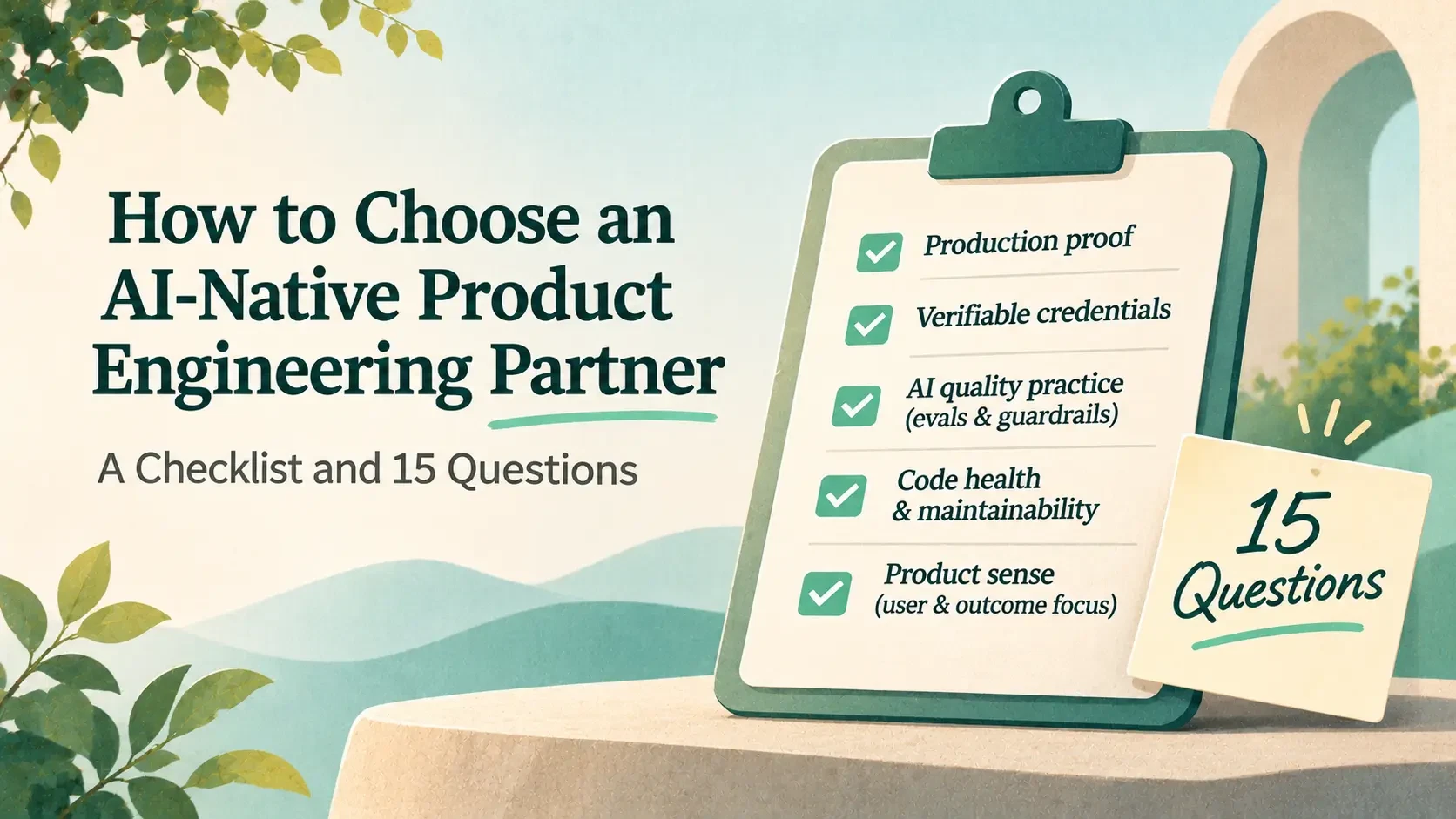
What should you check? The five-part checklist
- Production proof. AI systems running with real users today, for long enough to have broken and been fixed.
- Verifiable credentials. Certifications and partner tiers you can check yourself, and the named people who will do the work.
- Quality practice for AI behaviour. Evals, failure handling, guardrails, and analytics on how agents behave with real users.
- Delivery and code health. How AI-written code is kept maintainable, how often they release, and how they roll back.
- Product sense and fit. How they decide what to build, whether they plan for user adoption, and what you own at the end.
The 15 questions below cover all five, three per area.
Area 1: Production proof
| Question | A good answer sounds like | Red flag |
|---|---|---|
| 1. What AI systems do you run in production today, and for how long? | Named systems, real users, months or years in production | Demos, proofs of concept and "pilots" only |
| 2. Tell me about one that went wrong. What did you change? | A specific failure and the process change that followed | "Nothing has gone wrong" |
| 3. Can I speak to a client whose AI went live with you? | Yes, with a reference who can talk about production, not just the pitch | No references, or only for non-AI work |
The failure question is the most revealing. Every team that has run AI in production has a story about a confident wrong answer or a workflow that broke with real data. A team without one hasn't been there yet. Ours is in The AI Demo Worked. Production Didn't.
Ask your AI partner one question: tell me about a time it went wrong.
Area 2: Verifiable credentials
| Question | A good answer sounds like | Red flag |
|---|---|---|
| 4. Which certifications and partner tiers do you hold, and where can I check them? | Links to public directories where you can confirm them | Logos on a slide, no way to verify |
| 5. Who exactly will work on my product? | Named people, their certifications, and the production work they've done | "We'll staff it after you sign" |
| 6. How do you choose which AI models to use? | Per task, across several providers, with the ability to switch | One model for everything, or only their partner's model |
Some credentials can now be checked directly. Anthropic's Claude Partner Network, for example, publishes a public directory showing each partner's tier, certified team, customer deployments and public references.
Its Select tier requires at least 10 active certified people, at least 2 joint customers deployed in production in the last 12 months, and at least 1 public customer story. Anthropic checks each firm's standing every quarter. A tier like that is evidence of production work, not just training.
Area 3: Quality practice for AI behaviour
| Question | A good answer sounds like | Red flag |
|---|---|---|
| 7. How do you test AI behaviour? Can I see the eval results from your last release? | An eval suite built from real cases, including messy ones, run on every change | "We test it manually" or "accuracy was high in the demo" |
| 8. What happens when an agent gets something wrong or a step fails? | Detection, retry, recovery, escalation to a person, and approval before risky actions | "It shouldn't fail" |
| 9. How will we see how agents behave with real users? | Tracing of every run, plus agent behaviour and conversation analytics: answer quality, retries, topics | Page views, clicks, or "we check the logs" |
Ask to see the trace of one real agent run: what it received, what it decided, which tools it called, what it cost. If there isn't one, nobody will be able to explain the first serious mistake.
For what good looks like on question 9, see agent behaviour analytics. For a fuller picture of testing before launch, see how to test an AI agent before go-live.
Area 4: Delivery and code health
| Question | A good answer sounds like | Red flag |
|---|---|---|
| 10. How do you keep AI-written code maintainable? | Architecture rules, drift measured continuously, tests written first and signed off by people | "Our developers review everything" |
| 11. How often do you release, and how do you roll back? | Small, frequent releases behind feature flags; versioned prompts and models; rollback in minutes | Big releases every few weeks |
| 12. What do you need from us each week? | A product owner who decides, and domain experts who supply real cases | "Just send us the spec" |
AI makes code cheap to write and easy to pile up. A partner who can't show you how they measure code health will hand you a codebase that's harder to change every month. We explain where that debt hides in the hidden cost of AI-written code.
Area 5: Product sense and fit
| Question | A good answer sounds like | Red flag |
|---|---|---|
| 13. How do you decide what to build first? | User evidence: what users struggle with, what motivates them, what would make them hesitate; then small experiments | "Whatever is top of your backlog" |
| 14. How will we know users actually adopt it? | Behaviour measures (are people using the new way?) and a planned transition from old habits | "If it works, they'll use it" |
| 15. Who owns the code and IP, and what happens if we part ways? | You own it; evals, architecture rules and documentation are handed over | Lock-in to their platform, or unclear ownership |
Question 14 catches teams that only think about technology. A capable AI feature can still go unused if people keep doing what they've always done. Good partners plan for that from the start. We learned this the hard way on a property portal.
How do you score partners?
Score each question 0, 1 or 2:
- 2: a specific answer, backed by evidence you could see or check.
- 1: a reasonable answer, but no evidence.
- 0: a red-flag answer, or no answer.
That gives a maximum of 30. As a rough guide, partners scoring 24 or more are worth a discovery sprint; under 18, keep looking. Weight Areas 1 and 3 most heavily: production proof and quality practice are the hardest to fake.
Why run a paid discovery sprint before you commit?
No pitch replaces working together. A short, paid, fixed-scope discovery sprint shows you how a team actually thinks: whether they ask about your users, write evals before code, push back on scope, and produce something you can use even if you don't continue.
A good sprint should leave you with an AI opportunity map, a target architecture, an eval baseline built from your real cases, and a build plan. If you don't go ahead, those are still yours.
You'll learn more in two weeks of working together than in two months of pitches.
How does Avesta Labs answer these 15 questions?
We'd rather show our answers than ask you to trust them.
| # | Our answer |
|---|---|
| 1 | We built Avesta AgentOS ourselves, and it runs AI agents in production for our clients. Live examples include F&F's order agent, handling 500 to 1,000 dealer orders a day. |
| 2 | A bill of lading extraction project returned a wrong vehicle number with high confidence on a poor-quality scan. We reworked the architecture, and since then every demo starts with evals built from real, messy cases. |
| 3 | Our live clients are named in our case studies, with what we built for each and the results. |
| 4 | Claude Select Services Partner and OpenAI Select Partner. Our Claude tier is listed in Anthropic's public Partner Hub directory. |
| 5 | Your pod is led by a Claude Certified Architect; more than ten of our engineers hold the certification. You meet the team before you start. |
| 6 | We pick the model per task: Anthropic, OpenAI, Google or open source, on your stack. |
| 7 | Evals from real cases, written before the agent is built and run on every change. AgentOS generates and runs them. |
| 8 | AgentOS orchestration detects failed steps, retries, recovers and escalates; higher-risk actions go to a person for approval. |
| 9 | Every agent run is traced, and Metricsense shows agent behaviour, conversations and customer feedback. |
| 10 | Acceptance tests are drafted by agents and signed off by people before any code is written; Code Clinic measures architecture drift and technical debt against your architecture rules. |
| 11 | Small changes deployed daily, unfinished features behind feature flags, agent versions you can roll back. |
| 12 | A product owner who decides every week, and domain experts who give us real cases. |
| 13 | Discovery first: our whole team is trained in Jobs-to-be-Done, so we start from what your users are struggling to get done. |
| 14 | We measure whether behaviour changes, not just whether the feature works, and release to small groups first. We learned this when users of a property portal kept their old search habits. |
| 15 | You own the code, the IP and the decisions. At handover you get the evals, architecture rules and documentation. |
To see how the team behind these answers is set up, read what an AI-native product team looks like.
Where to start
Shortlist three partners and send them all 15 questions before the first call. The quality of the written answers will narrow your list fast. Then run a discovery sprint with your top choice.
If Avesta Labs is on your list, book a discovery call. We'll answer all 15 in person, with evidence.
Sources
- Anthropic, Introducing the Services Track and Partner Hub of the Claude Partner Network, June 3, 2026
- Gartner, Gartner Predicts Over 40% of Agentic AI Projects Will Be Canceled by End of 2027, June 25, 2025
Frequently asked questions
- How do I choose an AI-native product engineering partner?
- Judge partners on evidence in five areas: AI systems they run in production, credentials you can verify, how they test AI behaviour, how they keep AI-written code healthy, and how they plan for user adoption. Then test your top choice with a short paid discovery sprint.
- What questions should I ask an AI development company?
- Ask what AI systems they run in production, what went wrong and what they changed, who will work on your product, how they test AI behaviour, what happens when an agent fails, how you'll see agent behaviour with real users, how they keep AI-written code maintainable, and who owns the code and IP.
- What are the red flags when hiring an AI development company?
- Only demos and pilots to show, no failure stories, credentials you can't verify, manual testing instead of evals, no tracing or agent analytics, "our developers review everything" as the answer to code quality, and unclear ownership of code and IP.
- How can I verify an AI partner's credentials?
- Check public partner directories where they exist. Anthropic's Claude Partner Hub, for example, lists each partner's tier, certified team, customer deployments and public references. Also ask for references from clients whose AI went live, and for eval results from a recent release.
- Who are the top AI-native product engineering companies?
- Rankings mostly reflect size and marketing. A better approach is to shortlist three firms, send them the same 15 questions, and score their answers on evidence. The firm that can show production AI, verifiable credentials and eval results is the stronger choice.
- Should I run a discovery sprint before hiring an AI partner?
- Yes. A short, paid, fixed-scope sprint shows how a team actually works. It should leave you with an AI opportunity map, a target architecture, an eval baseline from your real cases, and a build plan, whether or not you continue.
Share this article