Digital Transformation vs AI Transformation: What Changes
What carries over from your digital programme, what's actually different, and why the old playbook breaks.
 Vivek Satasiya
- 9 min read
Key takeaways
- Digital transformation digitized records and gave each department a system. AI transformation redesigns how work gets done, with AI coworkers and people working across those systems.
- Leadership, change management and clean systems of record still matter. Your digital foundation is an asset, not something to replace.
- Five things change: the unit of change, how software behaves, what you buy, when the work ends, and who does the work.
- Digital software does the same thing every time. AI doesn't, so you need tests built from real cases, monitoring and human approvals, not just a one-time sign-off.
- Go-live is day one, not the finish line. AI transformation runs as a continuous loop, one process at a time.
- You don't need to finish digital transformation first. AI can work with the documents, emails and spreadsheets your systems never captured.
Digital transformation moved your business onto software. AI transformation puts AI coworkers to work inside that software, alongside your people.
They sound like two chapters of the same story. Many leaders treat them that way. They hand the AI mandate to the team that ran the ERP rollout, and reuse the same playbook: gather requirements, pick a vendor, configure, test, go live.
That playbook is why so many AI programmes stall. Some of what you learned in digital transformation still holds. But the rules for how the work is run have changed, and the leaders who see that early are the ones whose AI actually reaches production.
What is digital transformation, and what is AI transformation?
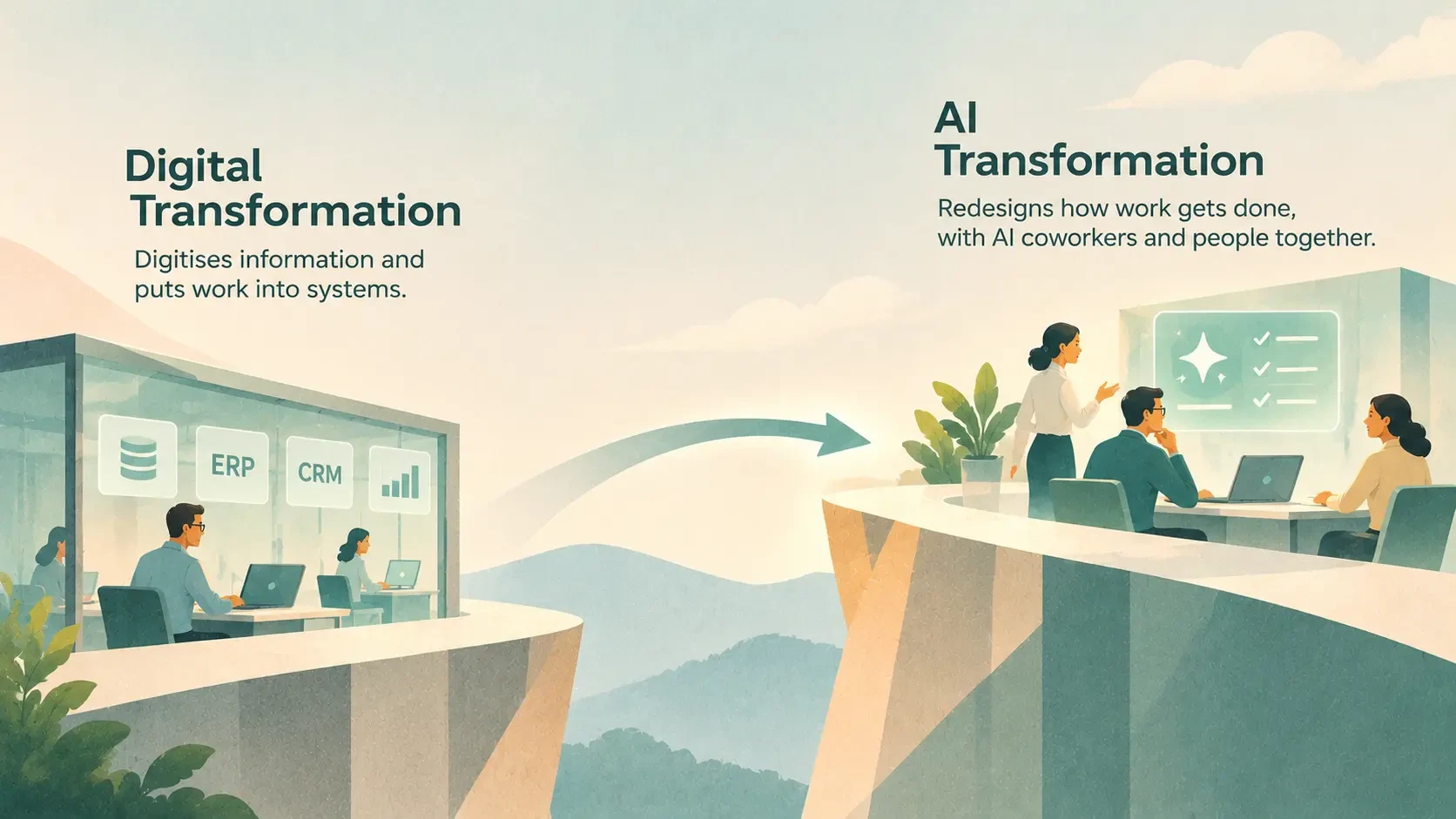
Digital transformation is the move from paper, email and spreadsheets to shared software systems that record and manage how a business runs. AI transformation is the redesign of how work gets done, so that AI coworkers and people run core processes together across those systems.
The first changed where information lives. Orders moved into the ERP. Customers moved into the CRM. Invoices moved into the accounting system. Tickets moved into the service desk. People still did the work, but they did it inside software.
The second changes who does the work. AI coworkers read the order, check it against the rules, update the ERP, flag the exception and draft the reply. People handle judgment, relationships and the cases that need a human call.
Put simply: digital transformation gave the business a memory. AI transformation gives it extra hands that can use that memory.
That's why the destination of AI transformation is an AI-native business: one where core processes run end to end with AI coworkers and people, shaped to how the business works, and governed from one place.
What carries over from digital transformation?
More than people expect. Three lessons from the digital era still apply, and one asset becomes more valuable.
It's a business change, not an IT project. Digital transformation was always hard. BCG research found 70% of digital transformations fall short of their objectives. The failures were rarely about the software. They were about leadership, ownership and how people worked. AI transformation is no different.
Senior ownership decides the outcome. In McKinsey's State of AI 2026 survey, AI high performers are twice as likely to say their senior leaders show real commitment to AI, and twice as likely to have defined ways to measure impact. That pattern would look familiar to anyone who led a digital programme.
People need time to change habits. New systems don't change behaviour on day one. We saw this on an AI search experiment for a large Australian property portal: we added natural-language search beside the old search box, and users kept typing suburb names. The move to new ways of working has to be gradual and supported.
Your systems of record are now an asset. The ERP, CRM, HRMS and accounting systems you put in place during digital transformation are exactly what AI coworkers need to read from and write to. You don't throw them away. You put them to work.
What is actually different about AI transformation?
Five things change. Each one breaks a habit that worked in the digital era.
| Digital transformation | AI transformation | |
|---|---|---|
| Unit of change | A department and its system | An end-to-end process across departments |
| How the software behaves | Same input, same output, every time | Output varies; it must be tested and watched |
| What you buy | A standard product you adapt to | AI coworkers shaped to your process |
| When the work ends | At go-live | Never; go-live is day one |
| Who does the work | People, using software | AI coworkers and people, together |
1. The unit of change is a process, not a department. Digital programmes were organized by system: the ERP project, the CRM project. Each department got its tool. AI transformation is organized by process. Work like order to cash or claims crosses four or five teams, and the value comes from carrying it across the handoffs. Automating one department's step rarely shortens the whole cycle.
2. The software no longer behaves the same way every time. An ERP posts the same invoice the same way on every run. An AI coworker reads documents, interprets them and makes judgment calls, so its output can vary. That's what makes it useful, and it's what makes old testing habits unsafe. You need tests built from real cases, tracing of every action, and human approval for sensitive steps.
3. You stop adapting to the product. SaaS gave everyone the same software, and customizing it was slow and expensive, so businesses changed their processes to fit. AI coworkers only work once they understand your rules, documents and exceptions. Giving them that context is the work. So customization moves from expensive extra to standard practice, and the software finally fits the business.
4. The work doesn't end at go-live. Digital projects had a finish line. AI coworkers face new document formats, new exceptions and new model versions every month. They need monitoring, regular re-testing and the ability to roll back a version. Running AI is closer to managing a team than to maintaining a system.
5. The workforce changes, not just the toolset. Digital transformation gave people better tools. AI transformation adds a new kind of worker. That raises questions digital programmes never had to answer: who supervises an AI coworker, who approves its work, who is accountable when it gets something wrong, and how its cost compares with the work it takes on.
These differences are why Gartner predicts over 40% of agentic AI projects will be cancelled by the end of 2027, citing rising costs, unclear business value and weak risk controls. Each of those is a sign of a programme run with the old rules.
Why does the digital transformation playbook fail for AI?
Because every step of it assumes the software behaves the same way every time, and that the project ends.
| Digital playbook step | Why it breaks with AI | What to do instead |
|---|---|---|
| Write a requirements document | AI fails on the cases nobody wrote down | Build tests from real, messy cases before building |
| Pick a vendor from a feature list | Demos look alike; production doesn't | Ask for production proof on cases like yours |
| Roll out everywhere at once | One bad output repeats across every team | Go one process at a time, starting small |
| One-time user acceptance testing | Inputs and models change after sign-off | Keep testing, monitor, and keep a rollback ready |
| Disband the project team | AI coworkers need ongoing supervision | Name a standing owner for each AI coworker |
We learned the first row the hard way. On a bill of lading project, we built a demo that extracted vehicle numbers from shipping documents. It worked well on the clean scans we tested with. When the customer tested it on their real vendor scans, some of which were poor, it returned a wrong vehicle number with high confidence. A requirements document would never have caught that. Reworking the approach cost us two to three weeks.
Since then, every build at Avesta Labs starts by writing tests from real customer cases, including the worst ones. Every AI coworker is versioned, so a change can be rolled back. And every action is traced and recorded in an audit log, so the business can see exactly what happened and why.
None of that existed in the digital playbook, because it didn't need to.
Do you need to finish digital transformation first?
No. You need enough of a foundation for the process you're starting with, not a finished one.
Many leaders assume AI must wait until every system is modern and every dataset is clean. That was true for older analytics projects, which needed structured data in neat tables. It's much less true now.
A lot of real work never made it into your systems: PDFs from suppliers, scanned shipping documents, email threads with customers, spreadsheets passed between teams. Digital transformation left that work to people. AI coworkers can read it. Our trade finance work is a good example: AI coworkers check letters of credit and shipping documents, mostly PDFs and scans, against the UCP 600 rules that govern them. That scattered, unwritten work is also why AI pays off more slowly outside tech, as I covered in Why AI Is Paying Off for Tech but Not Everyone Else.
What you do need for each process:
- Access to the systems it touches. An API, an integration or at least a secure way to read and write. For example, we connect AI coworkers to SAP S/4HANA through its standard interfaces.
- People who know how the process really runs. Including the exceptions that live only in their heads.
- A way to check results. Real cases you can test against, and a clear view of what "right" looks like.
If a process has those three, you can start, even if the rest of your digital estate is still a work in progress. Each AI process you transform will also show you which parts of the foundation matter most to fix next.
How should leaders run AI transformation differently?
Five shifts, one for each difference.
- Fund processes, not systems. Instead of "the CRM AI project", fund "cut quote-to-order time" and let the work cross whatever teams and systems it needs to.
- Make testing a standing discipline. Agree what "right" looks like for each process, build tests from real cases, and re-run them whenever a model, prompt or input changes.
- Buy fit, not features. Judge vendors and partners on how well they shape AI to your process, and on production proof, not on feature lists or demos.
- Plan for day two. Budget for monitoring, improvement and supervision from the start. Set up one place to see and control every AI coworker before you have ten of them.
- Manage AI coworkers like a workforce. Give each one an owner, define what it may do alone and what needs approval, and measure it on outcomes, not on how much AI it uses.
The data points the same way. McKinsey's 2026 survey found nearly three-quarters of AI high performers have fundamentally redesigned workflows because of AI, against about one-quarter of other companies. The leaders getting results didn't bolt AI onto the digital estate. They changed how the work runs.
You already did the hard work of digital transformation. AI transformation builds on it. It just plays by different rules. If you're new to the idea, start with what an AI-native business is and how an existing business becomes one.
If you ran a digital transformation, here's a question worth asking your team: which of your old playbook steps are you still using for AI, and which ones would have caught your last AI surprise?
Frequently asked questions
- What is the difference between digital transformation and AI transformation?
- Digital transformation moved business information and processes onto software systems such as ERP and CRM. AI transformation redesigns how the work gets done, so AI coworkers and people run core processes together across those systems.
- Is AI transformation part of digital transformation?
- It builds on it, but it isn't just the next phase. It changes who does the work and how software behaves, so it needs different ways of testing, governing and running programmes.
- Do we need to finish digital transformation before starting AI transformation?
- No. For each process, you need access to the systems it touches, people who know how it really works, and a way to check results. AI can also work with the documents, emails and spreadsheets your systems never captured.
- Why do AI projects fail when digital projects succeeded?
- Often because they're run with the digital playbook: requirements documents instead of tests from real cases, one-time sign-off instead of ongoing monitoring, and a project team that disbands at go-live.
- Who should lead AI transformation?
- A senior business leader who owns outcomes, supported by technology leaders. It works best when it's owned like a business change, not handed to IT as a system project.
- Will AI replace our ERP or CRM?
- No. Systems of record stay as the source of truth. AI coworkers read from and write to them, and carry the work between them.
- Can the team that ran our digital transformation run AI transformation?
- Yes, if they adopt the new rules: process-based funding, continuous testing, day-two planning and managing AI coworkers as a workforce. The experience in change management is valuable; the delivery playbook needs updating.
Share this article