What Is an AI-Native Business? A Guide for Leaders
And how an existing business becomes one, one process at a time.
 Vivek Satasiya
- 10 min read
Key takeaways
- An AI-native business runs its core processes with AI coworkers and people working together, across departments, with AI shaped to how the business works and one place to govern it.
- AI adoption is not AI transformation. Personal AI assistants make individuals faster, but they rarely change company results.
- The SaaS era made you adapt to the software. AI makes customization affordable, so AI coworkers can adapt to your processes instead.
- Existing businesses can become AI-native. Not through a big-bang rebuild, but one process at a time, on top of the ERP and CRM you already run.
- As AI coworkers spread, you need a control plane: governance, monitoring, access control and human approvals in one place.
- Start with one process where results can be checked, prove it in production, then move to the next.
Most leaders I speak with have already "adopted AI." Their teams use ChatGPT or Claude every day. Someone has run a pilot. A vendor has pitched an AI add-on for the CRM.
Yet when I ask what has changed in the business, the honest answer is usually: not much.
That gap is the difference between a business that uses AI and an AI-native business. This article explains what an AI-native business is, how it differs from the digital transformation you have already done, and how an existing business becomes one, one process at a time.
What is an AI-native business?
An AI-native business runs its core processes with AI coworkers and people working together, end to end across departments, with AI shaped to how the business works, and with one place to govern, monitor and improve that digital workforce.
Each part of that sentence matters:
- Core processes. AI does real work inside the processes that run the business, such as order to cash, claims, onboarding or document checks. Not just chat tools on the side.
- AI coworkers and people. AI coworkers take on the repetitive, rules-heavy work. People handle judgment, relationships and exceptions. Neither works alone.
- End to end, across departments. Value for a customer is created across many handoffs. An AI-native business automates the flow, not one department's slice of it.
- Shaped to how the business works. AI coworkers learn your rules, documents and exceptions. You don't reshape your business to fit a product.
- One place to govern it. Every AI coworker is visible, controlled and auditable from a single control plane.
Others define the term more broadly. Gartner describes an AI-native business model as one where AI is embedded in how a business creates, delivers and captures value. Bain describes an AI-native enterprise as one that has moved past scattered AI tools and rebuilt its workflows, data and agents. Both are right. Our definition is narrower on purpose: it describes what you would actually see if you walked through the business.
How is an AI-native business different from a digitally transformed one?
Digital transformation put your business on systems of record. AI-native transformation puts AI coworkers to work across them.
In the digital and SaaS era, most businesses adopted a central system for each department: ERP for inventory and purchasing, CRM for sales, an accounting system for finance, HRMS for people, a service desk for support, a project tool for delivery. That was real progress. Data moved out of filing cabinets and spreadsheets into shared systems.
But each product was built for one department and one job, and it gave everyone the same solution. Customizing it was slow and expensive. So businesses did the practical thing: they changed their processes to fit the software.
AI changes that economics. An AI coworker becomes useful only when it understands your context: your rules, your documents, your exceptions. Giving it that context is the work. So customization, which used to be the expensive part, is now the normal part. For the first time, the software can fit the business.
| Digitally transformed business | AI-native business | |
|---|---|---|
| Unit of change | A department | An end-to-end process |
| Software | One product for everyone; you adapt to it | AI coworkers shaped to your processes |
| Who does the work | People, using tools | AI coworkers and people, together |
| Systems of record | One per department | Still there; AI coworkers work across them |
| How it's bought | Licences per seat | Capacity and outcomes, closer to hiring than to software |
| Control | Each app's own admin settings | One control plane for the whole digital workforce |
One point leaders often miss: becoming AI-native does not mean replacing your ERP or CRM. Those systems stay as the record. AI coworkers sit on top, reading from and writing to them, and carrying the work across the gaps between them.
Why isn't giving everyone ChatGPT enough?
Because personal AI makes people faster, but it doesn't change how the business runs.
The numbers show the gap clearly. In McKinsey's State of AI 2026 survey, 80% of respondents say AI has improved their individual productivity. Yet only 37% attribute any EBIT impact to AI, the same as a year earlier, and only about 6% are "high performers" with significant impact. MIT's 2025 GenAI Divide report found the same pattern: high adoption, low transformation, with most organizations seeing no measurable return.
What separates the few who get results? McKinsey found nearly three-quarters of high performers have substantially redesigned workflows because of AI, against about one-quarter of everyone else. They changed the work, not just the tools.
I think of personal AI assistants as the Excel moment. When spreadsheets arrived, every person became more productive. But the business soon ran on hundreds of disconnected files, each one a private copy of a process nobody could see or control. Eventually companies needed proper systems. We traced this pattern in more detail in AI Is Having Its Microsoft Office Moment.
Personal AI is the same, and it arrives faster:
- The gains stay with the individual. Skilled users get a lot; others get little.
- The know-how stays in private chat histories, not in the business.
- Nobody can see what data went where, or check the output.
- No process gets shorter, because the handoffs between people and departments don't change.
Personal AI is a good first step. We train teams on it ourselves. But it is adoption, not transformation. I covered why this hits businesses outside the tech sector hardest in Why AI Is Paying Off for Tech but Not Everyone Else.
Can an existing business become AI-native?
Yes. Not in one leap, but one process at a time.
Some analysts disagree. Cognizant argues that existing businesses can't become AI natives themselves, and should instead learn from AI-first upstarts. I understand the logic: a startup has no legacy systems or old habits to unwind.
But an established business has things a startup would love to have: customers, years of operating data, and people who know exactly how the work really gets done. That know-how is the raw material AI coworkers need. The challenge isn't whether you can become AI-native. It's how you get there without breaking a business that already works.
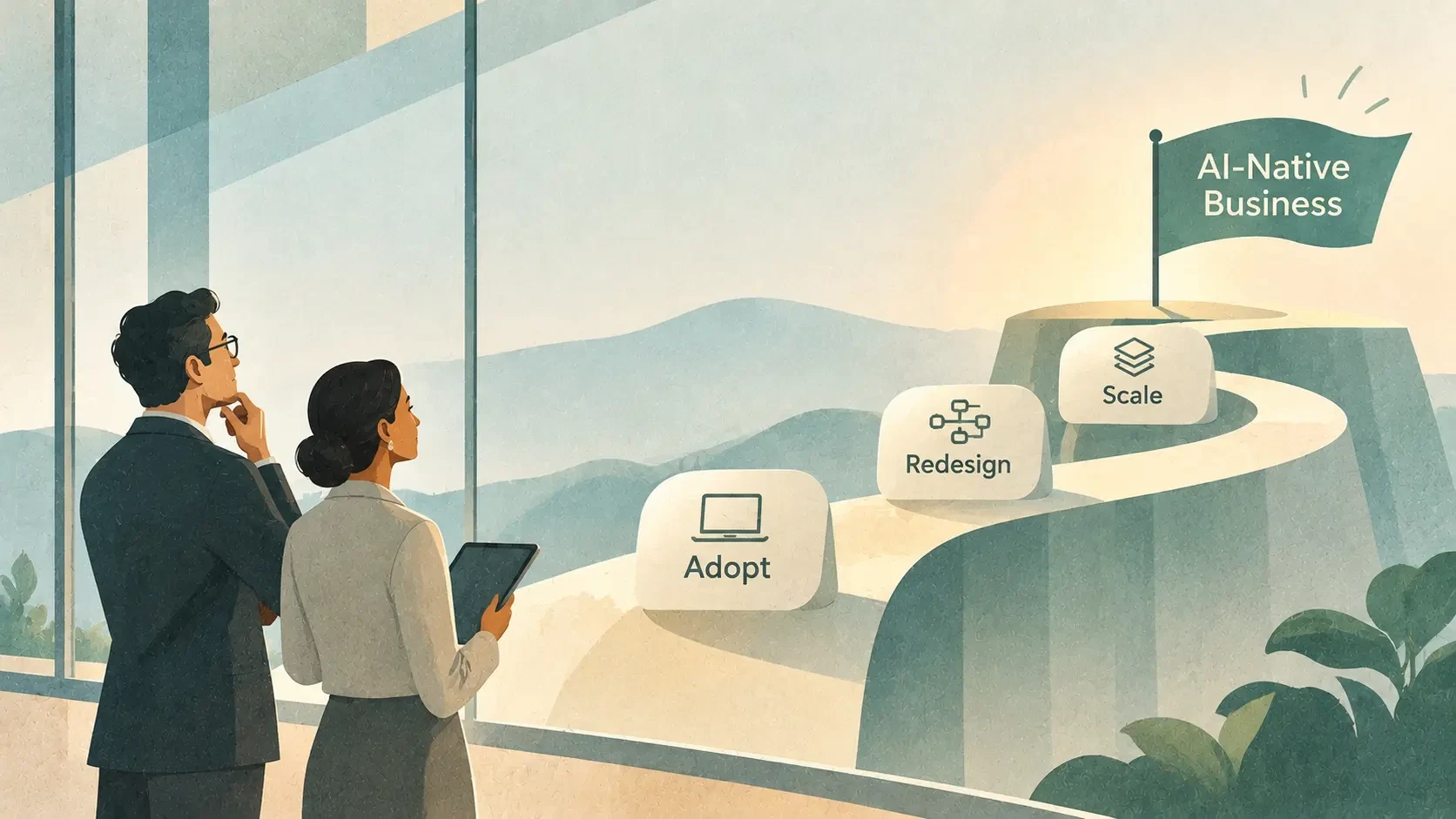
The answer is to transform process by process. For each one, we follow the same loop, which we call the AgentOps Loop:
- Embed. Sit with the team and understand how the process really runs, including the exceptions nobody wrote down.
- Codify. Turn those unwritten rules into context an AI coworker can follow.
- Prioritize. Pick the steps where AI adds the most value and results can be checked.
- Build. Build the AI coworkers and connect them to your existing systems.
- Prove. Test them against real, messy cases from your business before anyone relies on them.
- Scale. Go live, watch closely, then move to the next process.
In our experience, one workflow typically goes from demo to production in two to four weeks, including testing and integration. Each process you transform makes the next one easier, because the context, integrations and controls are already in place.
We've been through this ourselves. Our engineering team has worked on a fully AI-native software delivery lifecycle for about a year and a half. Our engineers, juniors included, now manage and review groups of AI agents rather than writing every line by hand. It didn't happen in one step, and it didn't happen by handing everyone a chat tool.
What does an AI-native business look like in practice?
Five traits show up in every business we've seen make real progress.
1. AI coworkers do real work inside core processes. Not a chatbot on the website, but work the business depends on. For a trade finance client, AI coworkers check shipping and payment documents against the UCP 600 rules that letters of credit follow. For a sales engineering team, an AI coworker looks up pricing in SAP so engineers can answer customers in minutes instead of digging through screens.
2. Work flows across departments. Take a process like order to cash. It touches sales, credit, operations, finance and customer service. Automating one department's step rarely shortens the whole cycle, because the work still waits at every handoff. AI-native businesses redesign the flow end to end, so AI coworkers carry the work across the gaps.
3. AI fits how the business works. AI coworkers learn your rules, document formats and exceptions. That only works if you test against reality. We learned this on a bill of lading project: our demo used clean scans, but a customer's real vendor scans were poor, and the system returned a wrong vehicle number with high confidence. We rebuilt the approach, and now every build starts by writing tests from real, messy customer cases.
4. Systems of record stay; AI works on top. The ERP and CRM remain the source of truth. AI coworkers connect to them, for example to SAP S/4HANA, and do the work in between. No replatforming project.
5. One control plane governs the digital workforce. Every AI coworker's actions are traced and logged. Each version is tracked, and can be rolled back. Access is controlled by role and data. Sensitive actions wait for human approval. We've written about tracing, audit logs and human approval in detail, because without them AI doesn't survive contact with a risk committee. Our AIRA series covers how to size those controls to the risk of each use case.
And the result for people? They spend less time on copying, checking and chasing, and more on customers, decisions and growth. That shift doesn't happen overnight. People's habits change slowly, so the move to new ways of working has to be gradual and well supported.
How do you know if your business is AI-native?
Ask four questions about your own business. Answer honestly.
- Are AI coworkers doing real work inside core processes, or are people just using chat tools on the side?
- Does AI follow your processes, or did you change your processes to fit a tool?
- Does work flow across departments, or does AI stop at each department's edge?
- Can you see, control and audit every AI coworker from one place?
If you answered "yes" to none or one, you are using AI, which is a fine place to start. Two or three, you are on the way. All four, for your most important processes, and you are running an AI-native business.
Most businesses we meet today are at none or one. That isn't a failure. It's the starting line. Our upcoming AI-native maturity model will break this into levels, with a self-assessment you can run with your leadership team.
Where should you start?
Start with one process, not a strategy deck.
Pick a process that meets three tests:
- It hurts. High volume, slow cycle times, or skilled people stuck on repetitive work.
- Results can be checked. You can tell quickly whether the AI coworker got it right, for example a document matches the rules or it doesn't. That makes it safe to scale.
- It crosses at least one handoff. So you learn early how AI coworkers carry work between teams.
Then do three things before you build anything. Write tests from real cases, including the ugly ones. Agree who approves what. And set up your control plane from the first AI coworker, not the tenth. Adding governance later is far harder than starting with it.
Becoming AI-native is a journey with five stages. This article is the first in a series that covers each one:
| Stage | The question it answers | Coming up in this series |
|---|---|---|
| Understand | What is changing, and why now? | Digital vs AI transformation |
| Reimagine | How should the work itself change? | Which process should you transform first? |
| Build the foundation | What do we need to stay in control? | The AI control plane |
| Run the transformation | How do we lead it, budget it and measure it? | The AI transformation roadmap |
| Choose a partner | Who do we build it with? | How to evaluate an AI transformation vendor |
The businesses that pull ahead won't be the ones with the most AI tools. They'll be the ones that changed how their work gets done.
So here's a question to take to your next leadership meeting: if you mapped your most important process today, where would an AI coworker take on real work, and who would be accountable for it?
Frequently asked questions
- What is an AI-native business in simple terms?
- A business where AI coworkers and people run the core processes together, across departments, with AI shaped to how that business works and governed from one place.
- Is AI-native the same as AI-first?
- Not quite. "AI-first" usually describes a mindset or a startup built around AI from day one. "AI-native" describes how the business actually runs. An existing business can become AI-native without having started that way.
- What is the difference between AI adoption and AI transformation?
- AI adoption gives people AI tools, such as ChatGPT or Claude. AI transformation redesigns how work gets done, so AI coworkers take on real parts of core processes. Adoption raises individual productivity; transformation changes business results.
- Do we need to replace our ERP or CRM to become AI-native?
- No. Your systems of record stay. AI coworkers connect to them and do the work between them.
- What is an AI coworker?
- An AI agent that does a defined part of a business process, such as checking documents, looking up data or preparing a decision, working alongside people who handle judgment and exceptions.
- How long does it take to become AI-native?
- It happens process by process, so it depends on how many core processes you have. In our experience, one workflow typically goes from demo to production in two to four weeks, so the first results can arrive within weeks rather than years.
- Does becoming AI-native mean fewer people?
- It means different work for people. AI coworkers take on repetitive, rules-based tasks, and people move toward customers, decisions and growth. How a business uses that capacity is a leadership choice.
- Can small and mid-sized businesses become AI-native?
- Yes. Because AI makes customization affordable, mid-sized businesses can now get software shaped to their own processes, which used to be a luxury only large enterprises could pay for.
Share this article