What to Automate First in Manufacturing With AI Agents
Start with everyday office work your team can check, and keep decisions about credit and price with people.
 Kishan Chandravadia7 min read
Key takeaways
- Automate first an office job that repeats every day or week, arrives as messages or documents, follows rules your team already uses, and lets you catch a wrong step before it costs money.
- An AI agent is worth it only where each case needs reading and judgement. For steps that are the same every time, ordinary automation or a report is cheaper and more reliable.
- Look at what your team already does by hand every day. Our live order agent for a textile manufacturer took over dealer orders that used to arrive across about 1,000 WhatsApp groups.
- Put the credit and order rules in the system, not only in the agent's instructions. An order over the credit limit waits for a person, and a placed order is never edited by the agent.
A textile manufacturer we work with had dealers ordering across about 1,000 WhatsApp groups, and a small team read every one by hand. Its first AI agent, software that reads a message, decides what to do and does it in your systems, took those orders over on WhatsApp and email.
Dealers word every order their own way, so each one needs reading, which is where an agent fits. Taking orders was everyday office work, not the hardest problem in the business. That is why it worked as a first agent.
Starting with the unglamorous job matters. Gartner, a research firm, tracks agentic AI, which is AI that takes actions on its own. It predicts that over 40% of these projects will be cancelled by the end of 2027, because of rising costs, unclear business value and weak risk controls.
What to automate first in manufacturing, and how do you choose?
What to automate first in manufacturing is an office job that repeats every day or week and arrives as messages or documents. It should follow rules your team already uses, and let you catch a wrong step before it costs money. Keep decisions about credit and price with your people.
Those four traits are why order intake worked as the first agent for the textile manufacturer. In one line:
Start with everyday work your team can check. Keep credit and price with people.
Which processes suit an AI agent, and which suit simpler automation?
Not every repeated job needs an agent.
| Kind of work | Example in a factory office | Better tool |
|---|---|---|
| Same steps every time, a fixed rule decides | Sending the daily dispatch report to the same people | Ordinary automation or a report |
| Looking something up | "What is our stock of item X?" | A search or an assistant |
| Reading messages, asking questions, then acting | A dealer's WhatsApp order with item names typed their own way | An AI agent |
| A decision about credit or price | Negotiating a price, releasing a held order | Your people, with the agent preparing the facts |
Gartner draws the same line. It advises using AI agents when decisions are needed, ordinary automation for workflows that run the same way each time, and assistants for simple look-ups.
OpenAI's guide to building agents (April 2025) adds why. Agents fit work with exceptions and judgement, and unstructured data: messages, emails and documents rather than neat rows. In other words, rules a person can explain but fixed software can't follow, because the input is messy.
If a job sits in the first two rows, don't buy an agent for it. Anthropic, which makes the Claude models, puts it plainly: find the simplest solution possible, and only add complexity when needed.
Which manufacturing processes make a good first AI agent?
For a manufacturer that sells through dealers, dealer order intake is the clearest first agent. Orders arrive all day, each one typed differently, and your sales team already knows the rules. The agent checks stock in the ERP (your stock and order system) and places the order only once the dealer says go ahead.
Other jobs split the way the table above does:
- A fixed rule decides it. A report that goes to the same people every day needs ordinary automation, not an agent.
- It's a decision about credit or price. Negotiating a price or releasing a held order stays with a person.
For a small factory with a tight budget, our step-by-step plan for MSME manufacturers lists more jobs to look at.
What should stay with your people?
Choosing the process is half the decision. Inside it, the agent's freedom should shrink as the cost of a mistake grows.
The more a mistake costs, the less the agent decides on its own.
OpenAI's guide makes the same point. Actions that are "sensitive, irreversible, or have high stakes" should trigger human oversight, such as cancelling orders, large refunds or payments.
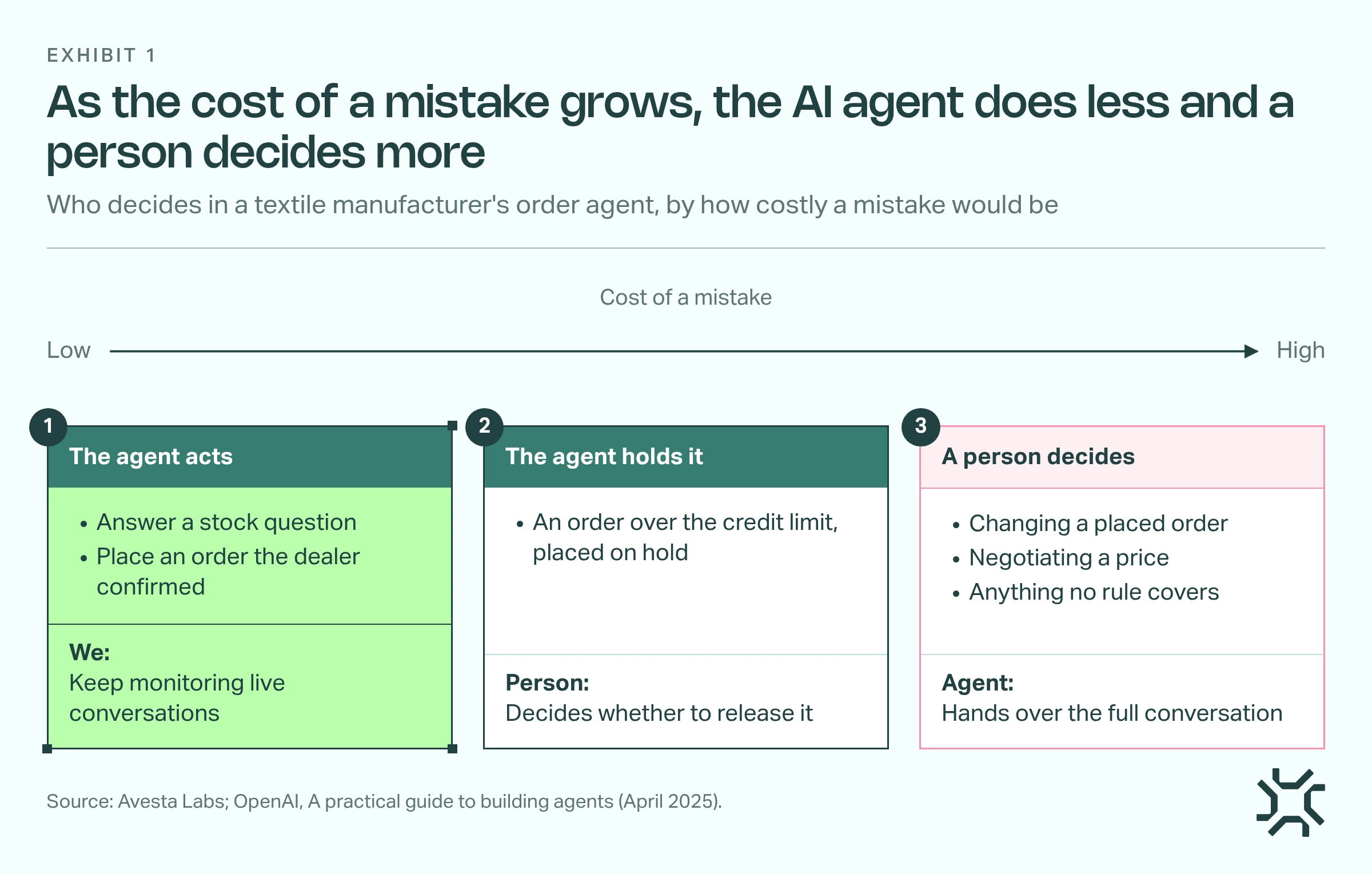
Here is how it works in our textile order agent:
- Low cost of a mistake: the agent acts. It answers a stock question, and places an order once the dealer says to go ahead. We keep monitoring live conversations.
- Medium cost: the agent holds it, a person releases it. An order over the customer's credit limit is placed on hold. A person decides whether to release it.
- High cost: a person decides. Changing a placed order, negotiating a price, or anything no rule covers, like a return. The agent hands over with the full conversation so nobody has to ask again.
This is called human in the loop: the agent does the work, and a person keeps the final say on decisions that matter. Our guide to AI agent human approval goes deeper.
How do you roll out the first process safely?
Keep the first rollout small and reversible.
- Write the rules down. Turn your best person's way of working into written rules.
- Test on a copy of your ERP. Build test cases from real situations and run each one against a test copy, so no real order is at risk.
- Release to a small group first. A handful of trusted dealers, with your team reading every conversation.
- Fix what your team would have done differently. Then open it to everyone.
- Add the next process only when this one is trusted.
Our step-by-step guide to WhatsApp order automation walks through this for dealer orders.
What we learned building a first agent for manufacturers in Avesta AgentOS
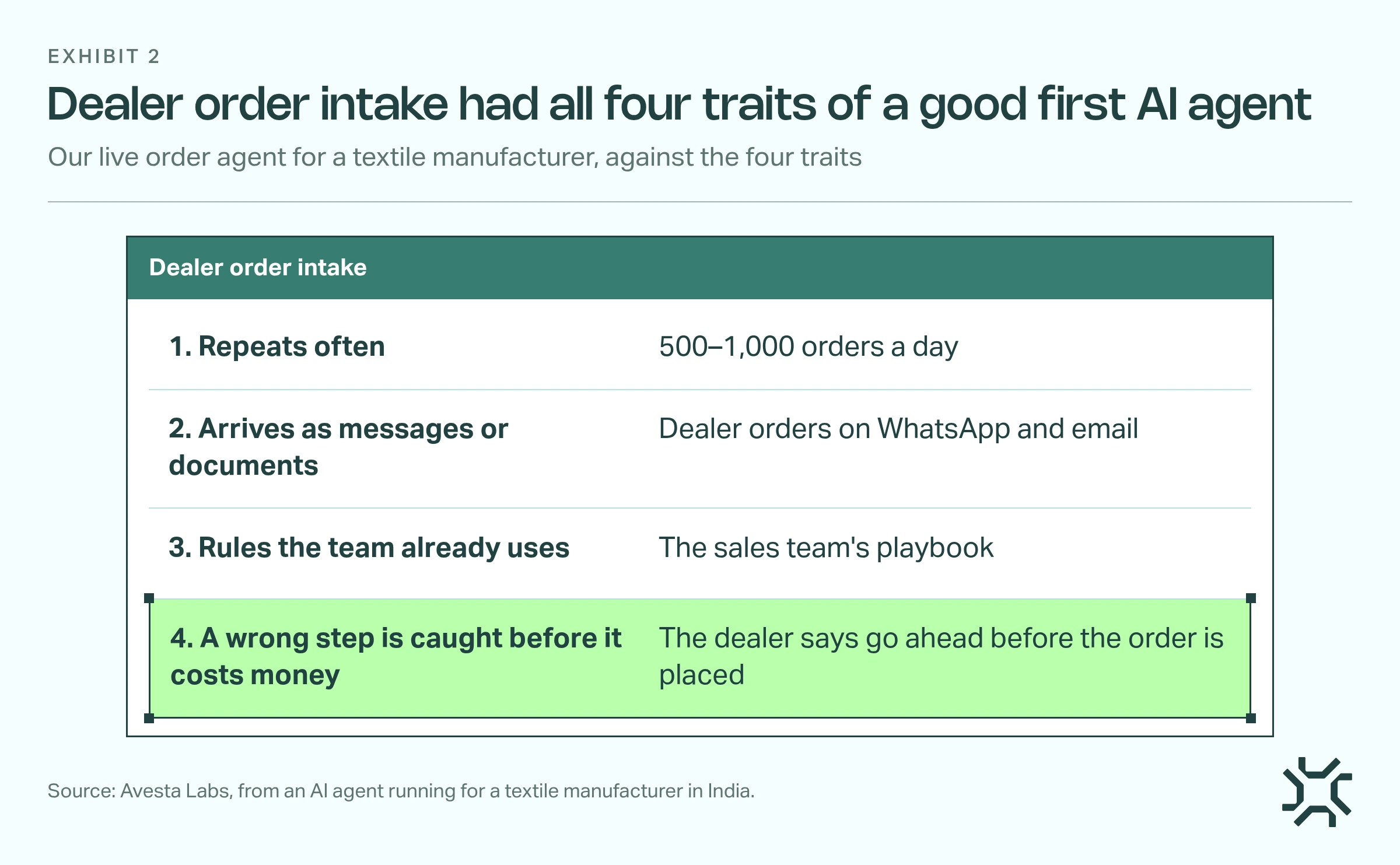
We build AI agents for manufacturers on Avesta AgentOS, our platform for building and running them. Here is our textile order agent against the four traits.
1. Start where the volume and the rules already exist
At the textile manufacturer, the volume was obvious: about 1,000 WhatsApp groups. The rules were already in the sales team's playbook. That made order intake the right first agent.
It went from start to production in five to six weeks. It has handled 500–1,000 orders a day since go-live on 21 September 2026 (as of late October 2026). In October 2026 its test set held 147 test scenarios, run on a copy of the ERP. Before a change goes live, we replay the scenarios it touches, including the ones that must reach a person.
2. Put the credit and order rules in the system, not only in the instructions
In the order agent, the credit rule is checked by the system, not left to the AI model's judgement. If it can't read the customer's credit figures, it holds the order for a person. It never edits a placed order: it passes the request on. Decide that line before you build, so every test can check it.
When is an AI agent the wrong first step?
Sometimes the right answer isn't an agent at all.
- Your data isn't trusted. Fix the figures the first process depends on before you start.
- The process is about to change. A new ERP or a new sales structure next quarter will undo the rules you write.
- Nobody owns it. A first agent needs one person in your team who checks its work and decides what changes.
We once found that a client's problem needed a simple dashboard rather than an agent. The story is in when not to build an AI agent.
The bottom line
The first agent doesn't have to be impressive. Prove one, and let it earn the next.
If you're already past the first agent, read why AI demos break in production.
List the office jobs your team repeats every week, and mark the ones where a wrong step is caught before it costs money. Start with one of those.
Not sure which process should go first? Our AI Kickoff is a 3-day workshop to choose it with your team. A 4-week pilot build follows.
Get started: hello@avestalabs.ai
Frequently asked questions
- What processes should not be automated first?
- Decisions about credit and price stay with your people, first or later. Beyond those, leave for later the processes that change every month, ones nobody can explain in rules, and ones you can't measure today. They can come once a first process has earned your team's trust.
- How do I identify automation opportunities in my factory's office?
- Look for jobs with the four things our order agent's job had: the work repeats every day or week, arrives as messages or documents, follows rules your team already uses, and lets you catch a wrong step before it costs money. For the textile manufacturer we work with, that job was dealer orders. Our AI Kickoff workshop chooses the first process with your own team.
- Do I need clean data before automating with AI agents?
- Not perfectly clean, but trusted. If your team already doesn't believe the stock figure in the ERP, an agent reading that figure will give dealers the same wrong answer, only faster. Fix the numbers the first process depends on. The rest can improve as you go.
- Should a manufacturer start AI on the shop floor or in the office?
- They are different projects. Shop-floor automation means machines, sensors and robots, and it needs engineers and capital spending. AI agents work on office work: messages, orders, documents and follow-ups. The office can be cheaper and faster to start, because the agent works inside the software you already run.
- How do you scale automation across a plant?
- One process at a time, each with its own written rules and test cases, released to a small group first. At the textile manufacturer, the next agent we are building works with vendors. When a dealer orders an item the factory doesn't keep in stock, it emails the vendor to ask about supply.
Share this article